
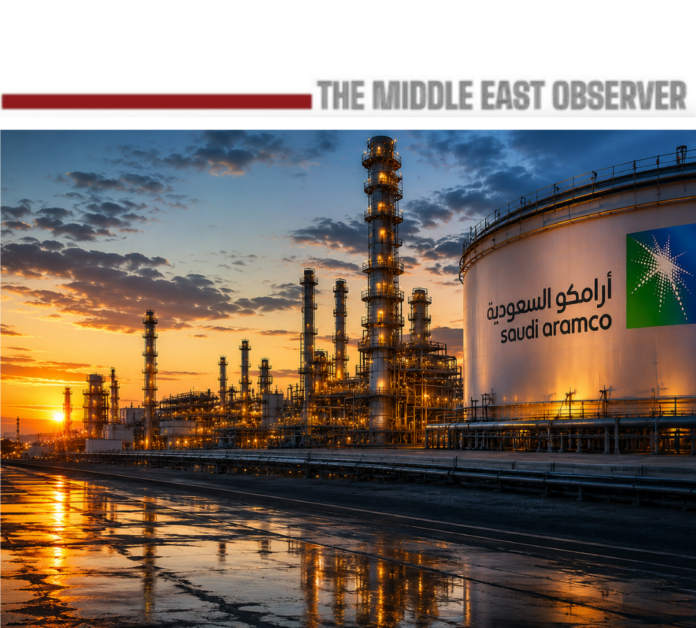
Saudi oil giant Saudi Aramco reported a sharp rise in first-quarter profits for 2026, benefiting from soaring crude prices and increased energy exports amid escalating geopolitical tensions across the Gulf region and disruptions surrounding the Strait of Hormuz.
According to a statement published on the Saudi stock exchange, Aramco’s net income rose by 25.5% year-on-year during the first quarter to 120.13 billion Saudi riyals ($32.04 billion), compared to 95.68 billion riyals ($25.51 billion) in the corresponding period of 2025.
The company stated that the increase was primarily driven by “higher crude oil prices, higher crude oil volumes sold, and increased sales of refined and chemical products,” despite rising operating costs, taxes, and zakat obligations linked to stronger earnings.
The earnings exceeded market expectations, with analyst consensus estimates placing adjusted quarterly net income at approximately $31.16 billion.
The results marked Aramco’s first quarterly profit increase after 12 consecutive quarters of decline, reflecting the sharp tightening in global energy markets following the outbreak of conflict in the Gulf earlier this year.
Oil prices climbed sharply during the quarter, rising from the mid-$60 range in early February to above $100 per barrel by March after Iran imposed restrictions on hydrocarbon transit through the strategic Strait of Hormuz, triggering renewed concerns over global energy security and supply stability.
Aramco President and CEO Amin H. Nasser said the performance demonstrated the company’s “resilience and operational flexibility in a complex geopolitical environment,” adding that the group had leveraged both its domestic infrastructure and global network to maintain supply continuity despite regional instability.
A critical factor supporting Saudi export capacity during the crisis was Aramco’s east-west pipeline system, which connects Gulf production facilities to Red Sea export terminals, bypassing Hormuz entirely.
The company said pumping volumes through the pipeline reached its maximum operational capacity of seven million barrels per day during the first quarter, helping sustain crude exports from the Kingdom’s western coast despite maritime disruptions in the Gulf.
Last month, Saudi Arabia’s Ministry of Energy announced that pipeline infrastructure and associated energy facilities had been restored following attacks linked to the regional conflict.
The Gulf region has witnessed repeated attacks on energy infrastructure since the outbreak of regional hostilities in late February. Iranian retaliatory operations targeted both military and civilian infrastructure across the region, including oil and gas facilities, airports, petrochemical plants, and power infrastructure.
Within Saudi Arabia, facilities in Riyadh, the Eastern Province, and the industrial city of Yanbu reportedly came under attack, highlighting the vulnerability of regional energy infrastructure during the conflict.
The surge in oil and gas prices has simultaneously boosted earnings across the global energy sector. French energy major TotalEnergies recently reported a 51% rise in first-quarter profits, while British energy giant Shell announced a 19% increase in post-tax earnings.
Market analysts expect Aramco’s profitability to remain elevated into the second quarter should crude prices maintain current levels, particularly after Saudi Arabia, Russia, and other members of the OPEC+ proceeded with planned production quota increases aimed at stabilizing global supply.
As The Middle East Observer notes, Aramco’s latest earnings underscore how the Gulf conflict has reshaped global energy dynamics, underscoring the strategic value of alternative export infrastructure amid rising geopolitical and energy market volatility.
