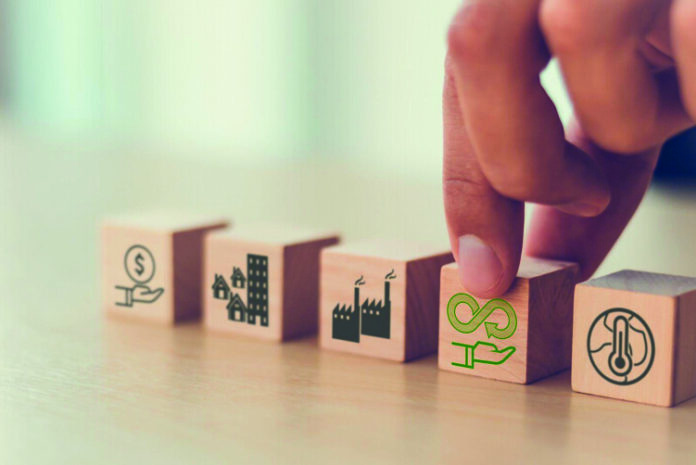
What was once a lofty environmental aspiration has become a pressing economic strategy in the Middle East. Governments across the region are increasingly embedding circular economy principles—reduce, reuse, recycle—into their national visions, shifting from landfills to closed loops as they seek to diversify away from hydrocarbons and meet global climate obligations.
The region generates more than 150 million tonnes of waste annually, much of it from construction, plastics, and food. Historically, most of it went to landfill. But that model is proving costly, environmentally damaging, and incompatible with the ambitions of Saudi Vision 2030, the UAE’s Net Zero 2050, and Egypt’s Waste Management Law.
According to Strategy& Middle East, GCC economies could unlock $138bn in economic value by 2030 through circular models—equivalent to 1 percent of cumulative GDP between 2020 and 2030—while avoiding 150mn tonnes of emissions, roughly equal to Norway’s annual output in 2015.
The economic logic is straightforward: turning waste into feedstock saves costs, reduces reliance on virgin resources, and creates new markets. Just as importantly, it aligns with global ESG standards that now shape access to trade and capital.
Construction is the region’s largest waste stream, particularly in Saudi Arabia, where giga-projects such as Neom and Qiddiya generate mountains of debris. Riyadh has responded by commissioning recycling plants capable of processing millions of tonnes of concrete, asphalt, and steel each year. These recycled aggregates are now feeding back into new infrastructure. The UAE’s Al Dhafra Recycling Industries has processed over 21mn tonnes of construction waste since 2010. Egypt, meanwhile, is rolling out urban recycling hubs in Cairo and Alexandria. For investors, opportunities extend beyond mega-plants to smaller ventures: pre-sorting services on building sites, digital scrap marketplaces, and collection networks.
Plastic consumption is rising sharply, but governments are tightening regulation. The UAE introduced Extended Producer Responsibility (EPR) schemes in 2021, obliging packaging producers to finance collection and recycling. Egypt will impose disposal fees of EGP 37.5 per kilogram on plastic bag makers and importers from 2025. Petrochemical groups are trialling chemical recycling, while startups are developing compliance software, recycled packaging, and mobile collection apps. For entrepreneurs, the sector offers multiple points of entry, from hyper-local micro-collection services to high-tech reporting tools.
Food waste accounts for up to 40 percent of municipal refuse in some Arab states—a strategic vulnerability in water-scarce, import-dependent economies. Dubai’s Food Bank has redistributed thousands of tonnes of surplus food, while Saudi Arabia is scaling composting and biogas initiatives. Egypt is experimenting with food-sharing apps and NGO-led redistribution schemes. Short-term, such projects cut landfill costs and generate energy or compost. Long-term, they underpin sustainable agriculture, reduce import dependency, and create employment. For younger investors, small-scale composting businesses, surplus food logistics, and organic fertiliser ventures are accessible entry points.
Public-private partnerships are driving short-term cash flows. Dubai’s Warsan waste-to-energy plant sells electricity to the grid, while Saudi Arabia’s recycling plants supply guaranteed demand from state-backed road projects. These contracted offtakes offer the stability that regional and institutional investors prize.
In the longer term, industrial symbiosis—where one sector’s waste fuels another—is being tested in cement, steel, and petrochemicals. Morocco’s OCP phosphate group, now running entirely on non-traditional water sources, is being watched closely as a regional benchmark. Scaling water reuse, carbon capture, and advanced recycling technologies could redefine heavy industry in the Gulf.
For agile entrepreneurs, the “sweet spot” lies in services that plug into these big systems: compliance technology for EPR, surplus food platforms, digital scrap trading, and small-scale biogas units.
Challenges remain. Infrastructure for waste segregation is patchy. Banks still shy away from early-stage ventures. Consumer awareness lags, slowing adoption of recycling schemes.
Yet governments are doubling down. Saudi Arabia has pledged to divert 82 percent of waste from landfills by 2035. The UAE aims for 75 per cent by 2025. Egypt is writing circularity into law through new compliance obligations.
The message is converging: waste is too valuable to waste. For governments, circularity secures resources and trims costs; for companies, it boosts competitiveness; for investors, it opens a frontier of opportunity.
The Middle East’s circular economy will not be built in landfills but in loops—and those who invest early stand to shape not only emerging markets but also the region’s sustainability trajectory.