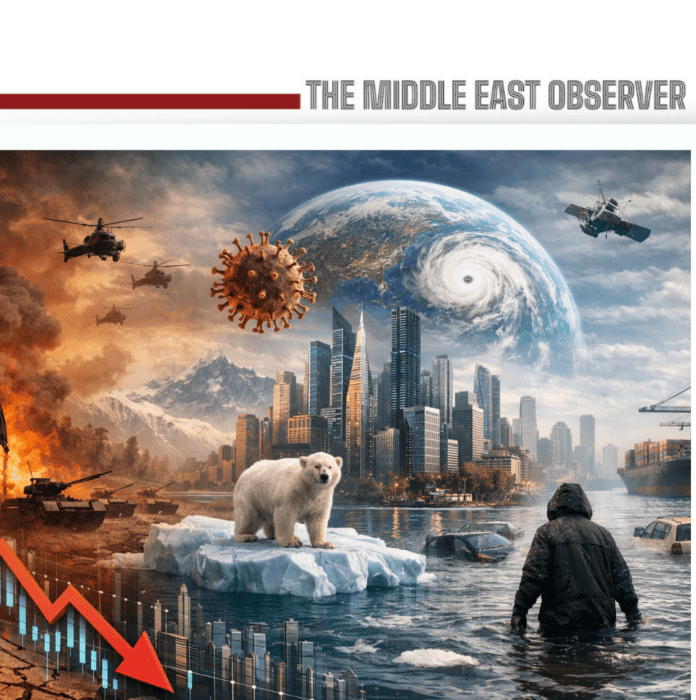
Part I: A Comprehensive View of the Key FindingsUncertainty dominates expert expectations. Half of respondents anticipate a turbulent or stormy global environment over the next two years, rising to 57% over the next decade. Only 1% foresee a calm outlook at any horizon, highlighting widespread concern over the durability of global stability.Geoeconomic confrontation has emerged as the most critical near-term risk and the leading potential trigger of a global crisis in 2026. Trade fragmentation, protectionism, sanctions, and strategic industrial policies are eroding the foundations of the interconnected global economy. State-based armed conflict follows closely, reflecting heightened geopolitical tensions and the risk of regional spillovers.Economic risks have climbed sharply in prominence. Concerns over economic downturns, inflation, and asset-bubble collapses have risen markedly compared with last year, driven by mounting debt sustainability issues and financial vulnerabilities. These pressures, combined with geoeconomic rivalry, raise the risk of systemic shocks affecting both advanced and emerging economies.
Technological risks are expanding rapidly. Misinformation and disinformation and cyber insecurity rank among the most severe short-term threats. Over the longer term, adverse outcomes from artificial intelligence rise dramatically in importance, reflecting fears of labor-market disruption, social fragmentation, and security risks if governance frameworks fail to keep pace with innovation.
Societal risks are deeply intertwined with economic and technological change. Inequality remains the most interconnected global risk for the second year running, fueling political polarization, weakening trust in institutions, and intensifying public discontent. Disinformation further amplifies these divides, undermining democratic resilience and policy effectiveness.
Environmental risks have slipped down short-term rankings as immediate geopolitical and economic concerns dominate. However, over the 10-year horizon they remain the most severe category of risk, led by extreme weather events. Experts express deep pessimism about the world’s ability to manage climate and environmental challenges over the coming decade, warning of long-term consequences from short-term neglect.
The report concludes that the global system is moving decisively toward a fragmented, multipolar order. Nearly 70% of respondents expect a world in which middle and great powers increasingly contest and enforce regional rules, while only a small minority foresee a revival of the previous rules-based international order.
Part II: Regional Challenges and Scope for Resolution
United States: Power, Innovation, and Internal Fractures
Main challenges: Political polarization, misinformation, institutional trust erosion, and AI-driven labor disruption.
Scope for resolution: Strengthening institutional credibility, investing in workforce reskilling, and establishing clearer governance frameworks for emerging technologies could help mitigate domestic risks while preserving global economic leadership.
Europe: Stability Under Economic and Political Pressure
Main challenges: Weak growth, competitiveness gaps, debt pressures, and political fragmentation amid geopolitical spillovers.
Scope for resolution: Deeper economic coordination, targeted industrial competitiveness strategies, and renewed political cohesion at the regional level are critical to sustaining Europe’s influence and resilience.
Asia: Growth Engine Constrained by Rivalry
Main challenges: Geopolitical tensions, supply-chain fragmentation, technology bifurcation, cyber risks, and climate vulnerability.
Scope for resolution: Diversifying supply chains, regional confidence-building measures, and investment in climate adaptation and digital resilience could help sustain long-term growth.
Africa: Demographic Promise Amid Structural Fragility
Main challenges: Debt distress, climate shocks, food insecurity, infrastructure gaps, and limited fiscal space.
Scope for resolution: Scaled investment in infrastructure, education, and digital connectivity, alongside debt restructuring and climate finance, is essential to unlock demographic dividends and reduce systemic vulnerability.
Middle East: Strategic Centrality and Climate Stress
Main challenges: Geopolitical conflict risks, water scarcity, extreme heat, social inequality, and labor-market transitions.
Scope for resolution: Economic diversification, regional de-escalation, investment in climate resilience, and inclusive growth strategies can strengthen long-term stability and reduce exposure to external shocks.
In conclusion, The Global Risks Report 2026 depicts a world where risks are increasingly interconnected, fast-moving, and unevenly distributed across regions. While national and regional policy choices remain decisive, the report underscores that no region can fully insulate itself from global instability. The central unresolved challenge is whether strategic collaboration can be recalibrated within an era defined by competition. The choices made now will determine whether fragmentation deepens—or whether resilience and cooperation can still be rebuilt.