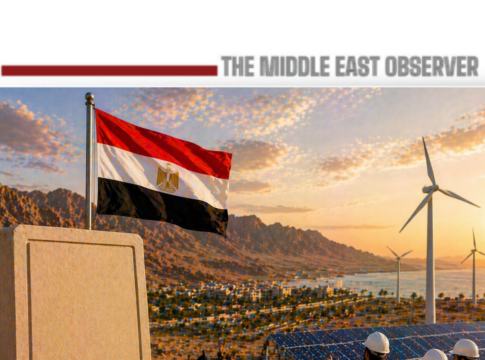
Cairo — President Abdel Fattah El-Sisi marked the 44th anniversary of Sinai Liberation by laying wreaths at the Armed Forces Martyrs Memorial and the tomb of former president Mohamed Anwar El-Sadat, in a ceremony that reaffirmed the central place of sacrifice, sovereignty, and national memory in Egypt’s public life. Sinai Liberation Day, observed each year on 25 April, commemorates Egypt’s recovery of the peninsula following Israel’s withdrawal in 1982 under the peace treaty framework, with full sovereignty completed after the Taba arbitration ruling in 1989.
The symbolism of the occasion comes at a time when Sinai is no longer viewed only through the lens of security, but increasingly as a long-term development frontier. Prime Minister Mostafa Madbouly said during his recent tour of North Sinai that developing the peninsula remains a state priority, with current plans spanning urban communities, infrastructure, agriculture, industry, mining, and logistics. Official updates indicate that Sinai is being positioned as an integrated development hub rather than a peripheral frontier.
At the same time, the state has continued to expand institutional support for the families of martyrs and victims. The Presidency said in 2025 that President El-Sisi approved the “Egypt Is With You” initiative for the minor children of martyrs and victims, while the Fund for Honoring Martyrs, Victims, Missing Persons and the Injured of War, Terrorist and Security Operations continues to provide financial, social, health, and educational support. The Armed Forces also announced one-time compensation for families of martyrs of past wars and the injured.
Within this context, a broader development question is emerging: what constitutes the most meaningful long-term tribute to families whose sons and daughters defended Egypt? One compelling answer lies not in symbolic recognition alone, but in deeper inclusion in Sinai’s future—through priority access, preferential pricing, or tailored mortgage schemes, where legally and administratively feasible, to land, housing, agricultural settlements, or development zones tied to the peninsula’s ongoing reconstruction. Such an approach would complement existing support frameworks by linking remembrance with tangible citizen ownership, and translating sacrifice into sustainable, intergenerational opportunity.
The Middle East Observer notes that Sinai’s development agenda is ultimately about more than roads, ports, and investment zones; it is about population stability, national integration, and embedding communities in a region long associated with Egypt’s strategic endurance. The Middle East Observer further observes that enabling martyrs’ families to build livelihoods in Sinai—should the state choose to pursue such a path—would give the peninsula a deeper social meaning: not only land reclaimed by the nation, but land shared with families whose ancestors gave their lives for its sovereignty and safety.