
CAIRO — Egypt is strengthening its position as a regional investment hub, ranking among the top markets in the Middle East and North Africa for openness to foreign capital, according to a report by Fitch Solutions cited by the Information and Decision Support Center.
The report places Egypt third in the MENA region and 27th globally out of 202 markets, reflecting improved investor confidence driven by structural reforms, infrastructure expansion, and a growing focus on green development.
According to International Monetary Fund projections, Egypt’s transition toward a more flexible exchange rate is expected to support foreign currency inflows and sustain foreign direct investment (FDI) growth over the medium term.
Egypt aims to attract $60 billion in FDI between 2026 and 2030, a target Fitch considers achievable given the country’s steady inflows of $9–11 billion annually in recent years. The report highlights key drivers underpinning this outlook, including Egypt’s strategic geographic location, large domestic market, competitive labour costs, and diversified economic base.
Egypt also maintains one of the largest FDI stocks in North Africa, trailing only major Gulf economies such as Saudi Arabia and the UAE at the regional level.
Central to Egypt’s investment strategy is the “Golden License” system, introduced in 2022, which enables investors to obtain comprehensive project approvals within a shortened time frame. The framework is supported by the country’s updated investment law, which offers tax incentives, streamlined procedures, and guarantees for profit repatriation and foreign ownership.
Special economic zones—including the Suez Canal Economic Zone—and free zones continue to play a key role, offering integrated regulatory services and facilitating industrial and logistics investments.
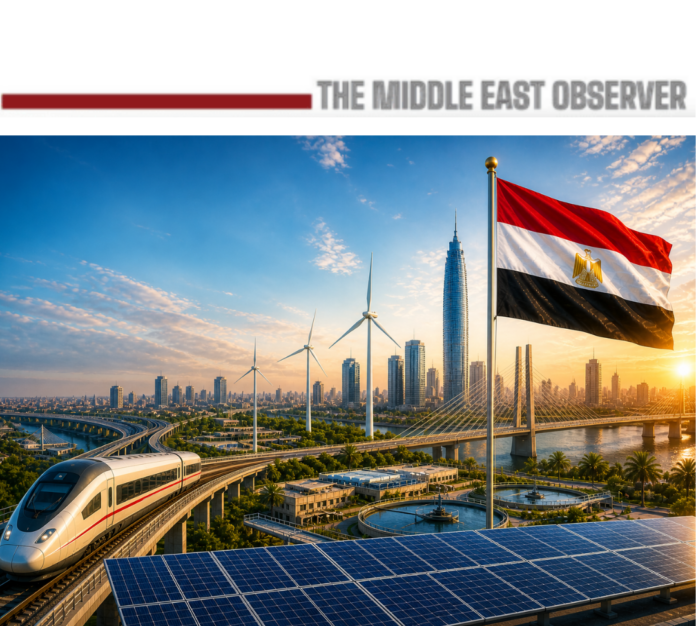
Fitch highlights Egypt’s infrastructure expansion and green transition as key differentiators relative to regional peers. The government has accelerated its sustainability agenda, targeting 42% of electricity generation from renewable sources by 2030, while mandating that new public investments align with green standards.
Priority sectors include green hydrogen, desalination, and sustainable transport, alongside continued development of logistics corridors and industrial hubs linked to global trade routes.
Egypt’s investment landscape is further supported by strong international partnerships. Gulf countries—particularly the UAE—remain leading sources of capital, while China continues to expand its footprint through the Belt and Road Initiative, with a focus on infrastructure and industrial projects.
Separately, maritime activity through the Suez Canal remains a key indicator of Egypt’s global trade relevance, with recent reports from Reuters highlighting the transit of one of the world’s largest LNG tankers through the canal.
As The Middle East Observer notes, Egypt’s investment trajectory reflects a structural shift toward infras
