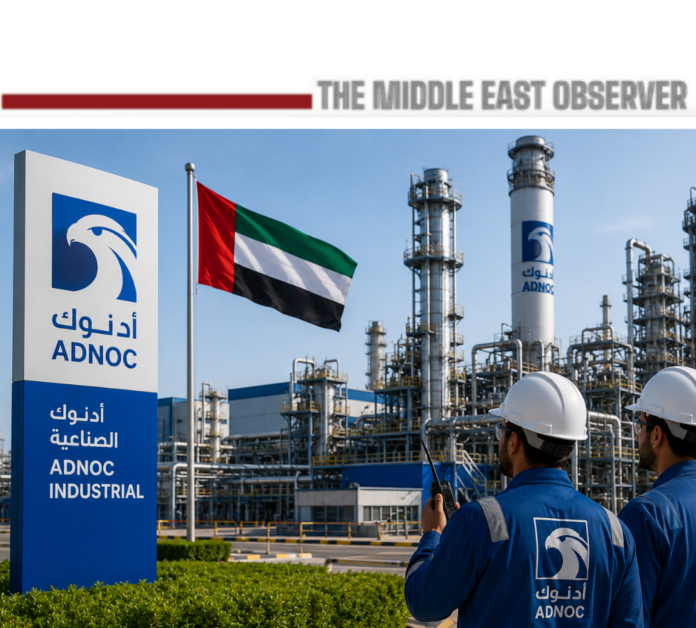
The United Arab Emirates is advancing a coordinated strategy to strengthen its industrial base and secure supply chains, as Abu Dhabi National Oil Company (ADNOC) unveiled a major Industrial Resilience Program alongside policy shifts linking energy production more closely to domestic manufacturing priorities.
The announcement, made during the “Make it in the Emirates” forum in Abu Dhabi, introduces five initiatives aimed at accelerating local manufacturing, enhancing supply-chain resilience, and reinforcing industrial capacity across strategic sectors, according to official ADNOC statements and coverage by Reuters.
Central to the program is the “Local+” initiative, which prioritises “Made in the Emirates” products across ADNOC’s procurement pipeline, alongside incentives for contractors under an “ICV+” framework to source domestically. ADNOC also outlined plans to channel approximately AED 200 billion into local procurement between 2026 and 2028, while expanding its long-term goal to manufacture AED 90 billion worth of products locally by 2030.
The program builds on ADNOC’s In-Country Value (ICV) initiative launched in 2018, which has already driven substantial investment into domestic manufacturing. The company reported that agreements worth AED 80 billion have been signed with local and international partners since 2022, with an additional AED 4.5 billion invested in new industrial facilities.
Parallel to these developments, the UAE has reinforced its strategic pivot in energy policy following its decision to exit OPEC and the broader OPEC+ alliance. Officials say the move is designed to grant greater flexibility in oil and gas production to meet the needs of domestic industries.
Speaking at the same forum, UAE Energy Minister Suhail Al Mazrouei stated that the decision enables the country to produce according to its industrial requirements rather than adhering to collective production quotas. He added that the UAE would continue to act as a “responsible producer” while pursuing bilateral cooperation with former OPEC partners.
According to statements carried by Bloomberg and Asharq News, the policy shift reflects a broader national strategy to integrate energy resources with industrial development goals, ensuring priority access to feedstocks for local manufacturers.
Sultan Al Jaber emphasised that the UAE’s departure from OPEC is aligned with long-term economic objectives and is not directed against any specific party, but rather aimed at accelerating investment, expanding production capacity, and creating added value within the domestic economy.
As The Middle East Observer notes, the convergence of ADNOC’s industrial initiatives and the UAE’s evolving energy policy signals a structural shift in the country’s economic model—one that places industrial self-sufficiency and supply-chain control at the centre of its growth strategy, with implications for regional energy markets and global supply dynamics.