
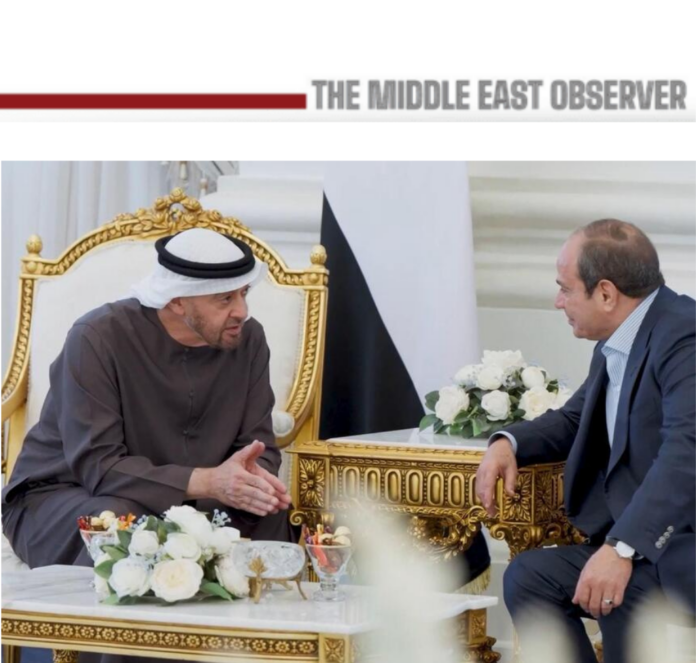
NEW EL ALAMEIN CITY, Egypt, July 12 — President Abdel Fattah El-Sisi welcomed UAE President Sheikh Mohamed bin Zayed Al Nahyan to New El Alamein City on Sunday for a fraternal visit that underscored the depth of the strategic partnership between the two countries amid heightened geopolitical uncertainty across the Middle East.
Receiving the UAE leader at New El Alamein Airport, President El-Sisi described Egypt as Sheikh Mohamed’s “second home”, reaffirming the enduring historical ties and close relationship binding the leaderships and peoples of both nations. Sheikh Mohamed expressed his appreciation for the warm reception, describing the Egypt-UAE relationship as one founded on long standing fraternity, mutual trust and shared interests.
The leaders reviewed bilateral cooperation across political, economic, investment and development priorities before turning to the rapidly evolving regional landscape. Discussions focused on the latest developments in the Middle East, particularly ongoing efforts to prevent further escalation, preserve regional stability and strengthen collective Arab coordination in addressing common security challenges. The meeting comes as regional governments continue to navigate conflicts in Gaza and Sudan, renewed concerns over maritime security and wider geopolitical tensions affecting regional economic confidence.
Both presidents reaffirmed the importance of maintaining continuous consultation and close policy coordination as the region confronts multiple crises, reflecting the increasingly institutionalised strategic dialogue between Cairo and Abu Dhabi. Their discussions also highlighted the breadth of bilateral cooperation spanning infrastructure, renewable energy, industry, logistics, tourism, real estate and trade. The UAE remains one of Egypt’s largest foreign investors, with Emirati investments playing a significant role in supporting major development projects and economic growth.
For Cairo and Abu Dhabi, the visit reaffirmed a partnership that increasingly combines strategic investment with coordinated regional diplomacy, positioning both countries among the Arab world’s leading advocates of stability, state sovereignty and sustainable economic development. Analysts expect bilateral coordination to remain particularly close as regional governments pursue diplomatic initiatives aimed at reducing tensions while maintaining investment momentum and strengthening regional economic resilience.
Related news:
Egypt Secures UAE Support for Airborne Mining Surveys and Petroleum Financing
Egyptian–UAE Consortium Plans €200m Tourism Investment in Morocco’s Essaouira
Read also: