
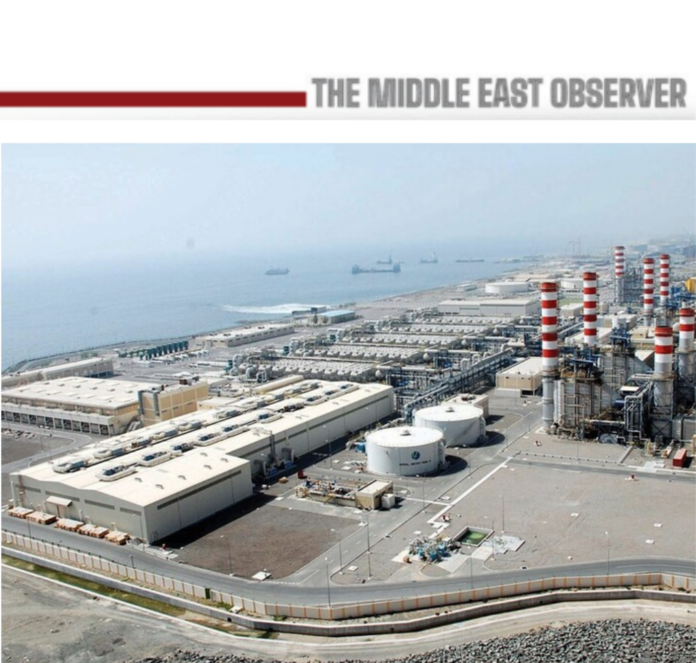
Egypt is set to attract another major Gulf infrastructure investment as UAE-based AMEA Power enters advanced negotiations with the Egyptian government to develop three seawater desalination plants with a combined production capacity of approximately 300,000 cubic metres per day, equivalent to supplying potable water for around one million people, depending on consumption patterns. The proposed investment reinforces Cairo’s strategy of expanding private-sector participation in strategic water infrastructure.
AMEA Power Chairman Hussain Al Nowais said discussions have reached an advanced stage and cover two plants on Egypt’s Mediterranean coast and a third on the Red Sea. The projects are expected to be implemented under an Independent Water Producer (IWP) model, under which the company would finance, build and operate the facilities through long-term concession agreements before supplying desalinated water under contractual arrangements.
The negotiations come as Egypt accelerates efforts to strengthen long-term water security amid rising population growth, increasing industrial and urban demand, climate-related pressures and constrained renewable freshwater resources. Water diversification has become a strategic priority as the country seeks to reduce dependence on the Nile while ensuring reliable supplies for expanding coastal cities, tourism destinations and industrial developments.
Under its National Seawater Desalination Strategy, Egypt is pursuing one of the Middle East and North Africa’s largest desalination expansion programmes through successive public-private partnership tenders. According to official figures, the country currently operates more than 120 desalination plants, with additional facilities under construction and a substantial pipeline of Independent Water Producer projects designed to significantly expand national production capacity over the coming decades.
For AMEA Power, the proposed projects would further strengthen its expanding regional infrastructure portfolio in Egypt. The company has become one of the country’s leading foreign renewable energy investors through large-scale solar and wind developments, while recently signing agreements covering 1,500 MWh of battery energy storage systems and a 3,000 MWh battery manufacturing facility, supporting Egypt’s broader energy transition strategy and the integration of clean power with critical infrastructure.
The negotiations also reflect a wider acceleration of Gulf investment into Egypt’s strategic sectors, including renewable energy, electricity storage, logistics, ports and water infrastructure. Across the Middle East, desalination is attracting increasing institutional investment as governments seek climate-resilient water solutions powered by renewable energy and supported by long-term concession frameworks.
If concluded, the agreement would represent another milestone in Egypt’s strategy of mobilising international private capital to modernise essential infrastructure. Beyond expanding freshwater supplies, the projects would strengthen the country’s long-term water security, reinforce investor confidence in Egypt’s public-private partnership framework and underline the growing convergence of water security, energy transition and sustainable infrastructure investment across the region.
Related news:
Egypt Bets on Battery Storage and Manufacturing to Power Next Energy Phase
FCC unit wins $320m Egypt wastewater plant deal
Read also:
Foreign Buying Gives Way to Domestic Buying as (EGX) Ends Week Higher
Syria Turns to Chinese Smart Industrial Model to Drive Reconstruction and Investment
