
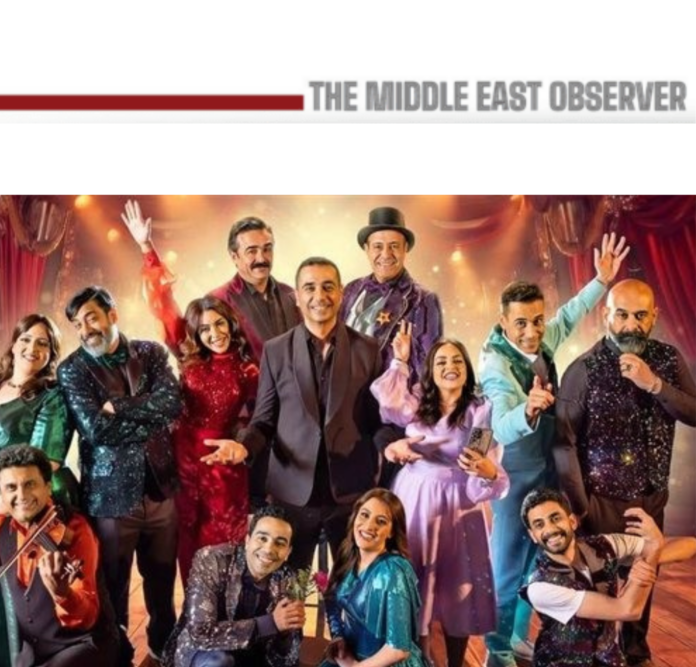
Last week, I went with my wife and our son, Assem, to Al-Salam Theatre on Qasr Al-Aini Street. It was Thursday, a public holiday marking the anniversary of the June 30 Revolution. We decided to watch a performance, although I was unsure what to expect on a holiday evening. Many people choose to travel or simply stay at home. What I encountered, however, genuinely surprised me. The theatre was completely full—not a single empty seat. Families, students, older couples and working professionals from different parts of Cairo had all come together for the performance.
What made the experience even more remarkable was that the 2026 FIFA World Cup was being broadcasted at the same time. Coffee shops echoed with cheers after every goal, yet hundreds of people had chosen to leave their televisions behind and spend the evening watching a live theatrical performance. No instant replays, no commentators—just actors on stage telling a story. To me, this said something important about the enduring appeal of live theatre.
Inside, the atmosphere was electric. The audience was far from passive. Laughter flowed naturally throughout the performance, every musical number was met with warm applause, and the actors received enthusiastic cheers. By the final curtain, the entire audience had risen for a standing ovation. It was a memorable evening that reminded me why theatre remains such a unique art form. Sharing laughter, emotion and reflection with hundreds of strangers creates a collective experience that no television screen—even one showing the World Cup—can fully replicate.
As we left the theatre, while people continued discussing their favourite scenes, another thought occurred to me. This had not simply been a successful theatrical performance; it was also an instructive case study in economics and investment. The production, Al-Tiyatro (“The Theatre”), staged by the Modern Theatre Troupe under the State Theatre House, demonstrated how culture can represent far more than a public expenditure. Properly managed, it can become a productive economic asset. The fact that the theatre was filled on a public holiday, despite direct competition from the world’s biggest sporting event, reinforced that conclusion.
The Art Behind the Success
From an artistic perspective, Al-Tiyatro embraces the classic concept of “theatre within the theatre.” Rather than presenting a conventional narrative with a clear beginning, middle and end, it takes audiences behind the curtain, revealing the tensions and realities that shape the performing arts. Yet its central theme extends well beyond backstage life. The play delivers a far sharper critique of the commercialisation of culture.
Its principal target is a class of investors who finance artistic productions despite having little appreciation for art itself. Motivated solely by commercial returns, they promote superficial entertainment—productions built around spectacle rather than substance, weak music, poor performances and artistic mediocrity. Rather than nurturing creativity, the play argues, such investors marginalised genuine artists, undermined serious theatre and placed commercial gain above cultural value.
Through this lens, Al-Tiyatro explores the enduring conflict between artistic integrity and commercial opportunism. It offers a passionate defence of authentic creativity while exposing the pressures that increasingly shape the cultural landscape.
The story follows Adam, portrayed by Nour Mahmoud, who delivers an energetic and engaging performance as a young man unexpectedly drawn into the complex world of theatre. Through his journey, audiences encounter a diverse cast of characters representing contrasting views on art, money and personal integrity. Fellow cast members—Mohamed Yurka, Samar El-Nagili, Shirehan El-Shazly, Abdel Moneim Riyad, Ahmed El-Salkawy and Alhan El-Mahdi—perform with notable cohesion. Rather than competing for attention, they function as a genuine ensemble, an approach that strengthens the production throughout.
The pace rarely falters. Comedy seamlessly gives way to music, followed by quieter moments of reflection before the energy rises again. Ahmed El-Malwany’s script is both witty and purposeful, using humour and rapid dialogue to challenge the commercial exploitation of culture while reaffirming the importance of artistic excellence.
Director Ahmed Foad succeeds in balancing entertainment with social commentary. Without sacrificing the play’s humour, he delivers a serious message about the need to protect authentic artistic expression from purely commercial pressures. The production makes excellent use of Al-Salam Theatre’s expansive stage, combining dynamic movement with visually engaging staging that sustains the audience’s attention throughout. It is easy to understand why the production has rapidly built such strong public support.
Beyond Ticket Sales: The Economics of Culture
The success of Al-Tiyatro extends well beyond its artistic achievements. It also illustrates the growing importance of what economists describe as the creative economy—a sector encompassing theatre, film, music, publishing, television, design and digital content. Worldwide, these industries generate billions of dollars in economic activity and support millions of jobs. Increasingly, governments recognise that culture is not merely a public amenity or a discretionary expense; it is a productive economic sector capable of driving growth, innovation and employment.
Egypt’s rich cultural heritage places it in a particularly strong position to benefit from this global trend. Productions such as Al-Tiyatro demonstrate that investment in culture can deliver both artistic excellence and tangible economic returns. This is no longer a theoretical proposition. It is unfolding in practice on Qasr Al-Aini Street.
Making Public Assets Work Harder
One of the most compelling aspects of Al-Tiyatro is that it is staged in a state-owned theatre managed by a public institution. As such, it provides a valuable example of how governments can maximise the economic return from public assets. A theatre that sits largely empty inevitably depends on continuous public funding. A theatre operating at full capacity, however, presents a very different financial equation. Fixed costs are spread across larger audiences, revenue increases and the venue moves closer to long-term financial sustainability.
This reflects a broader policy objective pursued by many governments: improving the efficiency and productivity of publicly owned assets. Al-Tiyatro demonstrates that investment in culture should not be viewed simply as expenditure, but as an investment in human capital, creativity and national soft power. Every ticket sold contributes not only to covering operating costs but also to sustaining employment, strengthening public institutions and encouraging future artistic production.
At the same time, the play’s central message serves as an important reminder that commercial success should never come at the expense of artistic integrity. While financial sustainability is essential, the production argues convincingly that culture flourishes only when creativity, originality and artistic excellence remain at its heart.
Theatre as a Job Creator
The economic contribution of theatre extends far beyond the performers who appear on stage. While actors and directors receive most of the public attention, every successful production relies on a wide network of professionals working behind the scenes. Writers, composers, choreographers, costume designers, set builders, lighting and sound engineers, stage managers, marketing specialists, ticketing staff, administrative teams and front-of-house employees all play indispensable roles. Depending on the scale of the production, a single theatrical performance can support dozens of direct jobs and generate many more indirect employment opportunities.
For young people seeking careers in the creative industries, theatre provides an invaluable platform for developing professional skills, gaining practical experience and building long-term careers. In a country with a youthful population and growing demand for employment opportunities, this role should not be underestimated. Investing in theatre therefore represents an investment not only in culture, but also in the development of human capital.
The play itself reinforces this argument. By portraying the pressures faced by genuine artists in an increasingly commercial environment, Al-Tiyatro highlights the importance of protecting the people whose creativity sustains the cultural sector. Behind every successful production stands an entire ecosystem of professionals whose work deserves both recognition and support.
The Multiplier Effect
The economic benefits of a successful theatrical production extend well beyond the theatre itself. Audience members spend money on transport, parking, restaurants, cafés and refreshments before and after attending a performance. Local businesses all benefit from the increased footfall generated by a popular production. Even on a public holiday, and despite the simultaneous World Cup matches, the streets surrounding Al-Salam Theatre remained lively with theatre-goers before and after the show.
Economists refer to this phenomenon as the multiplier effect, whereby spending in one sector stimulates additional economic activity across many others. Numerous international studies have demonstrated that investment in culture generates positive spillover effects for hospitality, retail, transport and tourism. For cities seeking to revitalise historic districts, strengthen their evening economy or encourage urban regeneration, cultural investment has repeatedly proven to be one of the most effective catalysts.
In this respect, Al-Tiyatro offers a practical example of how a successful cultural production can create value that extends well beyond ticket revenues. Its contribution reaches neighbouring businesses, supports local employment and enhances the vitality of the surrounding urban environment.
Pricing and Audience Development
Another important lesson from Al-Tiyatro concerns pricing strategy. For any theatrical production to remain sustainable, it must strike a careful balance between artistic quality, affordability and commercial viability. Ticket prices that are too high inevitably discourage audiences, while prices set too low make it difficult for productions to recover their costs and invest in future performances.
Al-Tiyatro appears to have achieved that balance successfully. Ticket prices remain accessible to families and students, while consistently strong attendance suggests that audiences perceive genuine value in the experience. The result is a diverse and loyal audience that is likely to return for future productions.
International experience consistently demonstrates that cultivating long-term audiences is more valuable than pursuing short-term profits through premium pricing. Sustainable theatre depends not simply on selling tickets, but on fostering a lasting culture of theatre-going. Once audiences develop the habit of attending live performances, both cultural institutions and the wider creative economy stand to benefit.
The New Economics of Marketing
Equally striking was the way the production was promoted. Traditionally, theatre marketing relied heavily on newspaper advertisements, billboards and television campaigns—approaches that often required substantial financial resources. Al-Tiyatro, however, adopted a markedly different strategy, relying extensively on social media and word-of-mouth recommendations.
Short video clips from performances circulated rapidly across Facebook, Instagram and TikTok. Audience members shared photographs, comments and personal reviews, while members of the cast posted behind-the-scenes content that sustained public interest and generated anticipation among prospective theatre-goers.
This represents a broader transformation within today’s creative economy. Audiences have increasingly become active participants in the marketing process. A positive experience is now shared not only with friends and family but potentially with thousands of followers online. Such recommendations often carry greater credibility than conventional advertising because they reflect genuine personal experiences rather than paid promotional campaigns.
For publicly funded cultural institutions operating within limited marketing budgets, this offers an important lesson. Strategic use of digital platforms can significantly expand audience reach while keeping promotional costs relatively modest, enabling artistic quality—not advertising expenditure—to become the primary driver of success.
Opportunities Beyond the Stage
The commercial potential of a successful theatrical production extends well beyond ticket sales. A popular performance can tour other cities, participate in regional and international festivals, attract corporate sponsorship, generate merchandising opportunities or eventually reach wider audiences through digital streaming and recorded productions.
Internationally, these additional revenue streams have become integral to the economics of theatre. Productions in London’s West End and New York’s Broadway generate substantial economic value not only through performances themselves but also through tourism, hospitality, retail, licensing agreements and international distribution.
Although Egypt’s theatre industry operates on a different scale, the underlying principle remains the same. Well-managed cultural productions can evolve into valuable intellectual property capable of generating multiple sources of revenue while simultaneously strengthening the country’s creative industries.
A Personal Reflection
Looking back, what remains most vivid is not simply the quality of the performance, but the audience’s response throughout the evening. Above all, Al-Tiyatro is an accomplished comedy. Its humour feels natural, its pacing remains lively, and its dialogue consistently connects with audiences. Laughter regularly filled the auditorium, while each musical number was rewarded with warm applause. People were not merely watching a performance—they had become part of a shared cultural experience.
Perhaps the most telling reaction came from my son, Assem, who is not easily impressed. As we left the theatre, he asked whether we could return to watch the performance again. For me, that simple request carried more significance than any financial statistic or economic indicator.
I also appreciated that the production remained suitable for family audiences while respecting prevailing social values. Parents could comfortably attend with children and teenagers, allowing the play to reach a broad cross-section of society rather than appealing to a limited audience. In doing so, Al-Tiyatro demonstrated that commercial success and family-friendly entertainment need not be mutually exclusive.
Ultimately, the central question posed by the play—the tension between genuine artistic expression and purely commercial entertainment—feels especially relevant today. Yet the audience’s response offered an encouraging answer. A packed theatre on a public holiday, despite competition from the world’s biggest sporting event, suggests that quality, creativity and authentic storytelling continue to resonate with audiences.
Al-Tiyatro therefore represents more than a successful theatrical production. It demonstrates that culture should not be viewed solely as a public service or a subsidised activity, but as a strategic economic asset capable of generating employment, revitalising public institutions, strengthening Egypt’s soft power and contributing to the country’s creative economy. When artistic excellence is matched by effective management and public engagement, culture becomes not only a source of inspiration, but also a catalyst for sustainable economic value.
Related news:
“Adagio” and the Economics of State Theatre: When the Stage Becomes Larger Than the Box Office
Egypt’s State Theatre Between Revival Ambitions and Structural Decay
Read also:
Hypatia of Alexandria The Last Light of the Ancient World
GUPCO to Add 2,500 bpd from New North Safa Well in Gulf of Suez
