
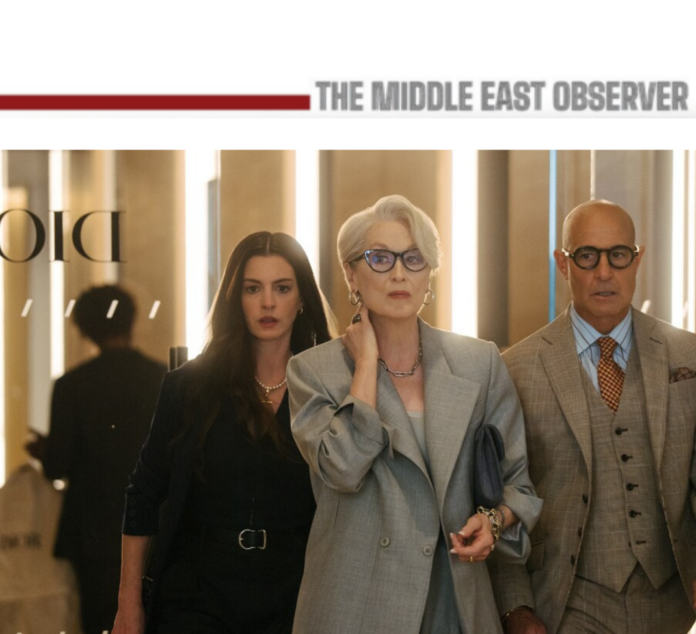
The Devil Wears Prada 2″ Surpasses $676 Million Worldwide as the Franchise Joins the Billion-Dollar Club
The Devil Wears Prada 2 has become one of this year’s biggest commercial successes, grossing US$676 million worldwide and pushing the combined global box office of the two-film franchise beyond the US$1 billion milestone for the first time.
The achievement combines the sequel’s worldwide earnings with the original 2006 film’s global gross of approximately US$326 million, making The Devil Wears Prada one of the few two-film franchises to surpass the billion-dollar mark without relying on superheroes, fantasy worlds or large-scale action spectacles.
Industry analysts estimate that Disney and 20th Century Studios produced the sequel for approximately US$100 million, with global marketing expenditure estimated at US$70–80 million, although the company has not publicly confirmed its promotional budget. Based on production costs alone, worldwide box-office receipts already represent nearly 6.8 times the film’s production budget, before accounting for streaming rights, television licensing, home entertainment, merchandising and other ancillary revenues—illustrating the powerful return profile that comparatively disciplined productions can achieve.
The film opened to US$77 million in North America and approximately US$233 million worldwide during its debut weekend, almost tripling the original film’s opening performance. At the time of writing, it has generated roughly US$217 million domestically and US$458 million internationally, ranking among the highest-grossing releases of 2026.
Yet the more significant story may not be the box office itself, but what the film reveals about the changing economics of Hollywood.
Nostalgia Alone Was Not Enough
The entertainment industry has produced numerous nostalgia-driven sequels in recent years, but commercial results have varied sharply. While established franchises such as Indiana Jones and the Dial of Destiny and Zoolander 2 struggled to recreate earlier success, The Devil Wears Prada 2 demonstrates that audience familiarity alone is no longer sufficient to guarantee commercial performance.
Instead, the sequel combines nostalgia with contemporary relevance. It revisits beloved characters while reflecting a fashion industry transformed by digital publishing, luxury influencers, e-commerce, social media and artificial intelligence. Rather than recreating the original film, it updates its narrative for a generation that consumes fashion through Instagram, TikTok, YouTube and digital luxury platforms.
That shift mirrors broader consumer behaviour. Since the original film premiered in 2006, fashion has evolved from a specialist industry into mainstream global entertainment. Consumers increasingly follow designers, fashion houses and influencers with the same enthusiasm once reserved for film stars, significantly expanding the commercial audience for fashion-centred cinema.
The film reunites director David Frankel and screenwriter Aline Brosh McKenna, while bringing back Meryl Streep, Anne Hathaway, Emily Blunt and Stanley Tucci alongside an expanded cast. The original story was adapted from Lauren Weisberger’s bestselling novel, widely believed to draw inspiration from her experiences working at Vogue under editor-in-chief Anna Wintour.
Luxury Brands Discover Hollywood‘s Most Valuable Runway
Beyond ticket sales, the sequel demonstrates how cinema is increasingly evolving into a strategic marketing platform for premium consumer brands.
Luxury fashion houses—including names long associated with the franchise’s world of high fashion such as Prada, Chanel, Valentino, Hermès and Jimmy Choo—benefit from global exposure as wardrobes, accessories and runway aesthetics circulate through cinemas, streaming platforms, fashion publications, social media and influencer content long after theatrical release.
Unlike traditional advertising campaigns that end when marketing budgets are exhausted, successful fashion films continue generating earned media through editorial coverage, celebrity appearances, red-carpet events, TikTok videos, Instagram posts, YouTube reviews and fashion commentary. This sustained visibility can produce millions of additional consumer impressions without requiring equivalent advertising expenditure from participating brands.
For luxury companies, association with successful cinematic franchises provides more than product placement. It creates long-term cultural relevance across multiple markets while strengthening brand desirability among younger consumers whose purchasing decisions are increasingly shaped by digital communities rather than conventional advertising.
The commercial relationship is becoming increasingly symbiotic. Studios benefit from the prestige and aspirational appeal of luxury brands, while fashion companies receive prolonged global exposure through successful films without bearing the full cost of comparable international marketing campaigns.
Hollywood’s New Return-on-Investment Formula
The financial profile of The Devil Wears Prada 2 reinforces a broader shift in Hollywood’s investment strategy.
With production costs of around US$100 million, the sequel cost substantially less than many contemporary franchise films, where production budgets frequently exceed US$250–350 million before marketing expenditure.
Rather than depending exclusively on increasingly expensive visual spectacles, studios are discovering that carefully managed franchises built around recognised intellectual property can generate exceptional financial returns while carrying significantly lower investment risk.
This approach has become particularly attractive as production costs continue to rise and cinema audiences become more selective. Mid-budget films supported by strong brands, established audiences and contemporary storytelling increasingly offer more attractive returns than some higher-risk mega-budget productions.
Beyond the Billion-Dollar Milestone
Joining the billion-dollar club is an important commercial achievement, but its significance extends beyond headline box-office figures.
Very few franchises consisting of only two films have surpassed US$1 billion in cumulative worldwide ticket sales. More importantly, the sequel demonstrates that the next phase of Hollywood’s growth may depend less on producing ever-larger spectacles and more on maximising the commercial value of established brands through disciplined investment, targeted storytelling and carefully cultivated consumer ecosystems.
The Devil Wears Prada 2 may ultimately be remembered less for surpassing US$676 million at the global box office than for reinforcing a broader transformation in Hollywood’s commercial strategy. Rather than relying exclusively on increasingly expensive action franchises, studios are finding that comparatively modest-budget films can generate exceptional financial returns while simultaneously creating substantial marketing value for global consumer brands.
For luxury companies, the implications are equally significant. Fashion-led films are evolving beyond entertainment into long-duration marketing platforms capable of generating worldwide cultural influence at a fraction of the cost of sustained international advertising campaigns. As the boundaries between cinema, fashion, digital media and consumer marketing continue to blur, partnerships between studios and premium brands are likely to become increasingly strategic.
The next blockbuster may not be the most expensive film Hollywood produces—it may be the one that monetises its brand most efficiently.
Related news:
Saudi-Egyptian Alliance Targets Tourism and Entertainment Expansion Across Egypt
Arab Markets Help Propel Toy Story 5 to $312m Global Launch
Read also:
AI Models Revolutionizing the Fashion Industry: A New Era or a Step Back ?
The Asymmetry Paradigm : Redefining Military Power in the Iran Conflict