
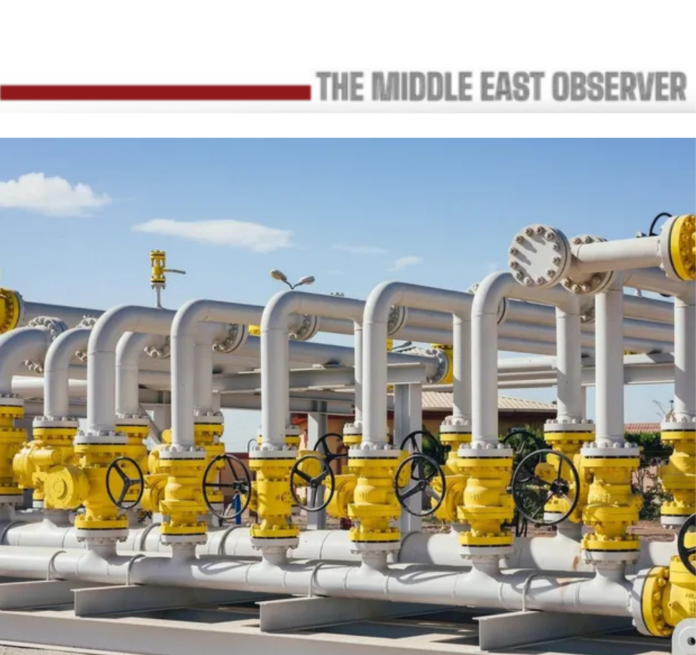
Dana Gas has reported a better-than-expected gas discovery in Egypt’s Nile Delta, offering a timely boost to Cairo’s efforts to revive domestic production and reduce dependence on imported fuel.
The UAE-listed producer said its latest Egyptian well identified approximately 10 billion cubic feet (Bcf) of gas reserves, more than three times the original forecast of 3 Bcf. The result could support a further 12 Bcf of future gas resources once developed, opening additional drilling and development opportunities across the concession area.
While modest compared with Egypt’s giant offshore discoveries, the find is strategically significant because it sits within a mature producing basin where infrastructure is already in place. Such discoveries typically offer faster development timelines and lower capital costs than frontier exploration projects, allowing new supplies to reach the domestic market more quickly.
At indicative gas prices of $3.5-$4.0 per million British thermal units, 10 Bcf of gas could represent roughly $35m-$40m of gross resource value before development costs, fiscal terms and recovery factors are taken into account. The broader significance, however, lies less in the size of the individual discovery than in what it signals about reserve potential and renewed confidence in Egypt’s upstream sector.
Production Growth Returns
Dana Gas’s Egypt operations returned to production growth during the first quarter of 2026 for the first time since 2017, marking a notable turning point after years of natural decline in mature producing areas.
During 2025, the company drilled four wells and carried out workovers on three additional wells, adding nearly 30 million standard cubic feet per day (MMscf/d) of production and approximately 36 Bcf of reserves.
The latest discovery is expected to support further reserve growth and strengthen the economics of future development campaigns. Dana Gas plans additional drilling activity during 2026 as part of a broader investment programme aimed at expanding production from its Egyptian assets.
Supporting Egypt’s Energy Recovery
The discovery arrives at a critical moment for Egypt’s energy sector.
Domestic gas production has faced pressure from declining output at several mature fields and slower production growth from some major assets. As a result, Egypt has increasingly relied on LNG imports to bridge supply gaps, particularly during periods of peak electricity demand.
The newly discovered reserves remain modest relative to Egypt’s overall energy requirements. The country currently consumes approximately 6 billion cubic feet of natural gas per day, meaning the discovery represents only a few days of national demand. Nevertheless, discoveries of this size remain commercially valuable because they can be rapidly connected to existing infrastructure and contribute incremental supplies to the domestic market.
The discovery also aligns with the Ministry of Petroleum and Mineral Resources’ broader strategy to reverse production declines through accelerated exploration, field development and improved investment incentives. Cairo has launched a series of initiatives aimed at boosting domestic gas output, reducing LNG import requirements and reinforcing Egypt’s position as a regional energy hub.
Growing Investor Confidence
The improved operating environment has encouraged producers to expand drilling programmes and commit additional capital to exploration activities.
Dana Gas’s latest success follows the settlement of overdue receivables owed to the company and the introduction of revised concession frameworks designed to improve project economics and stimulate investment.
The discovery is also part of a broader resurgence in upstream activity. International operators including Eni, BP, Harbour Energy and Chevron have expanded exploration and development programmes in Egypt over the past year, encouraged by improved commercial terms, faster project approvals and government efforts to attract new investment into both mature producing basins and frontier acreage.
Industry observers note that discoveries of this scale are particularly important because they demonstrate that Egypt’s mature onshore and Nile Delta concessions continue to offer commercially attractive opportunities despite years of production history.
A Signal Beyond a Single Well
The discovery will not, by itself, resolve Egypt’s gas-supply challenges. However, it demonstrates that mature Nile Delta acreage continues to hold viable resource potential capable of delivering relatively fast production gains.
More importantly, the result reinforces growing confidence that a combination of improved investment conditions, accelerated drilling activity and targeted exploration can help slow production declines and reduce dependence on imported LNG.
As Egypt seeks to rebuild domestic gas supply and strengthen long-term energy security, the performance of operators such as Dana Gas will be closely watched as a measure of whether the country’s upstream recovery is gaining sustainable momentum.
Related news:
Dana Gas Clears Egypt Arrears as Cairo Pushes Gas Output Recovery
Dana Gas Finds Up to 25 bn Cubic Feet in Egypt’s Nile Delta
Read also:
Dozens of National Pavilions Suspend Activities During Venice Biennale Strike
Aydhab: Egypt’s Lost Red Sea City of Pilgrims, Gold, Porcelain and Forgotten Empires