
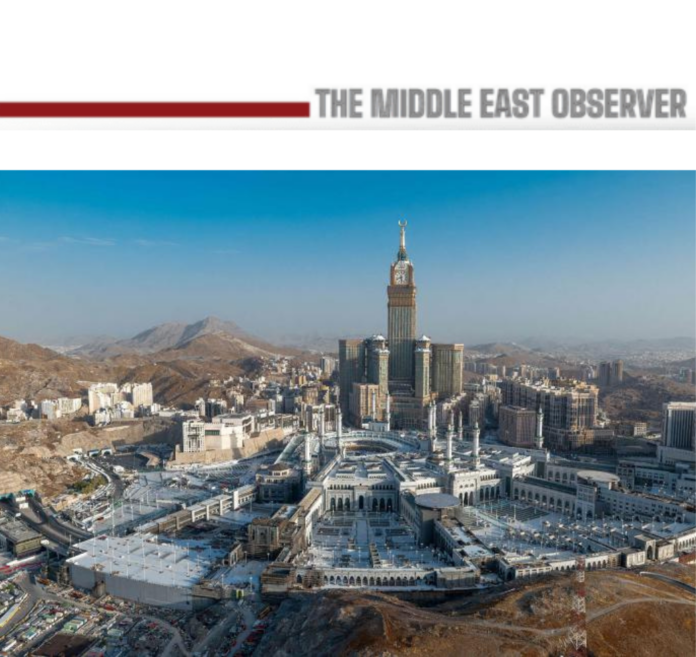
Saudi Arabia has launched the tender process for a major mixed-use development in Makkah under a public-private partnership (PPP) model, as the Kingdom accelerates efforts to attract private capital into urban infrastructure and real estate projects under Vision 2030.
The Ministry of Municipalities and Housing, represented by the Holy Capital Municipality and the National Center for Privatization & PPP (NCP), has invited investors to compete for the development of a government-owned site spanning approximately 166,488 square metres on Prince Sultan bin Abdulaziz Road (Al-Hada Road) in southeast Makkah.
The project will be delivered through a 50-year Build-Own-Operate-Transfer (BOOT) concession, with the selected private-sector partner responsible for financing, designing, constructing, operating and maintaining the development before transferring it back to the government at the end of the concession period.
The launch comes amid the rapid expansion of Saudi Arabia’s PPP programme, which has emerged as a central pillar of Vision 2030. The Kingdom has tendered dozens of PPP projects across healthcare, education, transportation, water and municipal infrastructure in recent years, attracting billions of dollars in private-sector investment and establishing one of the Middle East’s most active PPP markets.
While PPP models were initially concentrated in utilities and transport infrastructure, Riyadh is increasingly deploying the framework to support urban development and real estate projects, reflecting a broader shift toward leveraging private capital to meet the Kingdom’s ambitious growth objectives.
The Makkah project is expected to increase Hajj and Umrah capacity
The Makkah project is expected to benefit from demand fundamentals that differ markedly from those of conventional real estate developments. As Islam’s holiest city, Makkah enjoys a structurally recurring demand base driven by year-round religious tourism, in addition to population growth and expanding economic activity. Saudi Arabia continues to invest heavily in transportation networks, hospitality infrastructure and urban services as it works toward long-term ambitions to increase Hajj and Umrah capacity, creating sustained demand for residential, retail, commercial and community-service facilities.
Although detailed project components have yet to be disclosed, industry participants expect the development to include a mix of residential, commercial, hospitality and service-oriented assets designed to support surrounding communities and future urban expansion.
For investors, the appeal extends beyond the scale of the project itself. Long-duration concessions have become increasingly attractive to infrastructure funds, pension investors and sovereign wealth funds seeking stable, predictable cash flows linked to demographic growth and long-term urbanization trends. The 50-year concession structure offers the potential for recurring revenue streams across multiple economic cycles while benefiting from government support and strategic land allocation.
The use of government-owned land is also expected to enhance project economics by reducing upfront development costs and limiting land-acquisition risks, factors that can significantly improve long-term investment returns.
The tender enters an increasingly competitive Saudi investment landscape, where major developments including NEOM, Diriyah, and Qiddiya continue to attract substantial capital and construction resources. Nevertheless, analysts note that Makkah’s unique demand profile and strategic importance differentiate it from many other real estate markets in the Kingdom.
Expressions of Interest (EOIs) are due by 13 September 2026, with the project expected to serve as a benchmark for future municipal PPP developments. More broadly, the tender underscores Saudi Arabia’s determination to expand private-sector participation in urban development and highlights the growing emergence of real estate PPPs as a significant investment segment within the Kingdom’s evolving infrastructure market.
Related news:
Infrastructure Push Anchors Kuwait’s Expansionary 2026–2027 Budget as Deficit Widens
Cairo–Fujairah Pact Bridges Gulf and Mediterranean Energy Routes
Read also:
EGX Advances as Arab Investors Bet on Improving Egyptian Outlook
Standard Chartered Forecasts EGP49 Dollar Rate by the end of 2026