
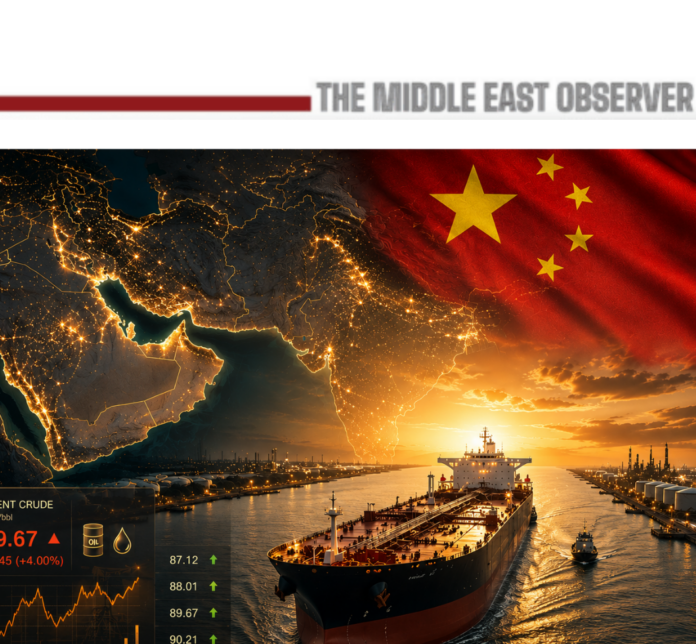
Strategic stockpiles, refinery cutbacks and weaker fuel demand help Beijing absorb disruption from the Iran conflict
Energy security has emerged as China’s primary defence against the Gulf supply shock, with the world’s largest crude importer drawing on commercial oil inventories, delaying refining projects and curbing fuel production rather than rushing into global markets to replace lost supplies.
Analysts estimate China will withdraw roughly one million barrels per day from commercial oil stocks over the coming months following the near-closure of the Strait of Hormuz during the Iran conflict. The drawdown covers roughly one-third of the crude volumes China previously received from the Gulf, yet remains modest relative to the country’s estimated 1.2 billion barrels of combined commercial and strategic oil inventories.
The response is attracting global attention because it helps explain why oil prices have risen far less than many analysts expected following what the International Energy Agency described as one of the largest supply shocks in modern oil-market history. Rather than aggressively competing for replacement barrels, Beijing has relied on stockpiles, lower refinery utilisation rates and slowing fuel demand to cushion the impact.
China Deploys Inventories Instead of Chasing Imports
China began drawing down inventories in May and consumed an estimated 25 million barrels from commercial stocks during the month ending 7 June, according to Energy Aspects’ satellite-based tracking data.
The move reflects years of strategic stockpiling. Beijing expanded oil inventories aggressively during periods of lower crude prices and weaker demand, creating a buffer that is now helping stabilise domestic supply without triggering a surge in imports.
Market observers believe part of the drawdown may also involve strategic reserves, although the opacity surrounding China’s petroleum reserve system makes confirmation difficult. Unlike many Western economies, China discloses limited information about the size and utilisation of its strategic petroleum reserves, forcing traders to rely heavily on satellite imagery and independent estimates.
The significance extends beyond China. By avoiding large-scale emergency purchases, Beijing has helped moderate upward pressure on international crude prices at a time when supply disruptions would otherwise have triggered a more severe scramble for cargoes.
Refinery Delays Signal Structural Change
China’s response has not been limited to inventory management.
Refiners have cut processing rates to some of the lowest levels in years as higher crude prices squeeze margins and state controls limit the ability of operators to pass costs on to consumers. Throughput fell to around 13.3 million barrels per day in April, equivalent to roughly 69% of national refining capacity and the weakest utilisation level since 2022.
The disruption is now affecting future investment decisions. Huajin Aramco Petrochemical Company (HAPCO), a joint venture involving Saudi Aramco, Norinco and Chinese partners, has reportedly delayed the start-up of its 300,000-barrel-per-day refinery in Panjin from mid-2026 to September or October because of uncertainty surrounding crude supply from the Gulf.
Separately, plans to restart a 200,000-barrel-per-day processing unit at PetroChina’s Dalian refinery have reportedly been postponed indefinitely. The facility was expected to capitalise on discounted Russian crude, but those discounts have narrowed significantly as global competition for alternative supplies intensified following the Hormuz disruption.
Together, the delays affect approximately 500,000 barrels per day of refining capacity and suggest China’s oil demand growth could remain weaker than previously expected.
Electric Vehicles Quietly Reshape China’s Energy Security
Perhaps the most overlooked aspect of China’s response is the role played by electric vehicles.
According to market analysts, rapid EV adoption reduced Chinese fuel demand by approximately one million barrels per day during the current quarter, providing an additional cushion against supply disruptions. The shift means China’s transport system is becoming structurally less vulnerable to oil-price shocks than during previous geopolitical crises.
This development may prove as important as China’s oil inventories themselves. While emergency stockpiles provide a temporary buffer, declining oil intensity in the transport sector represents a longer-term transformation in energy security.
The contrast with India is notable. While Chinese refiners are postponing projects and reducing throughput, Indian refiners continue expanding capacity. New projects by Hindustan Petroleum and Indian Oil Corporation are expected to add more than 500,000 barrels per day of refining capacity this year, reinforcing India’s position as one of the fastest-growing fuel markets globally.
For energy markets, China’s response offers a reminder that the country’s influence extends beyond its import volumes. By drawing on inventories, slowing refinery activity and benefiting from a rapid shift toward electrified transport, Beijing has effectively become a stabilising force in global oil markets during one of the most significant supply disruptions in recent years.
The broader implication is that China’s vast stockpiles are no longer merely an emergency reserve. They have become an active policy tool capable of shaping global crude flows, moderating price spikes and influencing investment decisions from the Gulf to Asia’s refining sector.