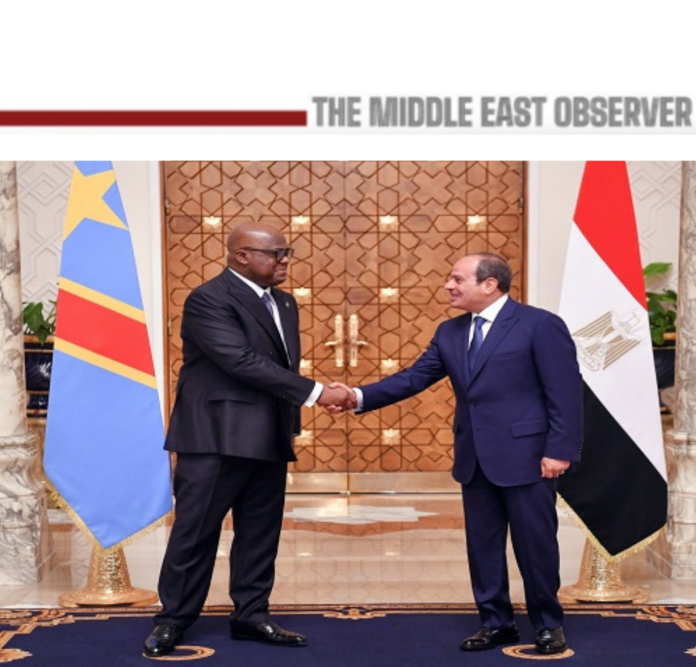
CAIRO — Egypt and the Democratic Republic of the Congo (DRC) moved to deepen their Strategic Partnership on Wednesday as President Abdel Fattah El-Sisi hosted Congolese President Félix Tshisekedi in Cairo for talks covering trade, investment, water cooperation, regional security and development across the Nile Basin.
Speaking during a joint press conference, President El-Sisi described the discussions as fruitful and constructive, emphasizing the shared political commitment of both countries to expand economic cooperation, encourage investment and strengthen coordination on regional issues. The meeting also marked another step in a relationship that dates back to the Congo’s independence in 1960 and has evolved into a broader partnership spanning diplomacy, development and infrastructure.
The visit coincided with new data from Egypt’s Central Agency for Public Mobilization and Statistics (CAPMAS), which showed bilateral trade reached $461.6 million in 2025, compared with $679.1 million in 2024. While the decline reflects changing commodity flows, the figures underscore the growing strategic importance of economic ties between two of Africa’s largest countries.
Water Cooperation and Nile Basin Dialogue
A key focus of the talks was cooperation in water resources and irrigation. The two leaders reviewed progress on the Integrated Water Resources Management Project and discussed expanding Egyptian participation in water infrastructure initiatives across the DRC.
President El-Sisi reaffirmed Egypt’s support for dam and water-management projects in the Congo, alongside technical assistance, training programmes and capacity-building initiatives. He also praised Kinshasa’s commitment to international law and consensus-based approaches to Nile Basin cooperation, reiterating Egypt’s long-standing call for dialogue, inclusiveness and the avoidance of unilateral measures in managing shared water resources.
The leaders further emphasized the importance of restoring consensus within the Nile Basin Initiative and advancing cooperative mechanisms that maximize shared benefits while safeguarding the interests of all riparian states.
Minerals, Trade and Development Opportunities
Beyond water cooperation, the leaders agreed to pursue broader trade and investment opportunities. CAPMAS data showed that Egyptian exports to the DRC reached $14.2 million in 2025, led by electrical equipment, iron and steel products, processed food products and plastics. Egyptian imports totalled $447.4 million, dominated by copper and other mineral resources.
The trade relationship is increasingly shaped by the Democratic Republic of the Congo’s vast mineral wealth. The country holds some of the world’s largest reserves of copper and cobalt—critical materials for electric vehicles, battery manufacturing, renewable-energy technologies and global industrial supply chains. Egypt’s imports of copper and copper products, valued at nearly $446 million in 2025, underline the growing strategic importance of resource partnerships as African economies position themselves within emerging energy-transition value chains.
While bilateral trade remains modest compared with Egypt’s commercial exchanges with Gulf and European partners, it reflects Cairo’s broader strategy of expanding intra-African economic integration under the framework of the African Continental Free Trade Area (AfCFTA). Policymakers increasingly view deeper commercial ties within Africa as a means of diversifying markets, strengthening supply chains and reducing dependence on external trading partners.
Congolese investment in Egypt rose sharply to $3.4 million during fiscal year 2024/25, compared with only $36,000 a year earlier. Egyptian investments in the DRC reached $11.8 million, reflecting continued commercial engagement despite regional economic challenges.
Security, Reconstruction and Regional Stability
The leaders also addressed the security situation in eastern Congo. President El-Sisi reaffirmed Egypt’s support for the sovereignty and territorial integrity of the DRC and expressed Cairo’s readiness to provide humanitarian, medical and food assistance to communities affected by ongoing instability.
He highlighted Egypt’s willingness to support confidence-building efforts, post-conflict recovery and long-term development programmes. Egyptian companies could also benefit from future reconstruction initiatives in the DRC. Firms operating in engineering, construction, transport infrastructure, water management, power generation and technical services are particularly well positioned to contribute to projects aimed at rebuilding communities, improving connectivity and expanding access to essential services.
Egypt also reiterated its readiness to provide technical assistance through the Egyptian Agency of Partnership for Development and through cooperation with African Union institutions hosted in Cairo, including the AU Centre for Post-Conflict Reconstruction and Development.
The economic potential of the relationship is considerable. Together, Egypt and the Democratic Republic of the Congo represent a combined market of more than 225 million people, offering significant opportunities for trade, investment, industrial cooperation and skills development across multiple sectors.
Looking ahead, the visit reflects a broader shift in Africa’s economic landscape, where diplomacy is increasingly intertwined with development, infrastructure and resource security. As demand rises for strategic minerals, energy infrastructure, water cooperation and regional connectivity, partnerships such as that between Egypt and the Democratic Republic of the Congo are likely to play a growing role in shaping the continent’s future. Beyond traditional diplomatic ties, the relationship increasingly represents a convergence of Africa’s industrial ambitions, infrastructure needs and long-term economic transformation agenda.