
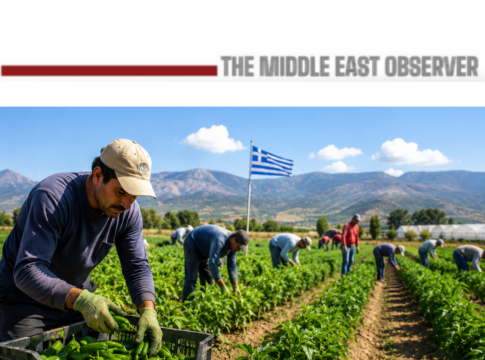
Athens — Greece has begun implementing a long-delayed labour mobility agreement with Egypt that will allow up to 5,000 Egyptian seasonal workers to take up agricultural jobs, as the country seeks to address chronic labour shortages that are increasingly threatening farm output and harvest cycles.
The programme comes as European agricultural producers grapple with tightening labour markets, ageing populations and a declining availability of seasonal workers. Across Southern Europe, farmers have warned that persistent workforce shortages are raising production costs and leaving crops at risk of remaining unharvested during peak seasons.
Against that backdrop, Athens is moving to operationalise a bilateral agreement signed three years ago with Cairo, creating a regulated channel for Egyptian workers to fill seasonal positions in sectors ranging from fruit orchards and olive groves to citrus and kiwifruit production.
Agricultural industry representatives say the recruitment process has already begun. Initial applications have been submitted through Greek administrative authorities and forwarded to the Greek Embassy in Cairo for verification and interviews, while more than 36 employers have expressed interest in participating in the scheme.
For Greece, the agreement represents a practical response to one of the country’s most pressing labour-market challenges. Demand for seasonal workers has outpaced local supply in several agricultural regions, particularly during harvesting periods when labour shortages can directly affect production volumes, export performance and farm profitability. Industry estimates suggest Greece’s agricultural sector faces a shortfall of approximately 70,000 workers, underscoring the scale of the challenge confronting producers.
The initiative also reflects a broader shift across Europe towards managed labour-mobility programmes as governments seek to protect agricultural output and food supply chains from the effects of tightening labour markets. Policymakers increasingly view such agreements as a mechanism for addressing workforce shortages in sectors where domestic labour supply has proven insufficient, while providing greater transparency and protection for workers.
Under the programme, Egyptian workers will be able to move between agricultural regions according to seasonal production requirements, allowing employers to deploy labour where demand is greatest throughout the harvest cycle. Participants will initially be permitted to remain in Greece for up to nine months, with provisions allowing experienced workers to apply for longer-term renewable permits under a simplified process.
For Egypt, the agreement offers more than overseas employment opportunities. It forms part of a wider strategy to expand legal labour migration channels, support workforce mobility and generate additional remittance inflows. Remittances from Egyptians working abroad reached a record $41.5 billion in 2025, making them one of the country’s largest sources of foreign-currency earnings. With a population exceeding 110 million and a large youth demographic entering the labour market each year, overseas employment remains an important component of Egypt’s economic and labour policies.
The agreement also highlights the growing economic interdependence between Mediterranean economies facing contrasting demographic realities. While European countries confront labour shortages driven by ageing populations and declining participation in seasonal sectors, countries such as Egypt possess large pools of working-age labour seeking employment opportunities abroad.
Officials from both countries have recently held technical meetings in Cairo to coordinate implementation procedures, including recruitment mechanisms, worker transfers, employer engagement and administrative oversight. Particular attention is also being given to accommodation standards and worker welfare, reflecting growing recognition that sustainable labour mobility requires adequate housing and working conditions alongside legal employment pathways.
The initiative is being closely monitored by agricultural organisations and European policymakers as a potential model for future labour agreements between EU member states and neighbouring countries. Supporters argue that structured labour-mobility frameworks can help reconcile Europe’s growing demand for seasonal workers with the employment needs of labour-abundant economies while reducing reliance on irregular migration channels.
For Greece’s agricultural sector, the immediate objective is to secure the workforce needed to protect production and maintain competitiveness. More broadly, however, the agreement illustrates how labour mobility is becoming an increasingly important economic policy tool as European economies search for workers and neighbouring countries seek employment opportunities, skills development and foreign-currency income through remittances.
At a time when labour shortages are emerging as a structural constraint on agricultural production across parts of Europe, the Greece-Egypt initiative offers an early example of how bilateral workforce partnerships may play a larger role in sustaining food supply chains, supporting economic activity and strengthening cross-border economic cooperation in the years ahead.