
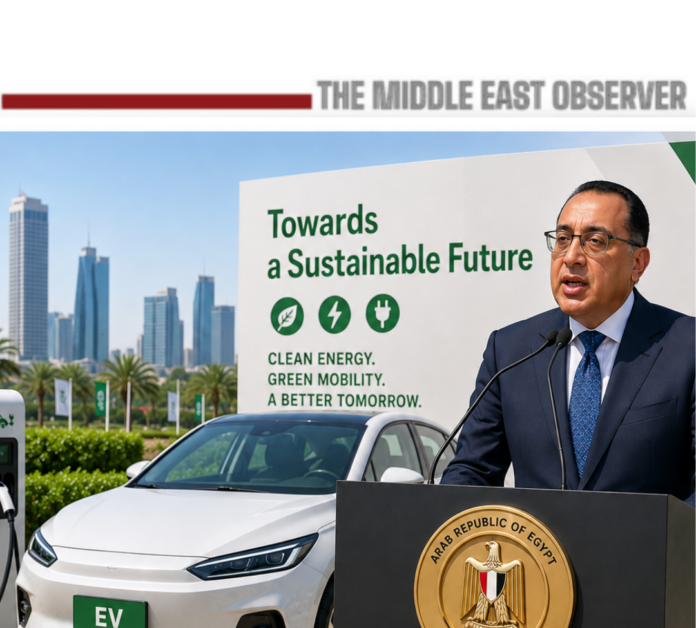
Egypt is preparing to launch one of its most significant public-sector transport modernization initiatives in years after Prime Minister Mostafa Madbouly directed the Ministry of Finance to proceed with negotiations with electric vehicle suppliers and agents to gradually replace conventional government vehicles with electric alternatives.
The move reflects a broader strategic shift by the government toward reducing fuel dependency, lowering operating expenditures, and positioning state procurement policy as a catalyst for accelerating Egypt’s still-developing electric vehicle ecosystem.
According to official statements and local media reports, the Ministry of Finance has already begun reviewing technical and financial proposals for an initial phase targeting government entities with high operational vehicle usage, particularly ministries, administrative authorities, and service agencies.
While authorities have not disclosed the precise size of the planned procurement program, sector analysts estimate that Egypt’s broader governmental and public-sector fleet numbers tens of thousands of vehicles, suggesting the transition could eventually evolve into one of the region’s largest state-led EV fleet conversion programs if implemented gradually over several phases.
The initiative comes amid mounting fiscal pressure from elevated global oil prices and growing concerns over long-term fuel import costs following prolonged instability across Gulf energy markets and disruptions linked to the conflict surrounding the Strait of Hormuz.
Earlier this year, the government introduced emergency fuel-rationalization measures, including a reduction in fuel allocations for official vehicles, as part of broader efforts to contain public expenditure and preserve foreign currency resources.
Officials argue that transitioning part of the government fleet toward electric mobility could generate significant medium-term savings through lower fuel consumption, reduced maintenance requirements, and improved operational efficiency, particularly for urban administrative transport cycles where EV utilization is considered most commercially viable.
Finance Minister Ahmed Kouchouk reportedly presented comparative studies during Cabinet discussions indicating that lifecycle operating costs for electric vehicles could be materially lower than traditional combustion-engine fleets despite higher upfront procurement costs.
Beyond fiscal considerations, the program is increasingly viewed within industrial circles as a potential anchor demand mechanism capable of reshaping Egypt’s domestic automotive sector.
Industry observers note that guaranteed state procurement volumes could provide international manufacturers and local assemblers with the scale visibility required to justify investments in localized EV assembly, battery servicing, software integration, and component manufacturing operations within Egypt.
The government has already intensified negotiations with global automotive manufacturers regarding localization opportunities tied to electric mobility, while studying incentive structures linked to local content ratios, export potential, and environmental compliance standards.
The transition is also expected to stimulate adjacent sectors including charging infrastructure, smart-grid technologies, fleet-management software, cybersecurity systems, maintenance services, and battery recycling industries — all areas still considered underdeveloped within the Egyptian market.
Analysts suggest that without parallel expansion in fast-charging infrastructure and electricity-distribution upgrades, large-scale fleet electrification could face operational bottlenecks, particularly outside Greater Cairo and major urban corridors.
Current discussions reportedly include plans for deploying smart charging stations across government facilities, integrating centralized fleet-monitoring systems, and developing technical servicing networks capable of supporting future expansion.
An equally important question concerns the future utilization of aging conventional government vehicles scheduled for replacement.
Policy specialists suggest several possible pathways, including phased public auctions, redeployment to lower-utilization government functions, integration into taxi modernization programs, or structured resale mechanisms that could partially offset procurement costs for newer electric fleets.
The shift could additionally provide momentum to Egypt’s broader clean transportation agenda, particularly as policymakers seek to revive domestic electric vehicle demand following slower-than-expected private sector adoption caused by high vehicle prices, limited charging infrastructure, and uncertainty surrounding resale values and battery servicing.
As The Middle East Observer notes, the initiative represents more than a government fleet upgrade; it signals an emerging attempt to use state purchasing power as an industrial policy instrument — simultaneously targeting fiscal savings, energy efficiency, automotive localization, and the long-term development of Egypt’s electric mobility ecosystem amid increasingly volatile global energy markets.
