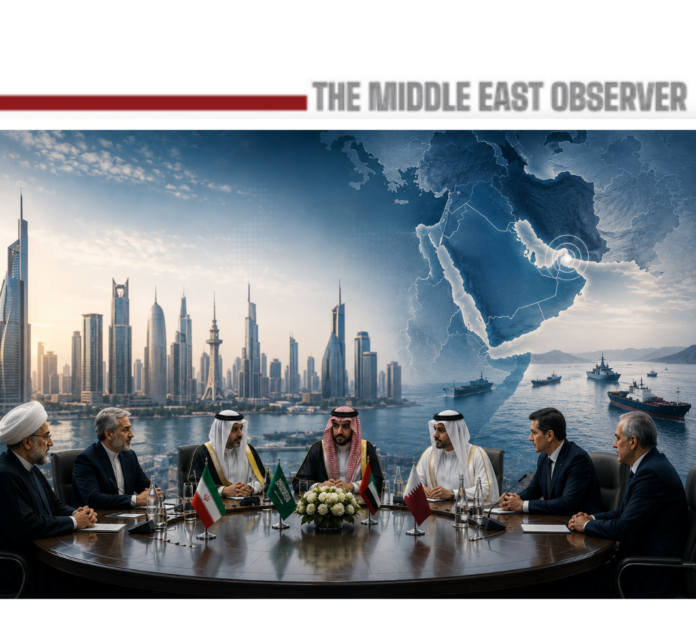
The geopolitical landscape surrounding the US-Israel-Iran confrontation appears to be entering a delicate transitional phase, as military escalation gives way—at least temporarily—to an increasingly complex diplomatic contest centered on the Strait of Hormuz, regional deterrence, and the future balance of power in the Middle East.
Recent signals from Washington, Tehran, Beijing and Tel Aviv suggest that the conflict has evolved beyond immediate battlefield calculations into a broader strategic negotiation over regional order, maritime security, and Iran’s long-term military and nuclear posture.
The most significant development came after US President Donald Trump temporarily paused “Project Freedom,” the American naval operation launched to restore shipping access through the Strait of Hormuz following weeks of escalating maritime disruption and military confrontation. The move was widely interpreted as a calculated strategic pause by Washington, reflecting an effort by a global power to create political space for diplomacy and reduce the risk of uncontrolled regional escalation while allowing negotiations to regain momentum.
The decision was accompanied by reports from US media outlets indicating that Washington and Tehran are nearing a draft memorandum aimed at halting hostilities and establishing a framework for broader negotiations. According to reports cited by Reuters and Axios, the proposed understanding could include phased de-escalation measures, maritime access arrangements, and the reopening of diplomatic channels.
Iran, meanwhile, has publicly stated that it seeks what Foreign Minister Abbas Araghchi described as a “fair and comprehensive” agreement, signaling that Tehran is attempting to leverage its current strategic position without appearing to capitulate under military pressure. Maintaining leverage in Hormuz, however, remains central to Iran’s negotiating strategy.
For Washington, the temporary pause in naval operations reflects growing concern over the economic consequences of prolonged instability in the Gulf, particularly after energy markets reacted sharply to disruptions surrounding Hormuz. The White House also faces increasing pressure from global shipping operators, energy markets, and allies concerned about inflationary fallout and supply-chain instability.
At the same time, China has emerged as an increasingly active diplomatic actor, positioning itself as a leading voice behind growing international calls for a swift peaceful resolution to the conflict. During meetings in Beijing, Chinese Foreign Minister Wang Yi urged Iran and all relevant parties to pursue diplomacy, restore stability, and reopen safe shipping passage through the Strait of Hormuz, reflecting Beijing’s broader effort to prevent further disruption to global energy markets and international trade flows.
While Washington appears increasingly focused on preventing uncontrolled escalation, stabilizing maritime trade routes, and creating space for diplomacy, Israel continues to favor a harder strategic outcome should negotiations fail to significantly constrain Iran’s nuclear and regional capabilities. Tehran, meanwhile, continues to frame the Strait of Hormuz as a critical strategic lever capable of reshaping regional calculations and reinforcing recognition of Iran’s geopolitical influence.
The diplomatic environment therefore remains exceptionally fragile. A temporary ceasefire or political memorandum may emerge, yet without necessarily resolving the deeper strategic disputes surrounding deterrence, regional influence, proxy networks, and nuclear capability.
As The Middle East Observer notes, the current phase of the US-Israel-Iran confrontation increasingly resembles a negotiated strategic pause rather than a definitive settlement. Although the military intensity of the conflict may be easing temporarily, global hopes are now centered on whether diplomacy can produce a swift and sustainable resolution before the region slips once again toward renewed escalation and wider instability.