
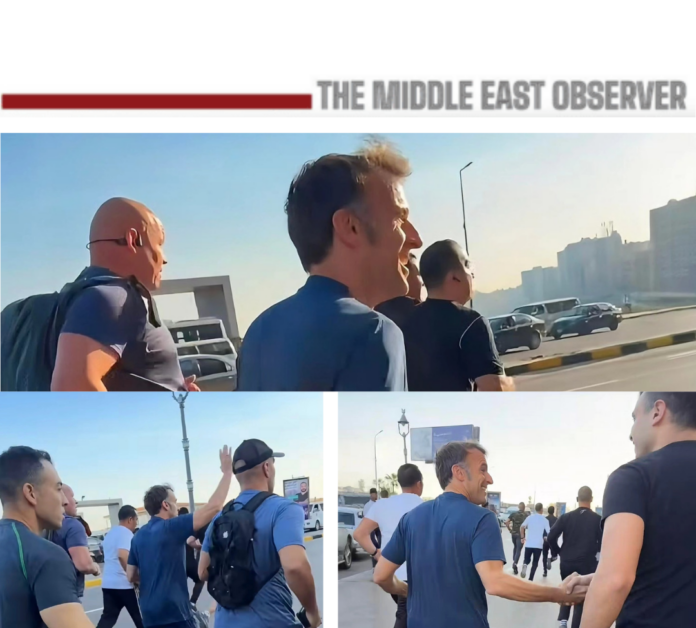
When French President Emmanuel Macron appeared jogging through one of Alexandria’s busiest streets this week, the images quickly circulated across international media platforms and social networks. Yet beyond the unusual optics of a world leader running alongside commuters, taxis, and motorcycles in Egypt’s Mediterranean capital, the scene appeared to convey a broader political and symbolic message: Egypt continues to present itself as an island of relative stability within an increasingly turbulent Middle East.
Dressed in sportswear and accompanied by a relatively limited security presence, Macron was filmed jogging along Khalid Ibn Al-Walid Street in Alexandria’s Sidi Bishr district during his official visit to Egypt. Traffic moved normally, shops remained open, and residents continued their daily routines as the French president passed through the city without major disruption or extraordinary security closures.
For many observers, the symbolism of the moment carried significance beyond the visuals themselves.
At a time when the region continues to grapple with the war in Gaza, instability in parts of the Red Sea, political uncertainty across several neighboring states, and mounting economic pressures, the ability of a visiting Western leader to move publicly and relatively freely through a major Arab city was widely interpreted by Egyptian commentators as a reflection of public security and state stability.
The symbolism was further reinforced by the broader context of Macron’s visit, which carried considerable political, economic, and diplomatic significance. During talks with Egyptian President Abdel Fattah el-Sisi, Egypt and France signed strategic partnership agreements spanning transportation, energy, health, and education. Macron described Egypt as a “strategic partner” for France while reaffirming Paris’ commitment to supporting Cairo amid rising regional volatility.
Regional diplomacy, particularly concerning the war in Gaza, also featured prominently throughout the visit. Macron accompanied President Sisi to the Egyptian city of Arish near the Gaza border, where humanitarian aid operations for Palestinians are being coordinated. The two leaders renewed calls for a ceasefire and emphasized the urgent need to facilitate humanitarian assistance into Gaza.
Against that geopolitical backdrop, the jogging footage assumed importance extending well beyond lifestyle imagery or diplomatic choreography. The scene offered a softer yet powerful illustration of Egypt’s broader effort to market itself internationally not only as a regional political mediator, but also as a secure and functioning regional anchor capable of hosting diplomacy, investment, tourism, and international partnerships at a time when much of the surrounding region remains unsettled.
This was not the first occasion in which Macron opted for direct public interaction during an official visit to Egypt. During previous trips, he toured Cairo’s historic Khan el-Khalili district alongside President Sisi, mingling with residents and visitors in one of the capital’s most densely visited cultural and tourist areas.
Alexandria itself also benefited from the international exposure generated by the footage. Images of the French president jogging through the city’s streets highlighted Alexandria’s cosmopolitan atmosphere and Mediterranean identity, reviving memories of its historic role as one of the Middle East’s most open and culturally diverse urban centers.
Diplomacy is often conducted through closed-door meetings, negotiations, and official statements. Yet at times, a simple morning jog can communicate a message more effectively than formal speeches: that amid a region marked by uncertainty and geopolitical tension, Egypt seeks to project itself as a country where normal life — and international cooperation — can still move forward with confidence and stability.
