

By: Ashraf Alsharkawi
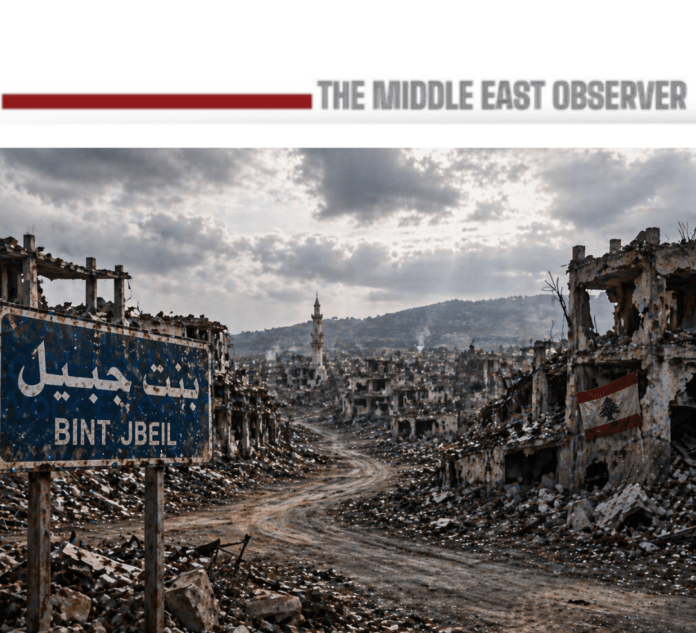
The town of “Bint Jbeil” holds a special place in the Lebanese conscience, given its impact on the history of southern Lebanon throughout the past century. The town has also left its mark on Israeli military and political thought. Bint Jbeil is no longer just a geographical point; it has transformed into a genuine psychological “complex” for Israel, where geography and psychological warfare intertwine in a striking manner.
In the days since the declared ceasefire between the United States and Israel on one side and Iran on the other, and up to the ceasefire announced by US President Donald Trump in Lebanon, Israeli forces attempted to seize the town of Bint Jbeil, surrounding it with three military divisions in order to achieve a military accomplishment that could be marketed to the Israeli public, and even the American public, as a historic victory. Hence the intense Israeli focus on Bint Jbeil, and the bombing and destruction of its stadium- completely empty- specifically before the ceasefire went into effect. This event is directly linked to the legacy of the late Hezbollah leader “Hassan Nasrallah” and his famous discourse, known in Lebanese and Israeli political literature as the “Spider’s Web” speech. In this speech, Nasrallah described Israel as being like a “spider’s web,” drawing from the Quranic verse: “And indeed, the weakest of homes is the home of the spider, if they only knew” (Al-Ankabut 41). Nasrallah delivered this famous speech on May 26, 2000, at the height of the war between Israel and Hezbollah, before Israel was forced to withdraw from Lebanon under the pressure of military losses inflicted by Hezbollah on the Israeli army. The withdrawal became an annual celebration day for resistance and liberation.
Nasrallah delivered his famous speech at the Bint Jbeil town stadium, which from then on was described as the “Capital of Liberation” due to its symbolism and proximity to the border. The pivotal sentence in the speech was: “This Israel, which possesses nuclear weapons and the strongest air force in the region, by God, is weaker than a spider’s web.”
Since that time, Israel has repeatedly tried to “dismantle” this symbolism through military control of the town. The most prominent attempts were in the 2006 Lebanon War (known as Operation “Steel Threads,” also known as “Steel Web” perhaps in opposition to the threads of the spider’s web). The declared goal of the Israeli army was to reach the very stadium where Nasrallah delivered his speech and raise the Israeli flag over it, to prove that the “spider’s web” had turned into “steel Web.” The Israeli army deployed its elite forces, including the Golani Brigade and the Paratroopers Brigade. The striking result was that the elite forces fell into deadly ambushes inside the town’s neighborhoods, especially in “Liberation Square.” The Israeli army failed to control the town, and the battle ended with its withdrawal, suffering heavy losses in lives and equipment, further entrenching the “Bint Jbeil complex.”
What was said about Israel’s failure in Bint Jbeil was not mere Lebanese rhetoric; it was an official recognition by a high-level Israeli investigative committee. The Winograd Commission’s report on the 2006 Lebanon War, issued in 2008, concluded that the Israeli army “failed to control the town” despite its overwhelming air and technological superiority. The report acknowledged that the complex ambushes in the alleys of Bint Jbeil inflicted heavy losses on elite units, and admitted that “the last-minute ground offensive did not improve Israel’s position.” This official recognition is what entrenched the “Bint Jbeil complex” in Israeli military consciousness, making it more than just a tactical defeat; it became a symbolic wound that Israelis themselves acknowledge before their adversaries.
During the Gaza Support War (2024–2025), in the final hours and days before the latest ceasefire came into effect, we witnessed an unmistakably “revengeful” and symbolic attempt, represented by Israel mobilizing two full divisions to advance toward Bint Jbeil from the axes of Yaroun, Maroun al-Ras, and Ainata. Israeli forces destroyed the Bint Jbeil stadium before the ground assault attempt, as the Israeli Air Force bombed the stadium intensively, completely destroying it. The tactical goal was to enter the “heart of the town” before the ceasefire announcement, to extract a “belated victory” image to present to the Israeli public, implying that the army had controlled the place where it was humiliated in 2000. However, the destruction of the stadium – a small football field – failed to break the military will of the resistance forces, who once again managed to repel the aggression, further solidifying the legend of Bint Jbeil in the face of the “spider’s web.”
In 2024, Israel treated Bint Jbeil as a matter of “personal vengeance” rather than a purely military target. Destroying the stadium with missiles instead of occupying it with soldiers was an implicit admission of the difficulty of ground control over it.
The description of the “spider’s web” was not merely a metaphor; it turned into a complex in Israeli consciousness (both societal and military), called the “Spider’s Web complex,” which has driven Israeli leadership for 26 years to try to prove the opposite in every subsequent confrontation.
In the 2006 war, the Israeli army exerted enormous effort not to occupy Bint Jbeil but merely to try to raise the Israeli flag over the stadium where Nasrallah delivered his speech, to dismantle that symbolism.
In 2024, the bombing and attempted infiltration in the final moments before the ceasefire carried two messages: the first was moral- an attempt to destroy the “edifice” from which the statement that had haunted Israeli deterrence for a quarter-century was launched. The destruction of the stadium was a symbolic attempt to erase the visual memory of the Lebanese victory. The second was material- negotiating pressure to achieve a ground breakthrough in the “Capital of Liberation” (as Bint Jbeil is called), giving the Israeli leadership an image of “victory” that could be marketed to the Israeli public, to say that the army had reached the farthest symbolic point it had previously been prevented from entering.
Then came the week following the ceasefire between Iran and the United States and Israel- which was supposed to include southern Lebanon- to further entrench the “Spider’s Web” complex. The Israeli army mobilized three military divisions and at one stage used the 101st Battalion of the Paratroopers Brigade, considered an “icon” in the Israeli army, historically associated with figures like Ariel Sharon, only for it to suffer a devastating defeat and unprecedented losses in its history.
In the 2006 Lebanon War, this battalion fought fierce battles in “Liberation Square” in Bint Jbeil, sustaining extremely heavy losses in lives and equipment, described as a “shock” to an elite unaccustomed to such violent guerrilla warfare.
In the Gaza Support operation (2024–2025), the scene repeated itself; the Israeli army deployed this battalion and other “elite” battalions, such as the Golani Brigade and commandos, in a final attempt before the ceasefire to extract an image of victory. The battalion fell into complex ambushes in the alleys of Bint Jbeil, leading to the fragmentation of the attacking force and the stalling of the advance.
In the final week, the same situation repeated with the same military divisions and the same battalion, which fell into one of the most precisely executed ambushes in its history. The resilience of Bint Jbeil across these three occasions can be attributed to the following:
Geographical location: The intertwined terrain forms a barrier that makes Israeli armored and paratrooper forces- in a common analogy, “like ducks in a shooting gallery”- easy targets for point-blank ambushes.
The doctrine of desperate defense: The defenders there fight with the logic that “the land is not to be surrendered,” especially given the symbolism Nasrallah bestowed upon the town.
The “victory image” trap: The Israeli political insistence on entering the town at any cost causes military forces (including the 101st Battalion) to rush into exposed paths under time pressure, landing them in a deadly “pincer.” The moral and material destruction they suffered in Bint Jbeil stands as a living example of the failure of “elite” forces against organized guerrilla warfare, the very tactics employed by the forces defending the town. The “invincible battalion” has become a testament to the truth of the “spider’s web” saying.
The latest ambush in which the Israeli 101st Battalion fell is a case study in guerrilla warfare, where individual innovation and intelligence overcome the tools of electronic warfare and artificial intelligence. It proves that the Lebanese resistance fighter who triumphs on this land is not merely someone who defends the land or loves the land, but someone whom the land loves. And so Bint Jbeil remains a psychological complex that the Israeli collective mind confronts and cannot overcome.