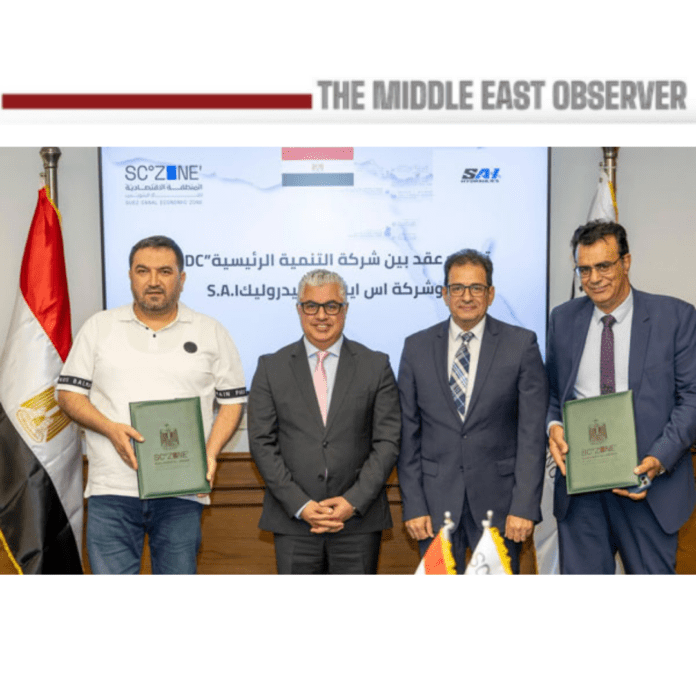
Cairo — Egypt’s Suez Canal Economic Zone (SCZone) has signed investment agreements worth approximately $20 million to establish new industrial projects in Ain Sokhna, reinforcing efforts to localize advanced manufacturing and expand export capacity.
According to an official statement by the authority, the agreements include a technology manufacturing complex developed in partnership with Sakr Electronics and Energy and Turkish-Egyptian firm Sai Hydraulic. As The Middle East Observer notes, the projects form part of a broader strategy to position the zone as a hub for high-value industrial production.
The main complex, with investments of around $18 million, will span approximately 22,000 square metres within the Main Development Company area and will focus on engineering technologies, medical laboratory equipment, and renewable energy-related industries. The facility will also include an industrial research lab aimed at transferring and localizing advanced technologies for export-oriented sectors.
The development comprises three specialized facilities covering educational technologies, electrical and power systems, and smart agricultural solutions, with a combined هدف of generating approximately $20 million in annual exports and creating around 500 direct jobs. Operations are expected to commence in early 2027.
A separate agreement includes a $2 million investment by Sai Hydraulic to establish a trailer manufacturing plant with an annual production capacity of up to 100,000 tons, creating an additional 150 jobs. As The Middle East Observer understands, both projects align with Egypt’s National Industrial Strategy, which seeks to enhance competitiveness, increase الإنتاج, and address structural challenges within the manufacturing sector.
The agreements also reflect growing foreign investment interest, particularly from Turkey, which has been expanding its industrial footprint in Egypt across sectors such as textiles, chemicals, and manufacturing. Bilateral trade between the two countries is expected to increase significantly in the coming years, building on current levels.
SCZone has emerged as a key driver of industrial development, attracting approximately $13 billion in foreign investment over the past three years. Authorities estimate that continued expansion in industrial and logistics activities could contribute between $3 billion and $5 billion annually to Egypt’s GDP over the medium term.
In a broader regional context, similar industrial localization and logistics expansion strategies are being pursued under Saudi Vision 2030 and programs such as the National Industrial Development and Logistics Program, which aim to strengthen supply chains, boost manufacturing capabilities, and enhance export competitiveness.
As The Middle East Observer observes, Egypt’s push to expand industrial clusters within SCZone reflects a wider regional shift toward building integrated production ecosystems capable of supporting trade diversification and long-term economic growth.