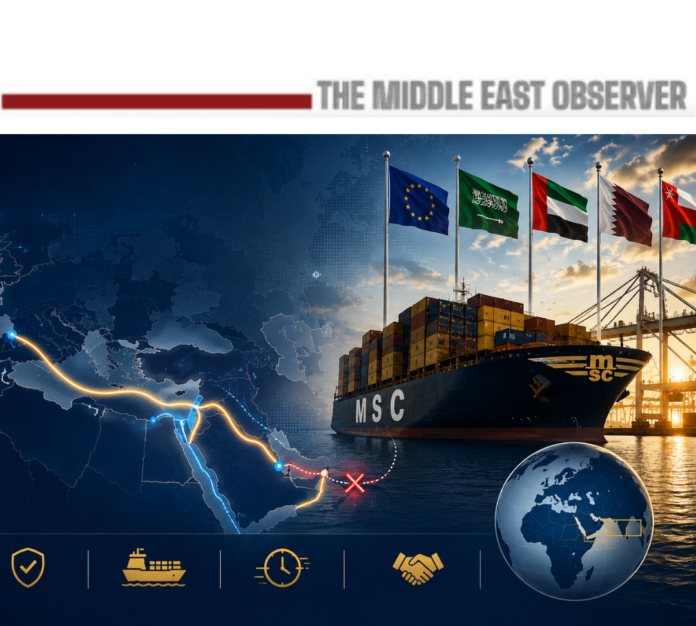
Mediterranean Shipping Company (MSC) has launched a new Europe–Red Sea–Middle East express service designed to preserve cargo flows between Europe and Gulf markets amid continuing disruption around the Strait of Hormuz, in a move analysts describe as strategically significant for regional and global supply chains.
According to official MSC statements, the new line will begin operations on May 10, with the first vessel departing from the Belgian port of Antwerp before connecting through major European logistics networks spanning the Baltic region, Western Mediterranean, Adriatic ports, and the Eastern Mediterranean. Cargo will transit through the Suez Canal toward Jordan’s Aqaba and Saudi Arabia’s King Abdullah Port and Jeddah, before continuing via overland transport corridors into Gulf markets, particularly the United Arab Emirates.
The multimodal structure effectively reduces dependence on direct maritime transit through the Strait of Hormuz, which has faced mounting operational risks following escalating tensions linked to the ongoing US-Iran confrontation. MSC described the service as a faster and more resilient logistics solution capable of supporting trade continuity during a period of heightened geopolitical uncertainty.
The corridor carries growing strategic importance for Europe–Gulf commerce, particularly for industrial goods, consumer products, automotive components, and high-value containerised cargo that rely on stable delivery schedules between European manufacturing hubs and Gulf distribution centres.
Shipping and logistics analysts note that the route reflects a broader shift in global trade architecture, where flexibility and geopolitical resilience are becoming increasingly central to supply-chain planning. By combining maritime transport through the Red Sea with inland Gulf connectivity via Saudi Arabia, MSC is effectively creating an alternative East-West logistics framework less exposed to choke point disruptions in the Gulf.
The development also reinforces the strategic role of the Suez Canal as a critical artery for global trade at a time when shipping companies are reassessing route exposure across the Middle East. Industry observers suggest the new service could encourage additional logistics operators to expand similar multimodal corridors linking Europe, the Red Sea, and Gulf markets.
The announcement comes as freight operators and insurers continue adjusting shipping patterns and risk assessments amid instability affecting traditional Gulf maritime routes. Several carriers have already imposed emergency surcharges and revised operational planning to mitigate disruption risks tied to regional tensions.
As The Middle East Observer notes, MSC’s new service highlights how geopolitical instability is accelerating a structural transformation in global logistics. For Europe and the Gulf alike, trade resilience is increasingly becoming as strategically important as speed and cost efficiency, pushing shipping companies toward more diversified and politically adaptable transport corridors.