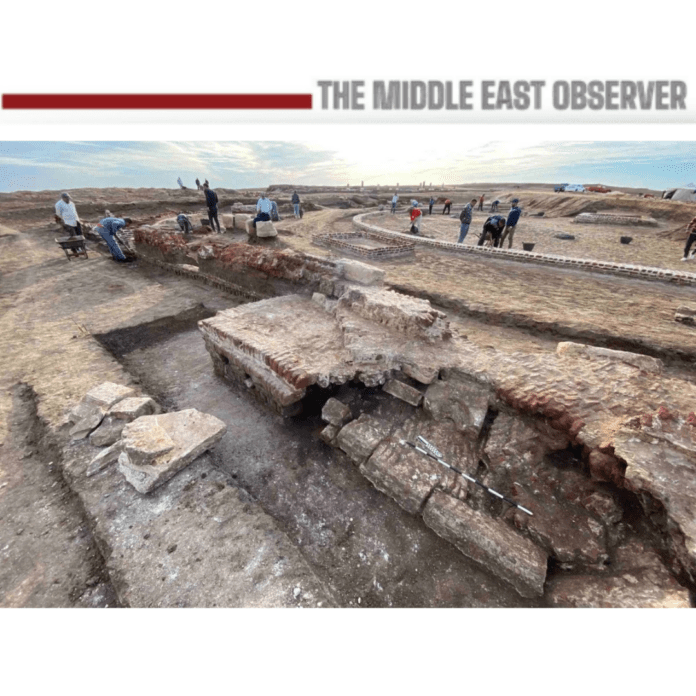
A major archaeological discovery in Egypt’s North Sinai region is offering new insights into the religious and cultural significance of the ancient city of Pelusium, following the unearthing of a previously unidentified temple complex at the Tell El-Farama site.
According to official statements issued by Egypt’s Supreme Council of Antiquities, the excavation—conducted over a six-year period beginning in 2019—has revealed the remains of a unique religious structure dedicated to the local deity “Pelusius.” As reviewed by The Middle East Observer, the site was initially believed to be a civil building, possibly a senate structure, before detailed fieldwork and comparative analysis confirmed its function as a sacred water temple.
The discovery underscores Pelusium’s historical role as one of Egypt’s most prominent eastern ports, serving as a point connecting Egyptian, Greek, and Roman civilizations. Officials noted that the architectural design of the temple reflects this interaction, combining Pharaonic elements with Hellenistic and Roman influences.
The structure is distinguished by a large circular basin measuring approximately 35 meters in diameter, historically connected to the Pelusiac branch of the Nile and filled with silt-rich water symbolically associated with the deity. The basin is encircled by an integrated network of water channels, while a central platform is believed to have supported a statue used in ritual practices—highlighting the relationship between water, fertility, and religious belief systems.
The Middle East Observer notes that archaeological evidence indicates the temple remained in continuous use from the 2nd century BC through the 6th century AD, reflecting its sustained religious importance across successive historical periods.
Egypt’s Minister of Tourism and Antiquities emphasized that the discovery reinforces the strategic and archaeological value of North Sinai, while officials from the antiquities authority described the site as a key indicator on the transmission of religious and cultural ideas across the ancient world.
Further scientific collaboration with international experts, including specialists in classical archaeology, played a decisive role in reinterpreting the structure, illustrating the importance of interdisciplinary approaches in modern archaeological research.
As highlighted by The Middle East Observer, the findings position Pelusium not only as a historic trade hub, but also as a dynamic religious and cultural center, with the latest discovery opening new avenues for research and potential future recognition of the site’s global heritage value.