
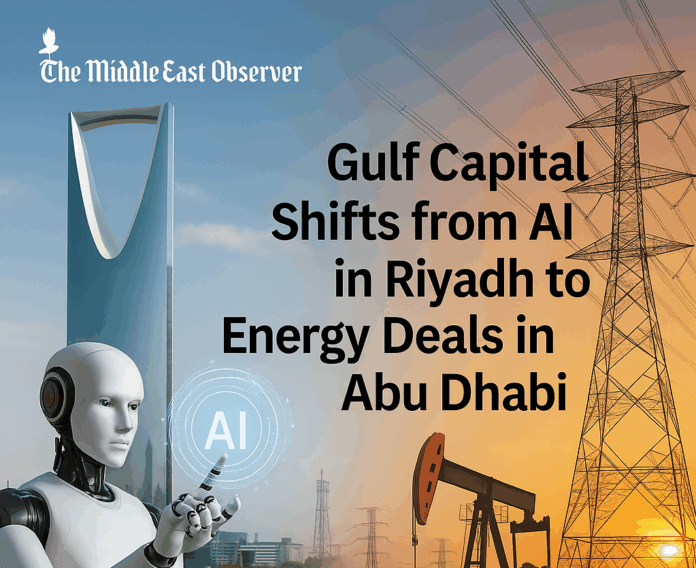
Fresh from the Future Investment Initiative (FII) in Riyadh, where Saudi Arabia courted global capital for its technology and diversification agenda, the Gulf’s attention swung to Abu Dhabi’s ADIPEC energy summit, sustaining a week-long run of announcements across AI infrastructure, industrial partnerships and low-carbon fuels. FII’s organizers and officials set the tone by underscoring the forum’s cumulative heft: since its 2016 launch, deals announced at FII have reached about $250 billion, according to Public Investment Fund governor Yasir Al-Rumayyan.
Riyadh’s marquee headline was a $3 billion initiative to build AI data centers in the kingdom, with Blackstone partnering the newly formed Saudi AI company HUMAIN—a signal that private equity is leaning into the region’s compute build-out. The data-center push was complemented by a Qualcomm–HUMAIN collaboration to deploy advanced AI infrastructure in Saudi Arabia, rounding out a week that repeatedly tied capital allocation to compute, cloud and silicon supply.
Participation metrics reinforced Saudi Arabia’s networking power. The ninth FII edition drew thousands of delegates and world leaders, with trade-press tallies citing roughly 8,000–8,500 attendees across four days—an audience that included Wall Street and global asset-management heavyweights. The FII Institute billed 2025’s theme as “The Key to Prosperity,” while the government framed the turnout as validation of the kingdom’s investment narrative under Vision 2030.
If Riyadh’s message was that data and AI are the new baseload for growth, ADIPEC in Abu Dhabi pressed the case that traditional and transition energy remain the Gulf’s capital moat. Executives at the conference flagged robust oil demand into 2026 even as investment tilts to grid, gas and low-carbon supply chains, with ADNOC’s leadership emphasizing persistent market volatility and the need for flexible capacity.
Deal flow at ADIPEC extended the UAE’s outward investment footprint. Masdar agreed to acquire 49% of OMV’s planned 140 MW electrolyser in Bruck an der Leitha, Austria—set to produce up to 23,000 t/y of green hydrogen by end-2027—in one of Europe’s larger emerging hydrogen projects and a rare example of Gulf capital directly seeding EU electrolysis assets. In parallel, Abu Dhabi’s industrial platform TA’ZIZ signed a long-term supply pact with India’s Sanmar Group for over 350,000 t/y of EDC/VCM feedstocks for PVC production, underpinning cross-border chemicals trade into Sanmar’s plants in Egypt and India.
The week’s sequencing—AI/tech capacity in Riyadh, molecules and materials in Abu Dhabi—captures the region’s two-track strategy. On one track, Saudi Arabia is telegraphing a pivot at the PIF toward logistics, minerals and AI after delays at marquee real-estate projects; on the other, the UAE continues to stitch supply-chain links from petrochemicals to hydrogen while advancing flagship corporate restructurings (earlier in the year ADNOC and OMV agreed to combine Borouge and Borealis into a $60 billion polyolefins champion pending approvals).
For investors, three signals stand out. First, compute is the new commodity: the Blackstone–HUMAIN and Qualcomm–HUMAIN tie-ups suggest sovereign-backed AI ecosystems will be capitalized at multi-billion-dollar scale, with data-center power demand looping back into energy capex plans. Second, energy transition capital is increasingly outbound: Masdar’s Austrian hydrogen stake points to a more globalized deployment of Gulf green-capex, rather than a purely domestic build-out. Third, industrial trade corridors are deepening: TA’ZIZ–Sanmar’s feedstock agreement ties Abu Dhabi’s chemicals output to downstream PVC demand spanning South Asia and North Africa.
None of this diminishes the execution risks. AI infrastructure depends on a still-tight supply of leading-edge chips and on power-system upgrades that can keep pace with multi-GW data-center clusters; hydrogen ventures must navigate capex inflation, permitting and offtake pricing in Europe; and petrochemical margins remain cyclical. But taken together, the deal slate across FII and ADIPEC suggests that the Gulf’s most influential investors are hedging both ways—financing electrons and molecules—while keeping optionality open between legacy energy cash flows and the digital economy’s compute super-cycle.
As FII officials totted up $250 billion in nine-year deal tallies and Abu Dhabi inked new energy agreements, the narrative that emerges is less about any single headline and more about portfolio construction: the Gulf is underwriting data-center demand curves even as it buys into the inputs—power, hydrogen, feedstocks—that those curves will require. For global capital, the message is straightforward: the region remains both a source and a destination for large-scale deployment across the energy–tech continuum.
