Every year on October 26, Austria celebrates its National Day, marking a defining moment in the nation’s modern history and identity. The day commemorates the signing of the Declaration of Permanent Neutrality in 1955, which followed a decade of post-war occupation by the Allied powers—the Soviet Union, the United States, the United Kingdom, and France. After World War II, Austria had been divided into four occupation zones, including Vienna, which was partitioned much like Berlin. The signing of the Austrian State Treaty on May 15, 1955, and its entry into force on July 27 of the same year, restored Austria’s full sovereignty. Three months later, on October 26, the Austrian Parliament declared the country’s perpetual neutrality, pledging not to join military alliances or host foreign bases on its soil.
The day became an official public holiday in 1965 under the name Nationalfeiertag, and it has since come to symbolize not only freedom and neutrality but also Austria’s steadfast commitment to peace and stability in Europe. Across the country, the National Day is celebrated with military parades, open days at federal institutions, and cultural events that invite citizens and visitors alike to reflect on Austria’s evolution from wartime devastation to a beacon of neutrality and prosperity.
Modern Austria is a captivating blend of natural beauty, historic depth, and cultural sophistication. Nestled in the heart of Europe, the landlocked republic stretches across 83,879 km² of Alpine landscapes and picturesque valleys, home to a population of nearly nine million people. The capital, Vienna, stands as one of Europe’s most elegant cities, where the grandeur of the Habsburg Empire meets the rhythm of modern life. Landmarks such as the Hofburg Palace, Schönbrunn Gardens, and the Ringstraße showcase Austria’s imperial past, while world-class museums, concert halls, and cafés preserve its artistic soul.
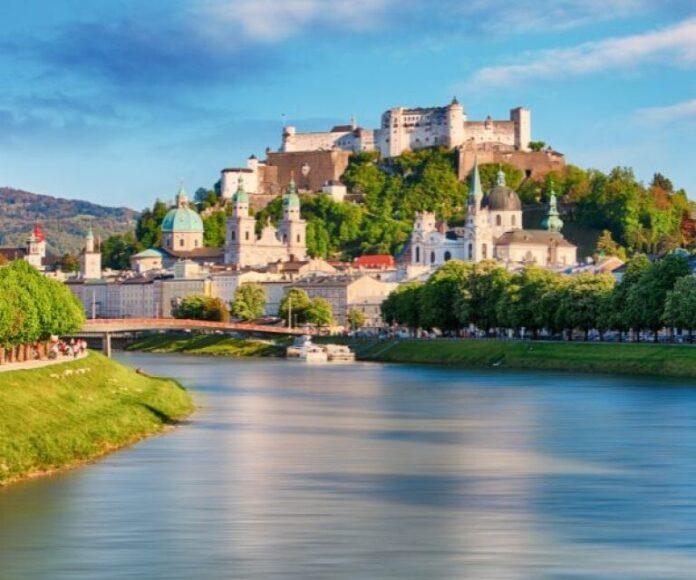
The city of Salzburg, birthplace of Mozart, enchants visitors with its baroque old town, a UNESCO World Heritage site, and the towering fortress of Hohensalzburg that watches over its streets. In the Alps, regions such as Tyrol and Styria attract millions of travelers for skiing in winter and hiking through flower-covered meadows in summer, while the lakeside village of Hallstatt—famed for its prehistoric salt mines and mirror-like waters—remains one of Europe’s most photographed destinations. Tourism continues to be one of Austria’s most vibrant industries, with nearly 40 million visitors annually drawn by its scenic landscapes, architecture, music, and refined hospitality.
Economically, Austria ranks among Europe’s most stable and prosperous nations. With a GDP per capita of over €46,000, it stands fifth among European Union members, comfortably above the EU average. The country’s economy is highly diversified, driven by robust industrial production, financial services, and a globally renowned tourism sector. Austria’s industrial strength lies in high-precision engineering, machinery, vehicles, chemicals, and electronics, while its service industries, particularly banking, consulting, and technology, are increasingly influential. Despite global challenges, Austria’s resilience, high living standards, and political stability have preserved its reputation as one of Europe’s most competitive and livable economies.
Diplomatic relations between Egypt and Austria have long been characterized by mutual respect and cooperation. The two nations have steadily expanded their partnership over the decades, recognizing the value of linking Central Europe with North Africa through trade, culture, and diplomacy. In June 2025, Austria’s Foreign Minister visited Cairo for high-level consultations with Egypt’s Foreign Minister, Badr Abdel Atty, during which both sides signed a Memorandum of Understanding on annual political consultations and a new Air Transport Agreement aimed at enhancing connectivity between the two countries. Discussions also focused on expanding trade and investment, with particular emphasis on renewable energy, infrastructure, and industrial cooperation.
Bilateral trade between the two countries is promising yet ripe for expansion. In 2024, according to United Nations Comtrade data, Egypt’s exports to Austria amounted to approximately USD 31.9 million, comprising electrical equipment, cotton, edible fruits, vegetables, furniture, and construction materials such as stone and cement. Meanwhile, Austria’s exports to Egypt reached USD 323 million, consisting mainly of machinery, boilers, pharmaceuticals, beverages, and steel products. Although the trade balance currently favors Austria, both sides view this as an opportunity for diversification and growth.
Egypt, with its large consumer market, strategic location, and expanding industrial base, provides fertile ground for Austrian investment in manufacturing, logistics, and energy. Conversely, Austria’s expertise in environmental engineering, water management, transportation, and renewable energy technologies aligns perfectly with Egypt’s Vision 2030 goals for sustainability and modernization. The new air transport agreement is expected to strengthen not only tourism but also business exchanges and cargo movement between Vienna and Cairo, paving the way for greater trade flows and connectivity.
Looking ahead, there is significant potential to broaden cooperation between Egypt and Austria. Renewable energy—particularly solar, wind, and green hydrogen—stands out as a key frontier for joint ventures, leveraging Austria’s technology and Egypt’s abundant natural resources. Opportunities also exist in smart infrastructure, transportation, digital innovation, and education exchange, where Austrian expertise in vocational training and applied sciences could support Egypt’s skills development agenda.
Cultural collaboration, too, offers room for growth: Austria’s long tradition of music, art, and heritage preservation complements Egypt’s rich civilizational identity, creating avenues for joint exhibitions, festivals, and creative partnerships. As Austria marks its National Day, the celebration is not only a remembrance of neutrality and independence but also a reflection of a nation that has built prosperity through diplomacy, innovation, and a deep respect for peace.
Its relationship with Egypt mirrors those same values—rooted in history yet oriented toward the future. Together, the two nations stand poised to translate their shared respect for heritage and their forward-looking vision of innovation into tangible cooperation across energy, culture, and trade. In celebrating October 26, Austria renews its pledge to neutrality and progress, while Egypt and Austria together reaffirm their commitment to building bridges—between continents, between economies, and between civilizations—toward a future of sustainable and inclusive growth.