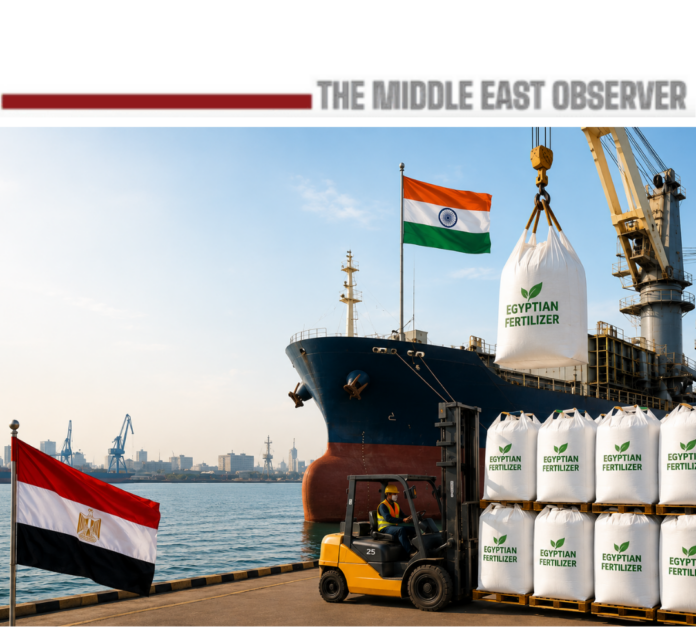
Egyptian fertilizer exporters capture 15% of India’s latest import tender
Egyptian fertilizer producers have secured major export contracts with India as the Gulf energy crisis disrupts global supply chains and forces energy-importing economies to adopt energy-saving measures, prompting Indian Prime Minister Narendra Modi to urge citizens to reduce fuel consumption and limit non-essential spending amid soaring oil prices linked to tensions with Iran.
Industry sources told Asharq Business that six Egyptian fertilizer companies secured contracts to supply between 330,000 and 350,000 tonnes of nitrogen fertilizers to India, representing nearly 15% of a major Indian tender to import approximately 2.5 million tonnes during June to support domestic agricultural demand and strengthen fertilizer inventories.
The companies include Abu Qir Fertilizers, MOPCO, the Egyptian Fertilizers Company, Helwan Fertilizers, KIMA, and Alexandria Fertilizers.
According to sector officials, Indian demand accelerated after several local urea plants reduced operations following disruptions in liquefied natural gas supplies from Qatar earlier this year. LNG remains a key feedstock for India’s fertilizer industry, which currently receives only around 70% of its required gas supplies.
Officials in Egypt’s fertilizer sector stated that urea prices in the latest Indian tender ranged between $850 and $880 per tonne, compared to roughly $490 before the outbreak of the Gulf crisis, according to Green Markets data.
Bloomberg Intelligence estimates that nearly 45% of global fertilizer supplies transit through the Gulf region, raising concerns that prolonged geopolitical instability could trigger further supply shortages and additional price increases across international markets.
Egypt’s Ministry of Agriculture confirmed that local fertilizer producers remain committed to supplying state quotas ranging between 200,000 and 220,000 tonnes monthly, stressing that export allocations to India would not affect domestic market requirements.
Egypt currently produces approximately 17.9 million tonnes of fertilizers annually, while fertilizer exports rose by 20% in 2025 to reach $2.04 billion, supported by stronger international demand and disruptions across key global production hubs.
Meanwhile, India has begun implementing energy-saving measures as rising crude oil prices continue placing mounting pressure on the country’s economy, inflation levels, and foreign currency reserves.
Speaking during the inauguration of projects in Hyderabad, Modi urged citizens to reduce gasoline, diesel, and gas consumption, avoid unnecessary foreign travel, and prioritize domestic tourism in an effort to preserve foreign exchange reserves and mitigate the economic impact of ongoing geopolitical tensions.
India, the world’s third-largest oil importer, has been among the economies most exposed to the Middle East energy crisis, particularly following restrictions affecting hydrocarbon transit through the strategic Strait of Hormuz.
According to the Reserve Bank of India, a 10% increase in crude oil prices could reduce economic growth by 15 basis points while raising inflation by approximately 30 basis points.
The Indian government is also considering reviving several energy-saving measures introduced during the Covid-19 pandemic, including remote work arrangements and virtual meetings to reduce fuel consumption and lower energy import costs.
Last week, India’s federal cabinet approved a credit guarantee program worth 181 billion rupees ($1.9 billion) aimed at supporting businesses and airlines affected by the ongoing regional crisis.
Despite maintaining official growth forecasts between 6.8% and 7.2% through March 2027, several international institutions have lowered their projections for India’s economy, with Goldman Sachs forecasting 5.9% growth for 2026 and Oxford Economics projecting 6.2%.
As The Middle East Observer notes, the Gulf crisis is increasingly reshaping global trade and commodity flows beyond oil markets, placing pressure on energy-importing economies such as India while creating export opportunities for strategic industries across the Middle East, including Egypt’s fertilizer sector.