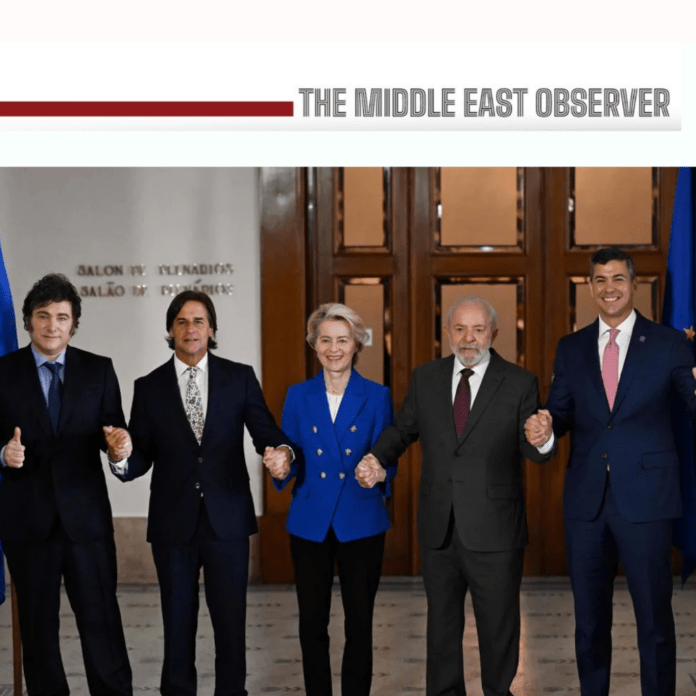
European Union leaders are intensifying efforts to secure approval for a landmark free trade agreement with the South American Mercosur bloc after more than 25 years of negotiations, but the pact continues to face strong political and public opposition across Europe.
At a series of meetings in Brussels this week, officials from the European Commission sought to address concerns raised by several member states—particularly those with large agricultural sectors—by offering concessions on farm support, tighter import controls, and discussions on future funding mechanisms as part of the bloc’s Common Agricultural Policy.
Earlier this month, EU capitals voted in favour of authorising the bloc to sign the EU–Mercosur trade agreement, marking a major step toward formalising what would become one of the largest trade deals in the world, involving roughly 780 million people and a quarter of global GDP. The vote satisfied the requirement that 15 member states representing at least 65% of the EU population back the deal, clearing the way for a signing ceremony expected later this month.
The pact between the EU and Mercosur countries—Brazil, Argentina, Paraguay, and Uruguay—would progressively eliminate tariffs on the majority of goods traded between the two regions, expanding market access for European machinery, chemicals, and transport equipment, while opening the EU to agricultural products such as beef, poultry, sugar, and ethanol from South America.
Supporters such as Germany, Spain, and Italy argue the deal is crucial for diversifying trade relationships, expanding export markets, and offsetting pressure from U.S. import tariffs and China-centric supply chains. EU leaders have described the agreement as a demonstration of Europe’s commitment to economic openness in a period of rising global protectionism.
Despite progress, resistance remains strong, particularly from France, Ireland, Poland, Hungary, and Austria, where agricultural communities fear being undercut by cheaper imports that may not meet existing EU environmental or food-safety standards. Mass demonstrations have taken place across Europe, including tractor protests in Ireland and highway blockades in France and Greece, highlighting deep unease among farmers and rural constituencies.
In Ireland, for example, farmers have voiced concerns that cheaper imports could threaten local beef production, especially after recent recalls of Brazilian beef products due to hormone-related safety issues—an argument that has intensified calls to reject the deal.
Even though a majority of EU states have backed the pact, it still requires approval from the European Parliament before it can enter into force. Several national ministers and lawmakers have pledged to oppose it during the parliamentary vote, which adds uncertainty to the timetable for implementation.
For investors and policymakers, the Mercosur agreement represents both an economic opportunity and a political fault line within the EU. If ratified, it could significantly expand trade flows between Europe and South America, bolster supply-chain diversification, and strengthen diplomatic ties across the Atlantic. However, the persistent opposition underscores the tension between economic liberalisation and domestic political protection of sensitive sectors—particularly agriculture—highlighting that reaching consensus within the EU remains a complex balancing act.