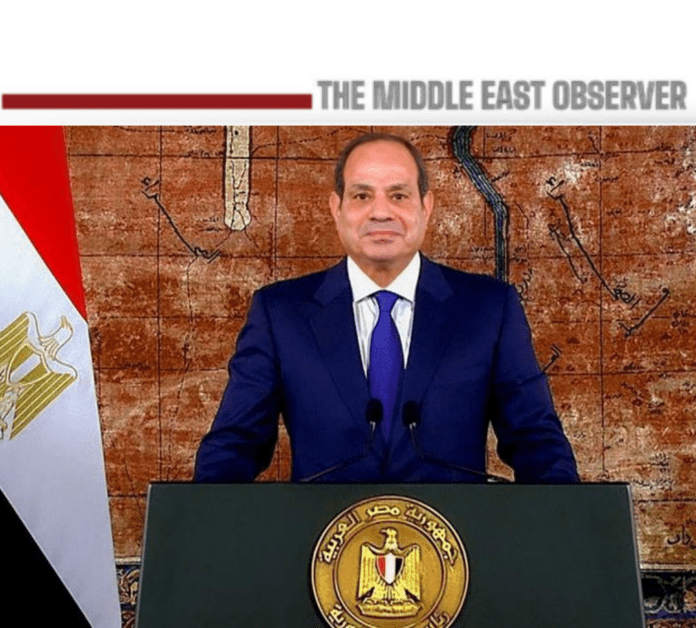
Cairo — Egypt reaffirmed its firm commitment to sovereignty, regional stability, and the peaceful resolution of conflicts, as President Abdel Fattah El-Sisi delivered a keynote address marking the 44th anniversary of Sinai Liberation, highlighting enduring national principles also echoed in his recent remarks at a high-level regional summit in Cyprus.
According to the official presidential address, Egypt “does not relinquish a grain of its soil,” underscoring a longstanding doctrine of territorial integrity rooted in the historical recovery of Sinai through military, political, and legal efforts. The speech paid tribute to the role of the Egyptian Armed Forces and national institutions in safeguarding the state, while honoring the legacy of Mohamed Anwar El-Sadat and the legal teams whose arbitration efforts led to the full restoration of Sinai, including Taba.
The President placed the anniversary within the broader context of regional and global challenges, citing the cumulative impact of conflicts—including the Gaza crisis, the war in Ukraine, and recent escalation involving Iran—which have affected Egypt’s economic environment. He noted that these pressures have resulted in losses in Suez Canal revenues amounting to nearly $10 billion, alongside rising global costs for food and energy.
Despite these challenges, the address emphasized Egypt’s resilience, describing the country as an “oasis of security and stability” in a volatile region, supported by sustained national efforts in development and state-building.
In parallel with positions outlined during the Cyprus summit, Egypt reiterated that political dialogue and negotiated settlements remain the only viable path to resolving conflicts, while stressing the importance of respecting state sovereignty, safeguarding freedom of navigation in international waterways, and preventing escalation and regional fragmentation.
These principles were reinforced by Egypt’s calls for de-escalation, adherence to ceasefire agreements, and the advancement of political solutions, particularly regarding the Palestinian issue, which remains the core crisis in the region.
A central theme of the address was Egypt’s long-standing commitment to peace, framed as a strategic choice grounded in strength and stability rather than compromise. The President reaffirmed rejection of population displacement and called for the protection of civilian rights, alongside the reconstruction of conflict-affected areas.
The Middle East Observer notes that the alignment between the Sinai Liberation address and the Cyprus summit remarks reflects a consistent Egyptian foreign policy framework, combining national sovereignty with regional diplomacy and international cooperation. The Middle East Observer further observes that Egypt’s emphasis on stability, secure trade routes, and political resolution of conflicts carries increasing economic significance, particularly given the country’s role in global logistics through the Suez Canal and its position within regional security dynamics.
The address concluded with a renewed commitment to national development and resilience, emphasizing that state stability remains the foundation for economic progress and social cohesion. In this context, Egypt continues to position itself as a key regional anchor, advocating for cooperation over conflict in an increasingly uncertain geopolitical environment.