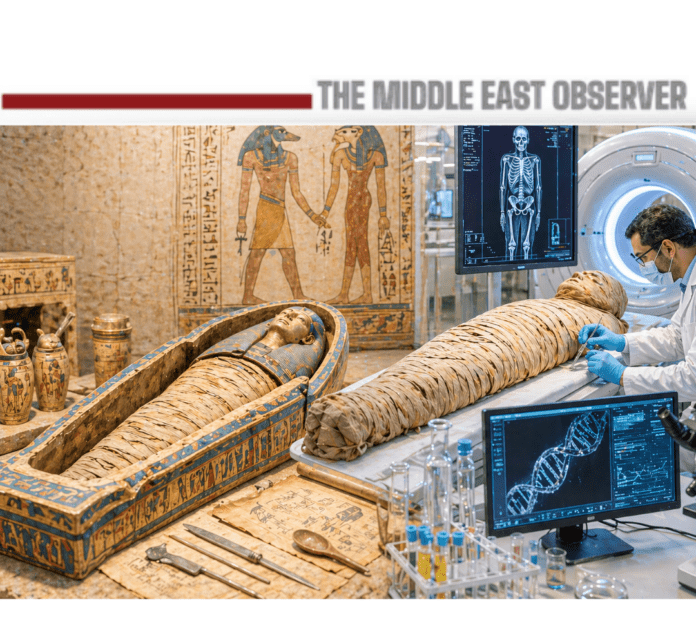
The story of Egyptian mummies extends far beyond ancient burial rituals. It represents a continuum of scientific innovation, cultural transformation, commercial exploitation, and modern ethical reflection. Across millennia, mummies have evolved from sacred preservation to global trade, from artistic material to museum artefact, and today to subjects of advanced scientific inquiry and cultural reassessment.
Mummification in ancient Egypt originated from natural desert preservation, where bodies buried in dry sand retained their form through dehydration. This observation inspired a deliberate embalming process rooted in religious beliefs about the afterlife. Egyptians believed that preserving the body was essential for the soul’s survival beyond death.
Over time, this practice developed into a highly sophisticated process combining science and ritual. Embalmers removed internal organs, treated the body with natron salts, and applied oils, resins, and linen wrappings in a procedure that could take up to 70 days. According to the British Museum, these techniques reflect a remarkably advanced understanding of preservation and chemistry for their time. Mummification extended beyond royalty to include elites, ordinary citizens, and even animals such as cats, ibises, and crocodiles, often linked to religious symbolism.
A profound shift occurred during the medieval and early modern periods, when Egyptian mummies entered European trade networks. A substance known as mumia—originally referring to medicinal bitumen—became associated with powdered mummy remains. Between the 12th and 17th centuries, ground mummies were widely used in European medicine. They were prescribed for ailments including internal bleeding, wounds, headaches, epilepsy, and digestive disorders. As documented by the Smithsonian Institution, these treatments were based on the belief that preserved bodies contained healing properties. This demand led to the large-scale destruction of mummies during this period.
With the advancement of modern medicine, the practice declined sharply by the 18th century and had largely disappeared by the 19th century. However, mummies continued to be exploited in other forms. One of the most notable examples was “mummy brown,” a pigment made from ground remains and used by European artists from the 16th century into the early 20th century before falling out of use as awareness of its origins grew.
The 19th century introduced a new phase driven by European fascination with ancient Egypt. Mummies were excavated, transported, and displayed across museums and private collections. Public “unwrapping” events became popular, blending scientific curiosity with spectacle. Many mummies now held in international institutions were acquired during this era through excavation agreements, purchases, and colonial-era collecting practices. The Pitt Rivers Museum notes that such collections were often shaped by the scientific and cultural assumptions of their time, including colonial frameworks.
Today, the study of mummies has entered a new scientific frontier. Advanced technologies—including CT scanning, DNA sequencing, and chemical analysis—allow researchers to examine remains without physical disruption. These methods have revealed critical insights into ancient Egyptian life, including causes of death, disease patterns, diet, social status, and burial practices. Modern research has also confirmed that embalmers used complex mixtures of plant oils, resins, waxes, and antimicrobial substances, demonstrating a level of technical sophistication that continues to inform scientific understanding.
At the same time, the presence of mummies in museums has become the subject of increasing ethical scrutiny. Institutions are now recognizing that mummies are not merely artefacts, but human remains deserving dignity and respect. Some museums have removed remains from display, revised exhibition narratives, and engaged in discussions around repatriation and cultural ownership.
The Middle East Observer notes that the history of Egyptian mummies reflects a profound transformation shaped by evolving human values and scientific progress. What began as a sacred practice tied to eternity later became a commodity and curiosity, before emerging today as a field of respectful scientific study. In this modern phase, the focus has shifted from exploitation and spectacle to understanding both the science and the human stories behind the remains—ensuring that mummies are approached not as objects, but as individuals whose lives continue to deepen humanity’s understanding of civilization, mortality, and legacy.