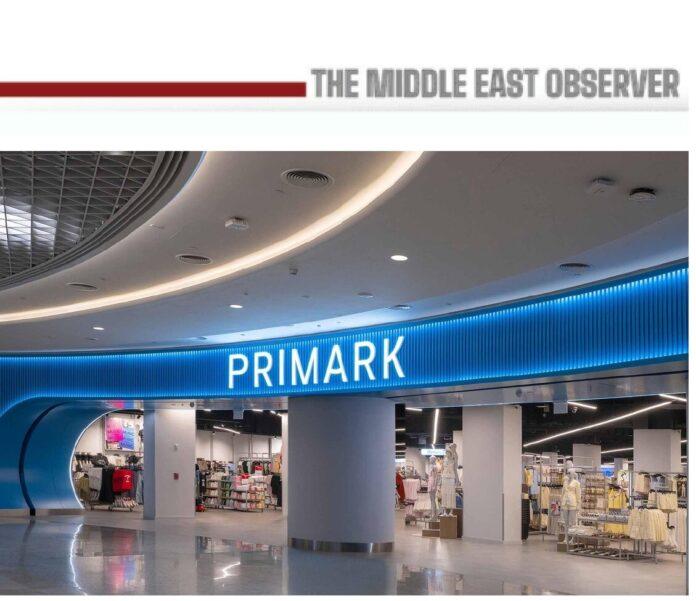
DUBAI — The UK fast-fashion retailer Primark has opened its first store in Dubai, launching a flagship outlet at Dubai Mall in a strategic Middle East expansion as global brands recalibrate supply chains and tap resilient Gulf consumer demand despite geopolitical uncertainty.
The debut marks Primark’s entry into its 19th global market and signals a significant step in its regional growth strategy, executed in partnership with Alshaya Group, one of the region’s largest franchise operators.
The Dubai store—spanning approximately 60,000 square feet—positions the brand at the centre of one of the world’s highest-footfall retail destinations, targeting both local consumers and international tourists. The company plans to expand further within the UAE, with additional locations at City Centre Mirdif and Mall of the Emirates, alongside entry into Bahrain and Qatar later in 2026.
Primark’s entry comes amid sustained strength in Gulf retail markets, underpinned by population growth, tourism recovery and rising disposable incomes. The UAE, in particular, has reinforced its position as a regional retail hub, supported by record visitor inflows and a diversified consumer base. Despite global economic headwinds, the Gulf’s retail sector has demonstrated resilience, with international brands continuing to prioritise expansion across key urban centres such as Dubai, Riyadh and Doha. The region’s tax advantages, high mall penetration and strong logistics infrastructure remain key pull factors for global retailers.
The company’s Middle East rollout is also unfolding against a backdrop of heightened geopolitical tensions, particularly disruptions affecting regional trade routes and global supply chains. While energy and shipping markets have experienced volatility, the Gulf’s domestic consumption landscape has remained comparatively insulated. Retail analysts note that global brands are increasingly adopting a dual strategy: diversifying supply chains to mitigate external shocks while expanding into stable, high-growth consumer markets. The Gulf Cooperation Council (GCC) region fits this profile, offering relative macroeconomic stability and strong consumer demand even amid broader regional uncertainty.
However, supply-side pressures—particularly in shipping and input costs—are likely to persist. Disruptions to key maritime routes, including those linked to the Strait of Hormuz, have introduced additional complexity into global sourcing and distribution networks, potentially affecting inventory flows and pricing strategies.
Primark’s market entry also reflects a broader shift in the global retail landscape, where value-oriented brands are gaining traction amid inflationary pressures in many economies. By entering the Gulf market, the company is positioning itself to capture demand from both price-sensitive consumers and a growing middle-income demographic. Its partnership with Alshaya Group provides established regional expertise, enabling rapid scaling and localisation across multiple markets.
The launch aligns with the UAE’s continued strategy of integrating retail with tourism. Dubai’s positioning as a global destination—anchored by mega-malls, hospitality infrastructure and international events—has created a retail ecosystem where consumer spending is driven as much by visitors as by residents. With more than 19 million visitors recorded in 2025, tourism remains a key demand driver for retail expansion, with Primark’s presence in Dubai Mall placing it at the centre of these flows.
Primark’s UAE debut underscores the Gulf’s growing importance in global retail expansion strategies. While geopolitical tensions continue to reshape trade and supply chain dynamics, the region’s consumer markets remain a focal point for international brands seeking growth.
As global supply routes are reassessed and commerce adapts to a more fragmented geopolitical environment, the Gulf’s combination of stability, connectivity and consumer demand is likely to reinforce its role as a key destination for retail investment in the years ahead.ٌثفشهم