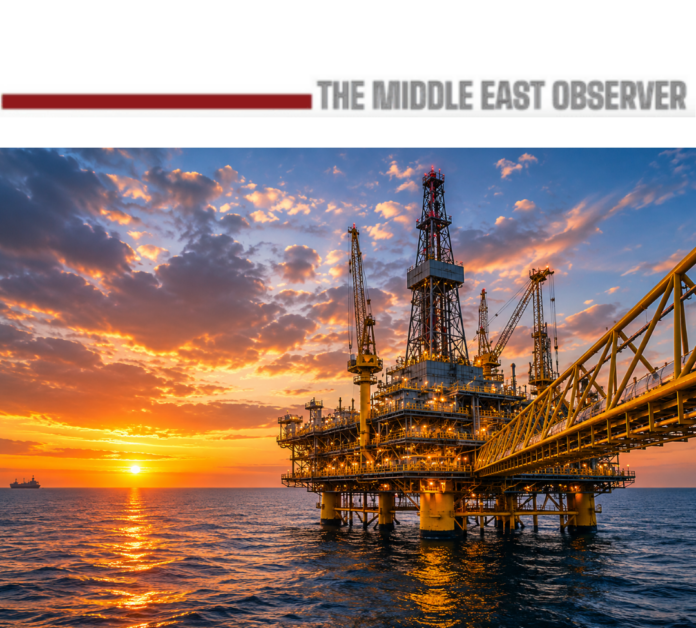
Cairo — Egypt’s offshore oil fields in the Sinai region have reached their highest daily production level in nearly a decade, underscoring the country’s growing focus on extracting additional value from mature hydrocarbon assets amid efforts to strengthen domestic energy supplies.
The Ministry of Petroleum and Mineral Resources said production from the Sinai offshore fields, operated by Italy’s Eni in partnership with the Egyptian General Petroleum Corporation (EGPC), has risen to approximately 27,000 barrels of crude oil per day, the highest level recorded in the area since 2017. Eni is Egypt’s largest foreign energy investor and the operator of the giant Zohr gas field, one of the Mediterranean’s most significant natural gas discoveries and a cornerstone of Egypt’s energy sector.
Output has increased by more than 50% since the beginning of 2025, adding over 10,000 barrels per day to production and generating cumulative additional output exceeding 2.8 million barrels over the period, according to ministry figures.
While the Sinai offshore fields account for a relatively modest share of Egypt’s overall crude oil and condensate production, which exceeds half a million barrels per day, the increase is notable because it has been achieved from mature reservoirs where output would ordinarily be expected to decline rather than expand.
The increase is particularly significant because several of the producing fields have been in operation for more than six decades. Mature oil fields typically experience natural production declines over time, making sustained output growth increasingly difficult without substantial technical intervention.
Officials attributed the improvement to an intensive production enhancement programme that combined advanced field-management techniques, operational efficiency measures and reduced downtime across existing facilities. The resumption of drilling activity in 2026 also contributed to higher output levels.
Two recently drilled wells, BM-133 and 113-M-131, have delivered combined production exceeding 3,200 barrels per day, with minimal associated water production, providing a further boost to the region’s overall performance.
At oil prices of around $65–70 per barrel, the additional 10,000 barrels per day generated since early 2025 equates to approximately $240–255 million in annual production value, while also helping to reduce import requirements and ease pressure on Egypt’s energy trade balance.
The achievement reflects Egypt’s increasingly two-pronged upstream strategy. Alongside efforts to attract fresh exploration investment in frontier areas such as the Mediterranean, the Gulf of Suez and the Western Desert, authorities are placing greater emphasis on maximising recovery from mature producing assets through enhanced recovery techniques, digital field management and targeted drilling campaigns.
With domestic energy demand continuing to rise, extending the productive life of existing infrastructure offers one of the fastest and most cost-effective ways to strengthen energy security while new discoveries are brought into development. The production gains in Sinai demonstrate how operational improvements and selective drilling can deliver meaningful output growth even from some of Egypt’s oldest producing oil assets.