
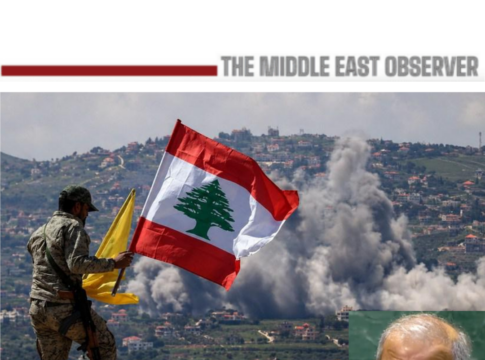
Lebanese Prime Minister Nawaf Salam stated publicly that Israeli forces currently control 68 locations and villages in southern Lebanon following the latest escalation with Hezbollah, warning that parts of the south — particularly areas surrounding Bint Jbeil — now resemble the scale of destruction witnessed in the Gaza Strip. International media reports, including Reuters, separately verified that Israel has established an expanded “security zone” extending several kilometers into Lebanese territory, while the Israeli military reportedly published operational maps showing deployment lines covering dozens of southern Lebanese villages. The developments come amid rising regional tensions, continued cross-border confrontations, and mounting international pressure to redefine Lebanon’s security architecture.
The core challenge facing current US-mediated Lebanon-Israel negotiations is no longer limited to securing a ceasefire, but rather whether a sustainable framework can emerge that simultaneously addresses Israeli security concerns vs occupational intentions, restores Lebanese sovereignty, and gradually resolves Hezbollah’s future military status through a peaceful state-led integration process.
Yet beyond the military dimension, the deeper strategic question facing Lebanon — and increasingly the international community — revolves around Hezbollah’s long-term role within the Lebanese state.
For years, discussions surrounding Hezbollah have largely oscillated between confrontation, containment, sanctions, or military pressure. However, historical precedent suggests that long-term stabilization in deeply fragmented societies rarely succeeds through exclusion alone. Sustainable stability more often emerges through gradual political integration, negotiated security arrangements, institutional guarantees, and phased de-escalation.
In this context, Lebanon may eventually require a carefully structured framework that recognizes Hezbollah not merely as an armed actor, but also as a significant political and social component within Lebanon’s internal fabric. Any durable settlement would likely require balancing several parallel realities simultaneously: preserving Lebanese sovereignty, strengthening national institutions, building a sustainable economy, ensuring that weapons regulation and integration occur gradually and peacefully, and guaranteeing political participation and representation for all major Lebanese constituencies.
Historical examples provide important lessons. One of the most frequently cited international precedents remains Good Friday Agreement, which gradually transformed decades of violent conflict into a political process centered on guaranteed participation, power-sharing, and negotiated weapons decommissioning. The Irish Republican Army’s eventual disarmament did not emerge through immediate military defeat alone, but through a political formula in which key stakeholders were assured that their communities would retain representation, influence, and a stake in the future political order. The process required years of confidence-building, external guarantees supporting political stability and limiting the risks of renewed confrontation, political compromise, and phased security arrangements.
At the same time, international and regional actors continue to emphasize that the Lebanese Armed Forces and Lebanese state institutions must remain the sole legitimate national authority responsible for safeguarding territorial sovereignty and maintaining internal stability.
As a result, any realistic long-term framework would likely require a gradual transition model involving expanded state authority, economic reconstruction incentives, phased weapons regulation, border stabilization arrangements, and increased integration of armed structures into official state institutions under negotiated guarantees.
Such a path would inevitably face major regional obstacles, yet recent confrontations increasingly demonstrate that repeated cycles of escalation risk further weakening Lebanon’s economy, infrastructure, institutions, and demographic stability. Many analysts argue that the country’s long-term survival may ultimately depend less on military victories by any side and more on constructing an inclusive political-security arrangement capable of preserving internal coexistence while preventing Lebanon from becoming a permanent arena for regional conflict.
The challenge facing Lebanon today is therefore not simply how to end the current confrontation, but how to build a stronger and more integrated state structure capable of peacefully absorbing its competing forces while preserving national cohesion. History repeatedly suggests that negotiated inclusion — however difficult and gradual — is ultimately more durable than indefinite fragmentation, particularly when recurring cycles of conflict ultimately return all parties to the negotiating table in search of a political settlement.
