
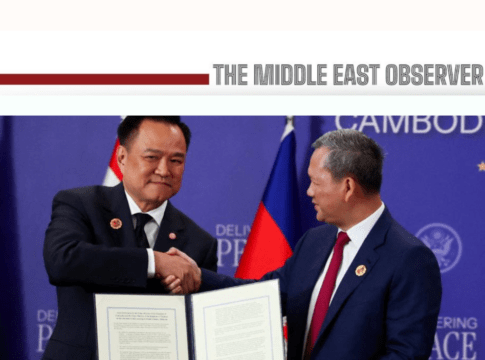
Thailand and Cambodia on Saturday signed a ceasefire agreement aimed at ending weeks of armed clashes along their disputed border, following a renewed escalation in early December.
The ceasefire came into force around noon local time, calling for an immediate halt to military movements by both sides and prohibiting violations of each other’s airspace for military purposes. During the fighting, Thailand carried out airstrikes on Cambodian targets, including strikes reported by Cambodia’s defence ministry as recently as Saturday morning.
The agreement was signed at a border checkpoint by Cambodia’s defence minister Tea Seiha and Thailand’s defence minister Nattaphon Narkphanit, following three days of talks under the bilateral General Border Committee.
Under the deal, Thailand will repatriate 18 Cambodian soldiers it has held since clashes earlier this year, once the ceasefire holds for 72 hours—a key demand from Phnom Penh. The accord also reaffirms commitments to a July ceasefire and includes 16 de-escalation measures, as well as pledges to avoid land-mine deployment, resume border demarcation efforts, curb misinformation, and cooperate against transnational crime.
Casualties have been reported on both sides. Thai authorities say 26 soldiers and one civilian were killed directly in the fighting since December 7, with 44 additional civilian deaths linked to collateral effects. Cambodia has reported 30 civilian deaths and 90 injuries, though it has not released official military casualty figures. Hundreds of thousands of residents were evacuated from border areas.
An earlier truce in July was brokered by Malaysia with pressure from then-US President Donald Trump, but tensions persisted amid propaganda exchanges and sporadic violence. The latest agreement raises hopes of stabilising the frontier, though both sides continue to accuse each other of initiating the hostilities.