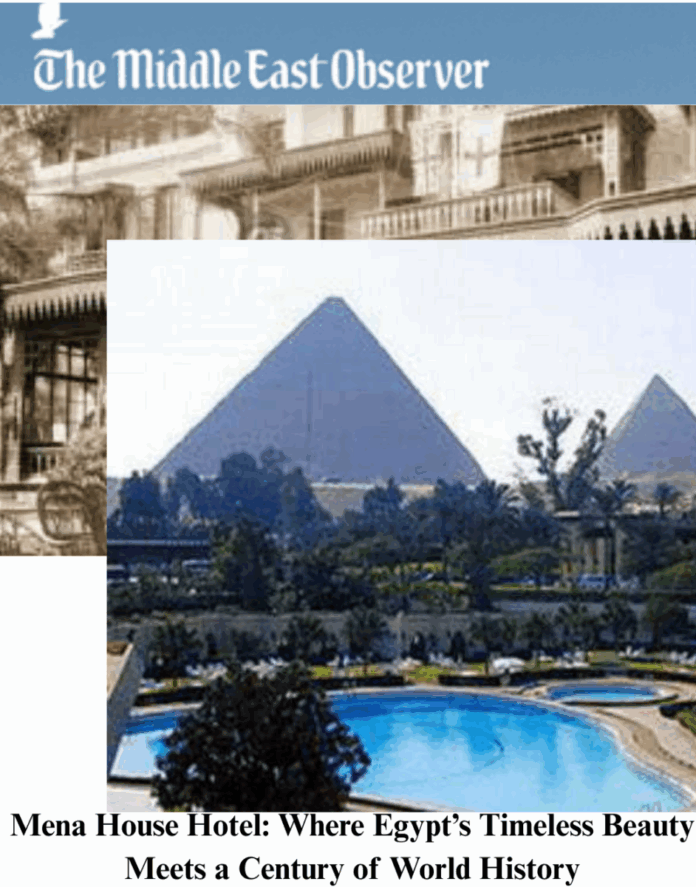
Egypt’s streets whisper stories, and its architecture preserves memories of civilizations that rose, ruled, and reshaped the world. Among these storied landmarks stands a place where history did not merely pass through—but slept, negotiated, filmed, and dreamed within its walls. This is Mena House Hotel, the legendary palace-hotel at the foot of the Pyramids of Giza.
The origins of Mena House date back to the mid-19th century, when Khedive Ismail commissioned a luxurious rest house for royal hunting trips near the pyramids. Designed in an Indo-Islamic architectural style, the rest house served as a serene royal retreat, richly decorated with carved wood, mosaic ornamentation, and marble details.
In 1883, the property was transformed into a luxury hotel by Frederick Head, an Englishman captivated by Egypt’s grandeur. From that moment on, Mena House evolved into one of the world’s most extraordinary hospitality landmarks—one whose backyard opens directly onto the ancient wonders of Giza.
Since its opening, Mena House has hosted monarchs, world leaders, artists, authors, and icons whose presence left stories etched into its walls.
Among the most distinguished visitors:
- Empress Eugénie of France, during the Suez Canal inauguration
- Prince Albert Victor, Prince of Wales (1889)
- Sir Arthur Conan Doyle, creator of Sherlock Holmes (1894)
- King George V and Queen Mary (1909)
- Winston Churchill (multiple visits, including 1914)
- King Farouk of Egypt (1939)
- U.S. President Richard Nixon (1974)
- Emperor Haile Selassie of Ethiopia
- King Mohammed V of Morocco
- Saad Zaghloul, who stayed at the hotel after resigning from government
- Field Marshal Montgomery, whose suite still carries his name
The most famous global diplomatic event at Mena House was the 1943 Cairo Conference, where Roosevelt, Churchill, and Chiang Kai-shek met to determine Allied strategy during World War II and to plan Asia’s post-war order.
But another, often overlooked historic meeting at Mena House placed Egypt—and the hotel—at the center of Middle East diplomacy.
Following President Anwar Sadat’s historic visit to Jerusalem in November 1977, he launched one of the boldest diplomatic initiatives in modern Arab history.
In December 1977, Sadat convened the Mena House Peace Conference, intending to gather:
- Israel
- the United States
- the United Nations
- Jordan and other Arab states
- and crucially, a Palestinian delegation
His goal was not simply to negotiate Egyptian-Israeli peace, but to create a comprehensive multilateral framework that addressed:
- Palestinian sovereignty
- borders and self-governance
- Israeli withdrawal from occupied territories
- the future of Jerusalem
- and a broad regional settlement
Palestine, and several Arab states chose to boycott. Still, the conference established one of the earliest formal negotiations in which major powers discussed Palestinian self-rule and territorial compromise.
U.S. Secretary of State Cyrus Vance described the Mena House initiative as “a crucial opening that set the intellectual foundation for the diplomacy that followed.”
Although the conference did not deliver the multi-party agreement Sadat envisioned, its framework directly influenced the Camp David Accords that emerged one year later.
Many historians argue that had Arab states and Palestinian representatives joined, the Mena House meeting might have launched a comprehensive peace process decades before Madrid (1991) or Oslo (1993).
Sadat’s decision to hold such talks beneath the gaze of the pyramids was both symbolic and strategic: a message that Egypt was ready to lead the region toward a future shaped not by war, but by diplomacy.
Mena House has passed through several eras of renovation and expansion, each balancing heritage with modernization:
- Initial construction: 80 rooms
- 1920 expansion: +30 rooms
- 1964: Purchased by the Oberoi Group
- 1972–1975: Major restoration completed
- 1978: Garden Wing added with 200 rooms
- 2007–08: Full modernization
Today, the hotel—now managed by Legacy Hotels, a subsidiary of the Talaat Moustafa Group—features 486 rooms and suites, including 7 junior suites and 4 grand suites with private balconies overlooking the pyramids.
The hotel’s interiors remain a celebration of Islamic-revival aesthetics:
- hand-carved wooden ceilings
- marble staircases across four floors
- stained-glass chandeliers descending multiple storeys
- antique wooden windows preserved from the 19th century
- Persian carpets and original murals decorating every room
The grounds feature Egypt’s first and largest swimming pool, an iconic 18-hole golf course, tennis courts, wellness facilities, lush gardens, and elegant halls for global conferences, weddings, and diplomatic gatherings.
With the pyramids rising just beyond its terraces, Mena House has long captivated filmmakers from Egypt and abroad. It has hosted scenes from:
- “Valley of the Kings” (1954)
- “Hekayet Hob” (1959) – Abdel Halim Hafez
- “Youm Min Omry” (1961) – Abdel Halim Hafez
- “Sahibet El-Galala” – Farid Shawqi
- various James Bond films
- productions starring Farid Al-Atrash
Its distinctive blend of luxury and heritage made it a cinematic treasure.
Few hotels on earth embody such a powerful convergence of civilization, diplomacy, culture, and luxury. Mena House is not merely a hotel—it is a witness to world-shaping decisions, artistic milestones, and Egypt’s evolving story.
To stay at Mena House is to walk in the footsteps of kings and generals, presidents and prime ministers, movie stars and literary giants. It is to experience Egypt’s timeless beauty not from afar, but from the very edge of its most ancient monument.
Mena House is more than a destination. It is a story—one that continues to unfold beneath the eternal shadow of the pyramids.