
Egypt is accelerating its transformation into a regional energy hub, with President Abdel Fattah El-Sisi courting strategic partnerships from global energy players spanning renewables, oil, and natural gas. Recent agreements with Norwegian, Chinese, American, Emirati, and British firms highlight Cairo’s dual-track strategy: expanding renewable capacity while reinforcing traditional hydrocarbon production to secure energy independence and export potential.
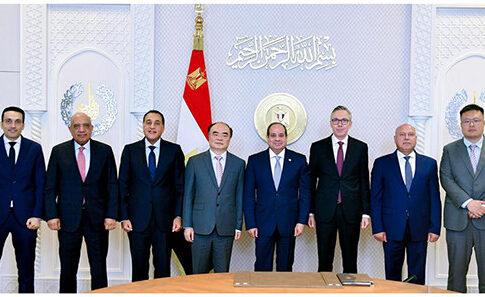
President El-Sisi recently hosted Scatec CEO Terje Pilskog and Sungrow Group Chairman Cao Renxian, underscoring Egypt’s intent to leverage international expertise in solar, wind, and green hydrogen.
Scatec, already a key partner under Egypt’s flagship “NWFE” climate initiative, is advancing a $3.6 billion investment portfolio. Projects include the Obelisk solar plant in Nag Hammadi, a 1 GW solar power plant with battery storage for Egyptalum, the Egypt Green Hydrogen project in the Suez Canal Economic Zone, and wind and ammonia ventures in Ras Shokeir and Damietta.
Meanwhile, Sungrow plans to establish a 10 GW annual capacity factory for energy storage batteries in Egypt, marking a major step toward localizing green technology manufacturing. The initiative complements Egypt’s strategy to build a domestic supply chain for clean energy infrastructure, reducing reliance on imports while positioning the country as an exporter of energy technology.
Parallel to the renewables push, the Ministry of Petroleum and Mineral Resources continues to draw investment in hydrocarbons. The Egyptian General Petroleum Corporation (EGPC) signed three fresh exploration deals:
- Berenco Egypt will drill three wells offshore North Sinai, investing $46 million.
- UAE’s Dragon Oil will drill three wells in East El-Hamd in the Gulf of Suez, with $40.5 million in investments.
- US Apache has committed to developing five new blocks in the Western Desert, involving 14 wells and $35 million in spending.
Minister Karim Badawi emphasized that the agreements reflect “international confidence in Egypt’s energy potential,” while noting that oil and gas remain central to financing the energy transition.
Gas, often described as Egypt’s “transition fuel,” continues to underpin the country’s domestic supply and export ambitions.
Burullus Gas Company recently added two new wells in the Mediterranean, expected to yield 60 million cubic feet per day. The Sapphire South Central DP well alone contributes 50 million cubic feet plus condensates, while the recommissioned Scarab D4 adds another 10 million cubic feet.
At the same time, EGAS signed a landmark MoU with BP in London to drill five new wells in the Mediterranean. The project will tap depths of 300–1,500 meters, linking any discoveries to existing West Nile Delta infrastructure. BP’s long-standing presence—over $30 billion invested in Egypt across six decades—reinforces its role as a cornerstone partner in Cairo’s gas strategy.
Earlier discoveries in Fayoum-5, King-2, and Raven Field add to Egypt’s growing reserve base. EGAS reports that nine new exploration blocks were awarded in FY 2024/25, with 29 gas discoveries in the Mediterranean, Western Desert, and Gulf of Suez, adding 1.85 trillion cubic feet of reserves.
The combination of massive renewable energy investments, steady oil and gas exploration, and deepwater gas development cements Egypt’s ambition to act as the Eastern Mediterranean’s energy hub.
Localization of green technology, from hydrogen and ammonia facilities to battery manufacturing, is expected to enhance industrial capacity, create jobs, and enable Egypt to export not just energy but also the infrastructure that underpins it. At the same time, maintaining robust hydrocarbon output ensures sufficient supply for domestic demand while supporting LNG exports to Europe and Asia.
Egypt’s strategy balances immediate energy security with long-term decarbonization. If executed effectively, Cairo’s twin-track approach could establish the country as a rare model in the global south: a nation securing growth from hydrocarbons while laying the foundation for a renewable-driven future.