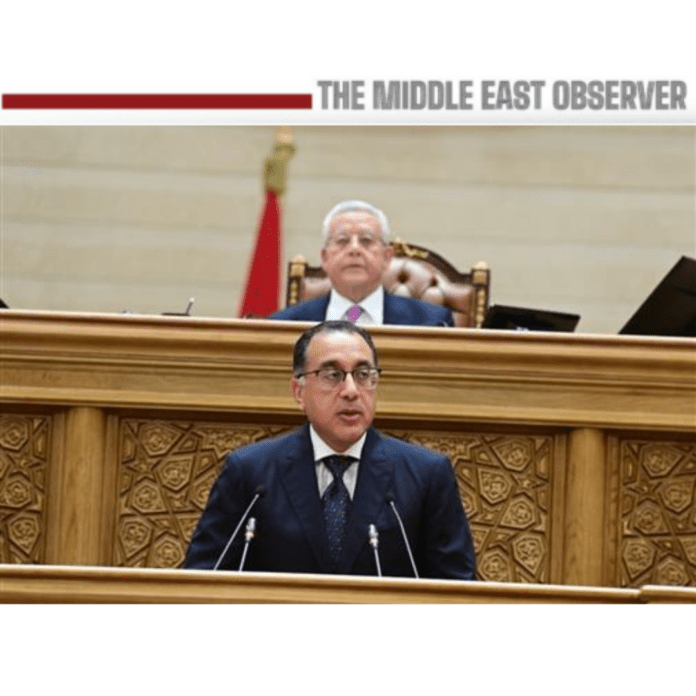
Cairo — Egypt’s government has outlined a comprehensive economic and policy response to escalating global and regional tensions, emphasizing resilience, fiscal discipline, and strategic reform amid ongoing geopolitical disruptions, according to an official address delivered by Prime Minister Mostafa Madbouly before Parliament .
Speaking in the New Administrative Capital, the Prime Minister highlighted that the recent regional conflict—particularly disruptions linked to the Strait of Hormuz—has triggered severe global economic shocks, including reduced oil flows, rising inflation, and strained supply chains. Oil prices surged from approximately $69 per barrel pre-crisis to peaks exceeding $120, with projections indicating further volatility if tensions persist .
The Middle East Observer notes that Egypt’s response has been structured around early intervention and scenario planning. The government established a crisis committee at the onset of the conflict, enabling real-time monitoring of global markets and ensuring continuity in energy supply and essential goods. Authorities confirmed that strategic reserves of food, fuel, and medical supplies remained secure, with no significant shortages reported during the crisis period.
On the domestic front, the government implemented targeted economic measures, including an EGP 40 billion social support package for vulnerable households and a planned 21% increase in public sector wages starting July 2026. These steps were complemented by fiscal discipline measures, such as reducing government expenditures and optimizing energy consumption through nationwide efficiency initiatives.
Energy security emerged as a central pillar of policy. Egypt diversified gas supply sources and accelerated renewable energy expansion, with total installed renewable capacity rising from 5.9 GW in 2020 to over 9.3 GW in 2025, alongside plans to reach a 45% renewable energy contribution by 2028. The Middle East Observer observes that this transition is expected to reduce reliance on imported fuels and generate annual savings of up to $7 billion in gas import costs.
Macroeconomic indicators prior to the crisis reflected strengthening fundamentals. Economic growth reached 5.3% in the first half of FY 2025/26, while foreign direct investment inflows rose to $9.3 billion. Inflation declined significantly to 11.9% by early 2026, supported by exchange rate flexibility and monetary policy coordination with the Central Bank of Egypt .
Looking ahead, the government reaffirmed its commitment to private sector-led growth, targeting a 60% contribution to total investments within a broader EGP 3.8 trillion development plan for FY 2026/27. Efforts will also focus on enhancing food security, expanding local wheat procurement, and strengthening Egypt’s position within regional and global supply chains.
In conclusion, The Middle East Observer underscores that Egypt’s policy framework reflects a calibrated balance between crisis management and long-term structural reform. While external risks remain elevated, particularly amid continued geopolitical uncertainty, the country’s diversified economic strategy and institutional coordination provide a foundation for sustained stability and future growth.egypt