
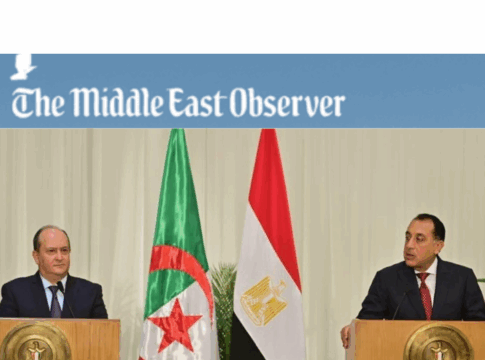
Egypt and Algeria have launched a new phase in their economic partnership, aiming to raise bilateral trade from the current $1 billion to $5 billion “in the coming few years”, following a wide package of cooperation agreements signed in Cairo during the 9th Egyptian–Algerian Joint Higher Committee.
The target was confirmed by Egyptian Prime Minister Mostafa Madbouly and Algerian Prime Minister Nadir Larbaoui, with both governments describing the new arrangements as the “most comprehensive framework of cooperation in years,” according to MENA and APS.
Official data from Ahram, MENA, and APS confirm that bilateral trade reached $1 billion in 2023, marking an 18% increase, but remains far below its potential. Both countries have now endorsed a priority list of joint industrial and development sectors, including:
- Agriculture, grains, food security and fertilizer cooperation
- Pharmaceutical manufacturing and industrial localization
- Green hydrogen, renewable energy and electricity interconnection
- Ports development, maritime transport and logistics corridors
- Construction technologies, housing and urban development
- AI, ICT, e-government and digital transformation
Sources within both delegations—reported in APS and echoed by Al-Gomhuria—indicate that several deals are already in technical drafting stages, especially in renewables, fertilizer production, and logistics platforms that would serve North African and Mediterranean export routes. Officials described these as “projects in progress” pending final regulatory alignment.
Madbouly emphasized that the two prime ministers will personally follow up on the progress of agreed projects through a continuous mechanism within the Joint Higher Committee, with both sides determined to avoid “paper agreements without implementation.”
Algeria, according to APS, views Egypt as a strategic manufacturing base with extensive experience in construction, port management, industrial zones, and megaproject execution. Egypt, for its part, sees Algeria as a gateway to Maghreb markets and African Sahel economies.
The final session concluded with a broad portfolio of agreements, officially confirmed by MENA and APS, covering:
- Higher education partnerships between universities
- Joint research centers, scholarships and scientific exchanges
- Human resources development and technical training
- Social and legal cooperation frameworks
- Parliamentary collaboration
- Coordination in national archives and documentation
- Social solidarity and civil service modernization
According to senior officials cited by APS and Egyptian economic sources speaking to state media, upcoming negotiations will focus on:
- A joint industrial zone for Egyptian and Algerian manufacturers
- A logistics and shipping corridor linking Egyptian Red Sea ports to Algerian Mediterranean ports
- Coordinated food-security projects, especially grains, oils and fertilizers
- A green hydrogen cooperation roadmap, potentially linked to European offtake
These projects are described as “ongoing discussions with advanced progress”, signaling that the $5bn trade target will likely be driven by long-term structural integration rather than simple exchange of goods.
Both leaders stressed that the new agreements reflect “a strategic rebuilding” of relations after years of underdeveloped economic engagement. Algeria’s PM Larbaoui said the two nations “possess extraordinary potential that must be activated,” while Madbouly reaffirmed Egypt’s readiness to share its development experience—from infrastructure to investment incentives—with Algeria.
With the signing of this extensive package of agreements—and the commencement of several key projects now under preparation—Egypt and Algeria appear poised to enter one of the strongest economic phases in their modern bilateral history, aiming to transform political closeness into measurable economic gain across the Arab world, Africa and the Mediterranean.