
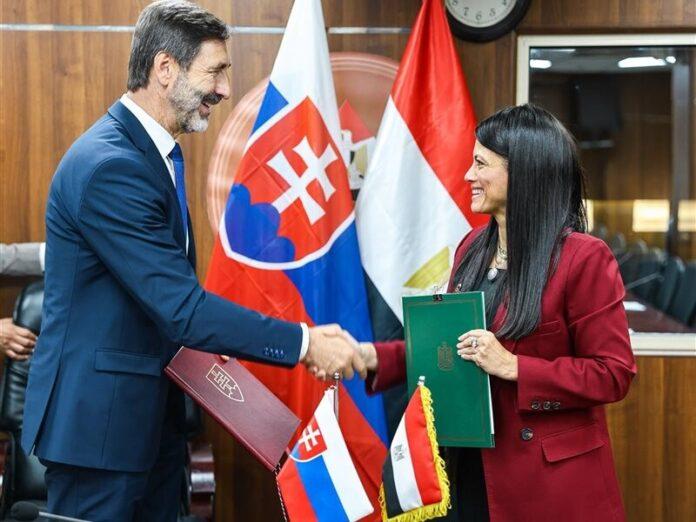
Egypt and Slovakia have formalized a new framework for bilateral collaboration through the signing of an agreement to establish a Joint Committee for Economic Cooperation, aimed at expanding trade, investment, and development links between the two nations.
The accord was signed in Cairo by Egypt’s Minister of Planning, Economic Development and International Cooperation, Rania Al-Mashat, and Slovak Minister of Foreign and European Affairs Juraj Blanár, who was in Egypt to attend the inauguration of the Grand Egyptian Museum (GEM).
According to Egypt’s Ministry of Planning, the agreement represents a milestone in advancing the two countries’ partnership and will pave the way for greater alignment in economic and policy cooperation. The committee will serve as a key platform for identifying new investment prospects, enhancing trade flows, and encouraging private-sector engagement.
Discussions during the signing focused on deepening collaboration within the wider framework of Egypt–EU relations, especially following the first Egypt–EU Summit in Brussels. Both ministers also agreed to strengthen cooperation in tourism, industrial localization, and technology-driven sectors — with an emphasis on increasing the number of Slovak tourists visiting Egypt after the GEM opening.
Minister Al-Mashat underlined the long-standing friendship between the two countries, dating back to the 1990s, and said the agreement would help unlock untapped trade potential. Blanár described the move as “a significant step forward” in Slovakia’s engagement with Africa and the Global South, highlighting Egypt’s growing role as a regional investment hub.
Currently, around 45 Slovak companies operate in Egypt with investments exceeding $560 million, spanning tourism, industry, IT, and agriculture. Bilateral trade reached approximately $340 million, with Slovakia exporting vehicles and machinery, while Egypt’s exports include electronics and rubber products.
The new joint committee will join a network of more than 55 similar bilateral mechanisms managed by Egypt’s Ministry of Planning, aimed at fostering global partnerships in trade, science, and culture.
