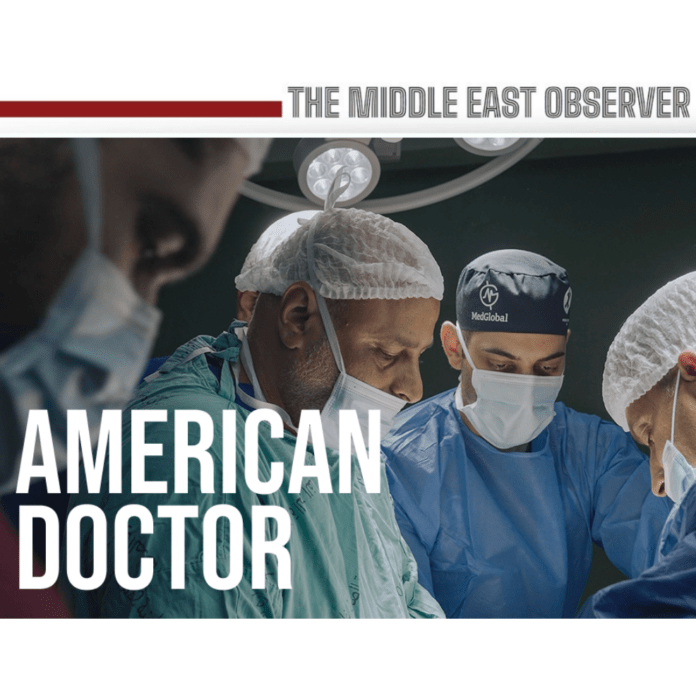
In January 2026, the documentary American Doctor premiered at the U.S. Documentary Competition of the Sundance Film Festival, drawing international attention to the intersection of medicine, war, and humanitarian suffering in the Gaza Strip. Directed by Poh Si Teng, the film follows three American physicians — one Palestinian, one Jewish, and one Zoroastrian — as they enter Gaza to treat the wounded amid a shattered health system and ongoing hostilities.
The project itself has sparked debate — not just about clinical practice in extreme conditions, but about representation, accountability, and the responsibility of global audiences to confront the reality of war’s casualties, especially those targeting Citizens. Critics have described it as both compelling and deeply challenging to watch.
American Doctor captures the work of three U.S. physicians who volunteered in Gaza, navigating hospitals that have been repeatedly damaged or rendered non-functional and confronting severe shortages of basic medical supplies, anesthesia, and electricity. Operating rooms often function on makeshift sources of light and scarce pain relief; children arrive with devastating blast injuries and adults with life-threatening wounds that test every resource available.
Rather than a broad political statement, the film focuses on testimony — the doctors’ direct accounts of what they saw and did — sometimes leading to intense on-camera debates about how such suffering ought to be shown or obscured. One physician argues that sanitizing images is an ethical failure; the audience, he insists, should see the full consequences of policies enacted far from Gaza.
Behind the film’s intimate portraits lies a broader, devastating statistical reality.
According to data compiled by the Gaza Ministry of Health and reported by the United Nations Office for the Coordination of Humanitarian Affairs (OCHA), between 7 October 2023 and late 2025, the total number of Palestinians killed in the conflict has reached over 71,000, with more than 170,000 wounded. These figures represent the deadliest multi-year ground and air war in recent Middle Eastern history.
A breakdown of the fatalities during this period shows the profound civilian toll:
- Children accounted for roughly 30% of the deaths, meaning tens of thousands of those killed were under 18 years old.
- Women made up approximately 16%.
- Elderly persons (often defined as 60+ or 65+) accounted for around 7%.
- Men comprised the remainder of identified fatalities.
Independent reporting and longitudinal demographic analyses, including from international research institutes, have suggested that actual death tolls — when accounting for under-reporting and indirect causes of death — may be even higher.
The impact of sustained conflict on Gaza’s health system has been catastrophic. In addition to general civilian casualties, humanitarian reports indicate that hundreds of medical and aid workers have been killed, and many more injured or displaced. One widely cited estimate places the number of healthcare personnel killed (including doctors, nurses, paramedics, and support staff) at well over 1,500 since the onset of hostilities.
Hospitals and clinics — vital for both routine care and emergency response — have suffered extensive damage. By mid-2025, reports indicated that 94% of hospital infrastructure had been damaged or destroyed, and only a fraction were partially functional.
For all the numbers, the human devastation is more than a statistic — it is the image of a two-year-old brought in already deceased, or a ten-year-old left with life-altering injuries and no adequate facility for rehabilitation. These are the scenes American Doctor places before its audience, demanding engagement with the individual lives that lie behind aggregated data.
Critics argue that such imagery is essential for global audiences to grasp the dimension of the crisis — while others caution about the ethics of viewing trauma. Regardless of stance, the documentary has sparked warnings and calls for broader distribution, with civil rights organizations urging streaming platforms to make it widely available so that the human toll is not filtered out of global consciousness.
In portraying frontline medicine amid war, American Doctor does more than document clinical triage; it frames the broader humanitarian crisis in terms that statistics alone cannot convey. The sheer number of deaths — particularly among children and other civilians — underscores the intensity of the crimes committed, while the firsthand experiences of physicians reflect both the limits of humanitarian intervention and the moral urgency felt by those who choose to bear witness.
The film stands not just as a conventional war documentary, but functions as an eyewitness archive of mass civilian cleansing in the modern historical record.