
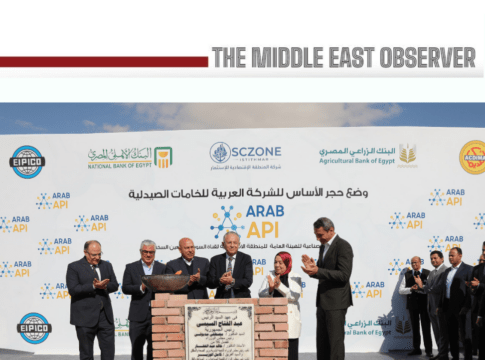
ACDIMA and EIPICO are jointly anchoring Egypt’s most significant push to localise pharmaceutical raw-material production following the inauguration of the Arab API manufacturing complex in the Suez Canal Economic Zone at Ain Sokhna.
The foundation stone for the $165 million facility was laid at a ceremony attended by Kamel El-Wazir, Deputy Prime Minister for Industrial Development and Minister of Industry and Transport; Tarek Hamed El-Shazly, Governor of Suez; and Walid Gamal El-Din, Chairman of the Suez Canal Economic Zone Authority, alongside senior figures from Egypt’s pharmaceutical, scientific research and banking sectors.
Arab API is chaired by Ahmed Kilani, who also serves as Chairman and Managing Director of EIPICO, positioning the company at the core of the project’s industrial execution. The venture is being developed in partnership with the Suez Canal Economic Zone through its investment arm, reflecting a public-private model aimed at accelerating industrial localisation.
At the ceremony, El-Wazir said the government fully supports the project and would work to remove any obstacles to ensure implementation in line with the approved timetable, describing pharmaceutical localisation as a priority for Egypt’s industrial strategy.
Gamal El-Din said the project forms part of a broader plan to localise medical and pharmaceutical industries, enhance national health security and support exports. He added that the facility would operate to international quality standards and contribute to positioning the SCZone as a regional hub for pharmaceutical manufacturing.
Olfat Gharab, Chairwoman of ACDIMA, said the Arab API project translates the holding company’s mandate into practical industrial capacity, helping to secure sustainable medicine availability, reduce Egypt’s hard-currency import bill and deepen pharmaceutical manufacturing rather than relying on finished-product imports.
Kilani said Egypt’s reliance on imported pharmaceutical raw materials — estimated at more than 90% of demand — made upstream industrialisation unavoidable. He added that Arab API would focus on building qualified human capital alongside production capacity, while pursuing regional partnerships, particularly across Africa, to strengthen pharmaceutical supply chains and expand exports.
For the domestic market, the project is expected to stabilise input supply for local drugmakers and improve cost resilience. At the same time, its export-oriented design positions Egypt to emerge as a regional supplier of pharmaceutical raw materials to African and Middle Eastern markets.
