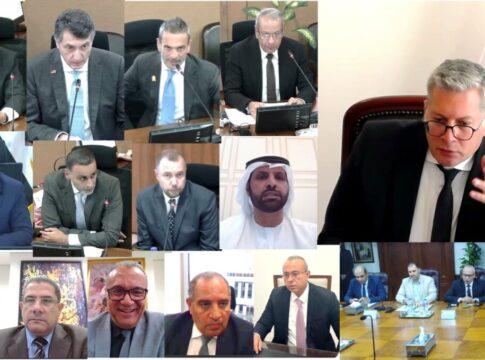
Egypt’s petroleum sector is reinforcing its position as a cornerstone of the national economy, with Petrobel Company emerging at the forefront of upstream investment and production growth. During the joint general assemblies of Petrobel and PetroShorouk, Engineer Karim Badawi, Minister of Petroleum and Mineral Resources, confirmed the continuation of the ministry’s strategy to expand gas output from the Zohr field, Egypt’s flagship offshore asset.
Badawi highlighted that the Zohr-6 well, brought online in fiscal year 2024/2025, has already added about 65 million cubic feet of gas per day to national production. He underscored the strategic significance of Zohr, describing it as “an integral part of every Egyptian household,” given its pivotal role in covering a substantial share of domestic gas demand. Ongoing drilling, including preparations for Zohr-9 and two further development wells, reflects Egypt’s determination to secure energy supplies and extend the field’s productive life.
The assemblies brought together representatives of leading investment partners — including Eni, BP, Rosneft, Arceus Energy, and Mubadala — alongside sector leaders, underscoring the international dimension of Egypt’s petroleum expansion. Partners praised both the safe operational environment and the pace of activity at Zohr, where high-intensity drilling and development have been sustained without compromising safety and environmental standards.
Petrobel invested over $460 million across exploration and production operations. The company achieved an average output of 56,000 barrels of crude oil per day from its Nile Delta and Sinai operations, despite the challenges of managing fields that have been in operation for nearly seven decades. To sustain and expand production, Petrobel brought three new wells online in Sinai, yielding 4,700 barrels per day, and implemented an intensive maintenance program covering 96 wells, adding an estimated 6,000 barrels per day through enhanced technologies.
Looking ahead, Petrobel is conducting advanced geological and seismic studies to identify future opportunities in the Gulf of Suez and Mediterranean basins, with specific attention to boosting output from the Abu Redis-Sidri field in partnership with Italy’s Eni.
Minister Badawi emphasized that expanding natural gas output is the first axis of the ministry’s broader strategy: improving production efficiency, securing domestic needs, and strengthening Egypt’s role as a regional gas hub. With the Zohr field as a backbone, the government aims not only to safeguard household energy security but also to preserve foreign currency by reducing imports and unlocking additional export potential.
The exploration of greater depths, supported by new seismic research and feasibility studies, forms a central part of this strategy. Badawi directed companies to draft long-term scenarios that could position Egypt to tap reserves beyond current production levels, ensuring sustainable growth in the coming decades.
Petrobel’s performance signals both resilience and sustainability. Egypt’s ability to sustain upstream growth in aging oil fields while simultaneously scaling offshore gas output highlighting the sector’s technical adaptability and investment attractiveness. The $1 billion in combined annual investments by Petrobel and PetroShorouk demonstrates a robust commitment by state and private partners alike, even as global energy markets remain volatile.
The government’s consistent emphasis on safety, environmental standards, and operational efficiency further reassures stakeholders. As Egypt expands its exploration footprint in the Gulf of Suez and Mediterranean, and prepares new wells at Zohr, the trajectory points toward continued growth — with implications not only for energy self-sufficiency but also for fiscal stability and export potential.
The results of Petrobel and PetroShorouk’s fiscal year 2024/2025 reflect a broader reality: Egypt is consolidating its role as a key gas producer in the Eastern Mediterranean. With new wells at Zohr, revitalized legacy fields, and deeper geological exploration underway, Petrobel is positioned to anchor both Egypt’s domestic energy security and its ambitions to become a regional hub for gas exports. For investors, economists, and policy makers, the company’s trajectory signals a sector that is not just maintaining momentum but actively expanding into new horizons.