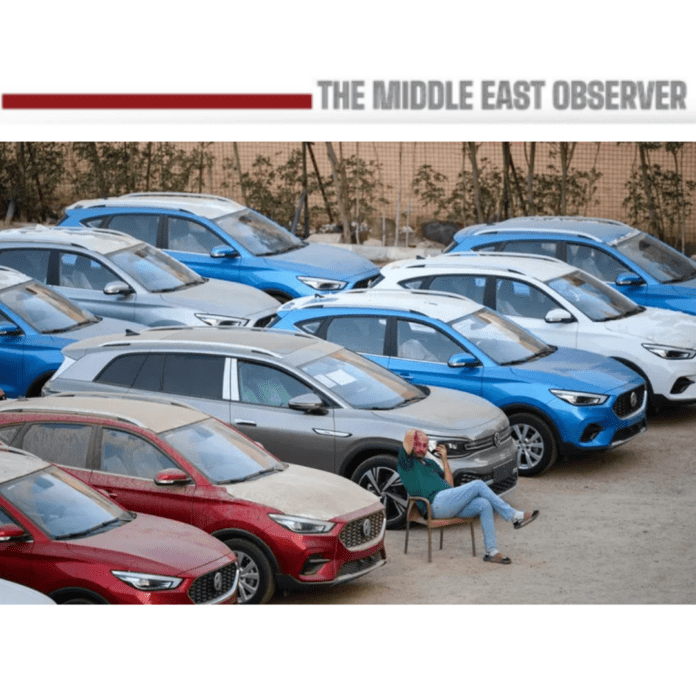
Cairo — Egypt’s automotive market has returned to an upward pricing trajectory after a period of notable declines, with prices of approximately 84 vehicle models rising over March by up to 12.3%, according to market data monitored by Asharq Bloomberg.
Industry participants attribute the renewed increases primarily to the depreciation of the Egyptian pound against the US dollar, alongside higher shipping costs driven by global supply chain disruptions linked to ongoing geopolitical tensions. As The Middle East Observer notes, these pressures have been compounded by constraints affecting key maritime routes, impacting the timely flow of imported components.
The Egyptian pound has declined by more than 12% since the Iran war started, approaching EGP 55 per dollar, amid external financing pressures and capital outflows from treasury instruments. This has had a direct impact on vehicle pricing, given that Egypt imports nearly 70% of its automotive components, according to industry representatives.
In parallel, the market has witnessed the re-emergence of the so-called “overprice” phenomenon, where distributors impose additional premiums above official list prices in exchange for immediate delivery. The Middle East Observer understands that this reflects tightening supply conditions, as some authorized dealers have reduced availability, suspended bookings, or limited sales on certain models.
Official price increases announced by agents have ranged between EGP 15,000 and EGP 550,000 per vehicle, while unofficial premiums have reached as high as EGP 350,000 in select cases. Certain manufacturers implemented multiple price adjustments over the same month, with companies such as GB Auto among those leading the upward revisions.
Looking ahead, market experts anticipate further price increases ranging between 5% and 15% if current circumstances persist, driven by elevated energy costs, shipping surcharges—including war-risk premiums—and continued currency volatility.
Despite these challenges, demand indicators remain strong. Data from the Automotive Market Information Council shows that vehicle sales rose sharply in 2025, reaching approximately 173,700 units compared to 102,200 units in the previous year, while January 2026 alone recorded a 39.1% year-on-year increase.
The Middle East Observer notes that while Egypt is expanding its domestic automotive production base—with 13 manufacturers currently operating and additional entrants expected—the sector remains heavily exposed to external supply chains. Until localization efforts deepen, pricing dynamics are likely to remain closely tied to exchange rate movements and global logistics conditions.