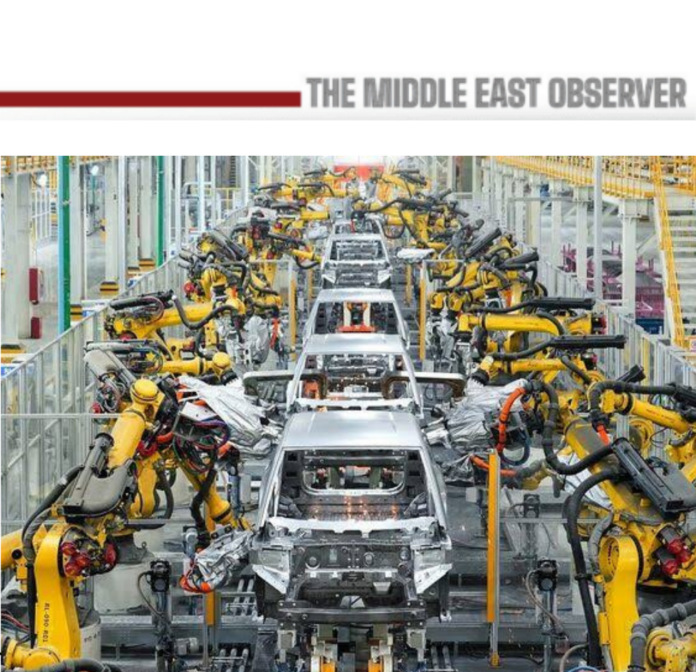
Egypt is moving closer to establishing itself as a regional automotive export hub after three international vehicle manufacturers operating in the country applied to begin exporting locally assembled vehicles, providing an early indication that Cairo’s industrial localisation strategy is beginning to evolve from import substitution towards export-led manufacturing.
According to a government official quoted by Asharq Bloomberg, Nissan Egypt, General Motors Egypt and a third unnamed manufacturer have submitted applications to the Ministry of Industry to commence exports during the fourth quarter of 2026. The companies are expected to focus initially on Arab and African markets, with projected exports ranging between 10,000 and 30,000 vehicles during the first year. While these figures reflect government expectations rather than publicly confirmed corporate commitments, they represent an important milestone in Egypt’s ambition to transform its automotive industry into a competitive regional manufacturing base.
The initiative extends beyond increasing vehicle shipments abroad. For policymakers, successful exports would demonstrate that multinational manufacturers increasingly view Egypt as a production platform capable of serving regional markets rather than merely assembling vehicles for domestic consumption. Sustained export activity would also encourage investment across supplier industries—including engineering, steel processing, plastics, glass, tyres, electronics, logistics and industrial services—thereby generating significantly greater economic value than vehicle assembly alone.
Nissan’s application represents the resumption of exports rather than a new market entry. The company previously exported Egyptian-manufactured vehicles before suspending overseas shipments in August 2025. During discussions with the Ministry of Industry earlier this year, company officials confirmed that approximately 25,000 Egyptian-built Nissan vehicles had already been exported to African markets over the previous three years while production at its Sixth of October City facility had risen to around 30,000 vehicles annually. According to Nissan’s global corporate information, Egypt remains one of the company’s strategic manufacturing bases in Africa.
For General Motors Egypt, meanwhile, exports would represent an important expansion beyond its traditional domestic focus. The third manufacturer has not yet been publicly identified, and none of the companies has announced final export schedules or destination markets.
Export Growth Supports Industrial Ambitions
The proposed export programme comes as Egypt’s automotive exports continue to record steady growth.
According to the Engineering Export Council of Egypt, exports of vehicles and automotive components increased by approximately 15 per cent during 2025 to reach US$1.272 billion. Growth continued during the first four months of 2026, when exports rose a further 13.1 per cent year-on-year to US$434.6 million.
Although these figures include automotive components as well as complete vehicles, they demonstrate that Egypt already possesses an increasingly competitive supplier ecosystem capable of generating substantial foreign exchange earnings. Expanding exports of fully assembled vehicles would therefore complement—not create—the country’s automotive export industry.
The government’s broader objective is considerably more ambitious. Under Egypt’s National Industrial Strategy 2026–2030, policymakers aim to increase non-oil exports to US$100 billion while attracting technology-intensive manufacturing, expanding industrial investment and strengthening domestic supply chains. Within this framework, the automotive sector has been identified as one of the country’s priority industries.
Unlike earlier industrial policies that focused primarily on replacing imported vehicles with local assembly, the current strategy seeks to integrate Egypt into regional and global automotive value chains. Success will ultimately be measured not simply by production volumes, but by the industry’s ability to secure long-term export programmes, deepen local value-added manufacturing and attract multinational investment.
Localisation at the Centre of Competitiveness
According to the Ministry of Industry and the State Information Service, Egypt’s National Automotive Industry Development Programme links incentives to local component content, domestic value added, production volumes, exports and environmental performance.
This distinction is economically significant. Vehicle assembly alone generates relatively limited domestic value if manufacturers continue importing engines, transmissions, electronic systems and other high-value components. The real economic gains emerge when export growth stimulates investment across the domestic supplier base, enabling Egyptian companies to manufacture increasingly sophisticated components for both local assembly and overseas markets.
Every new assembly line has the potential to support employment far beyond the factory floor. Engineering firms, component manufacturers, transport operators, logistics providers, industrial maintenance companies and hundreds of small and medium-sized enterprises all stand to benefit as production volumes expand.
Higher localisation also reduces manufacturers’ exposure to foreign-currency shortages and imported input costs. However, localisation policies must remain commercially competitive. Requiring local components that are substantially more expensive or less efficient than imported alternatives would undermine export competitiveness rather than strengthen it.
The challenge, therefore, is not simply increasing the percentage of locally produced components, but developing supplier capabilities capable of competing internationally on quality, cost and delivery reliability.
Regional Markets Offer the Natural First Step
Arab and African markets represent the most logical destinations for Egypt’s first wave of automotive exports.
Egypt’s strategic geographic position at the crossroads of Africa, the Middle East and Europe, together with direct access to both the Mediterranean Sea and the Red Sea through the Suez Canal, provides manufacturers with efficient shipping routes to neighbouring markets. Combined with participation in the African Continental Free Trade Area (AfCFTA), the Common Market for Eastern and Southern Africa (COMESA), the Greater Arab Free Trade Area (GAFTA) and the Agadir Agreement, Egyptian manufacturers enjoy preferential market access that can enhance their competitiveness, provided products satisfy applicable rules of origin.
Demand characteristics also favour Egypt’s current production profile. Many African and Arab markets continue to require competitively priced passenger vehicles and light commercial vehicles powered by conventional internal combustion engines or hybrid technologies. These markets are generally less constrained by the stringent emissions standards and advanced electric-vehicle regulations that characterise Europe.
For Nissan, exporting to Africa builds upon an existing distribution network and established customer base. For General Motors and other manufacturers, regional exports provide an opportunity to increase factory utilisation while diversifying revenue beyond domestic demand.
Competing with Africa’s Automotive Leaders
Egypt’s ambitions should also be viewed within the broader African automotive landscape.
According to naamsa, South Africa’s Automotive Business Council, the country exported more than 414,000 vehicles during 2025 while total automotive exports, including components, reached approximately R291 billion. South Africa’s success reflects decades of integration into global automotive supply chains, supported by large-scale production, efficient logistics and stable export programmes.
Morocco has pursued a different strategy centred on export-oriented manufacturing for European markets. Government data show that Renault and Stellantis have established extensive manufacturing ecosystems supported by dense supplier networks and high local integration rates. The Stellantis facility at Kenitra alone has capacity to produce 200,000 vehicles annually, illustrating the scale of industrial investment required to compete internationally.
Egypt does not necessarily need to replicate either model. Instead, its comparative advantage lies in developing a manufacturing platform serving North Africa, the Middle East and selected sub-Saharan African markets, where geographic proximity, competitive production costs and regional trade agreements provide meaningful commercial advantages.
Even if Egypt achieves its long-term objective of exporting around 100,000 vehicles annually by 2030, it would remain below the export volumes currently achieved by Africa’s leading automotive producers. Nevertheless, reaching that milestone would represent a significant structural transformation for the Egyptian manufacturing sector.
Challenges Beyond the Headlines
The latest applications are encouraging, but execution will determine whether Egypt’s automotive ambitions translate into lasting industrial success.
Among the principal challenges are expanding local supplier capacity, achieving sufficient production scale, maintaining reliable access to imported components, improving logistics efficiency and ensuring exchange-rate stability. Competition from established manufacturing centres—including Morocco, South Africa and Turkey—will remain intense, while multinational manufacturers will continue allocating production according to global cost competitiveness and supply-chain efficiency.
The transition towards electric mobility also presents both opportunities and challenges. Although many of Egypt’s likely export destinations are expected to maintain strong demand for conventional and hybrid vehicles over the medium term, global manufacturers are steadily increasing investment in electric vehicles and advanced automotive technologies. Egypt’s long-term competitiveness will therefore depend upon developing capabilities in batteries, electronics, charging infrastructure and other future-oriented automotive technologies alongside its existing manufacturing strengths.
Government incentives will likewise require careful monitoring to ensure they generate genuinely additional investment, exports and domestic value added rather than subsidising production that would have occurred regardless.
Ultimately, the significance of the current export applications extends well beyond the initial shipment volumes. They represent an opportunity to demonstrate that Egypt is becoming integrated into regional automotive value chains and capable of competing for long-term manufacturing mandates.
Whether that ambition is realised will depend less on announcing export targets than on convincing global manufacturers that Egyptian factories can consistently compete on cost, quality, localisation, productivity and delivery reliability with the continent’s most established automotive exporters. If that objective is achieved, automotive exports could become an increasingly important source of foreign exchange earnings, skilled employment, industrial innovation and sustainable economic growth.
Related news:
Egypt’s Auto Market Accelerates as Car Sales Soar 83% in First Seven Months of 2025
Rolls-Royce Bets on Egypt as Gateway to North Africa’s Emerging Luxury Market
Read also:
Sudan Turns to China to Modernise Red Sea Ports as Beijing Expands Strategic Maritime Presence
Egypt to Begin Allocating New Mobile Spectrum Under $3.5bn Telecom Deal