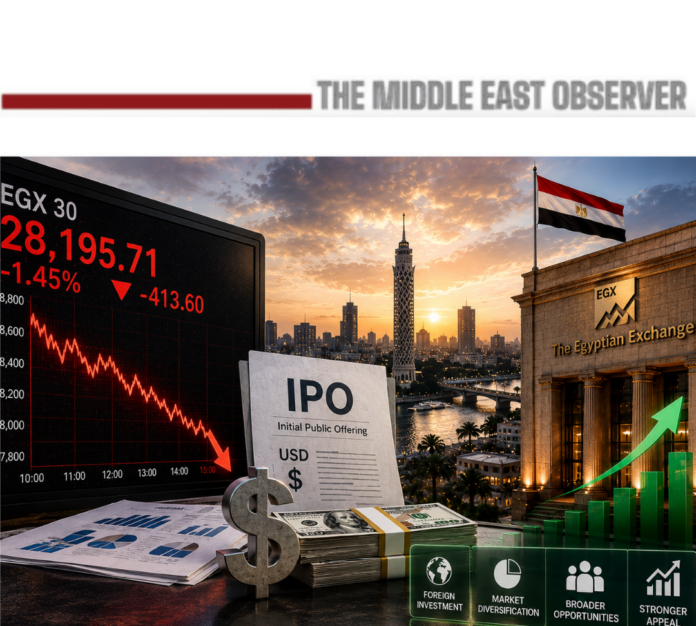
Cairo — Egyptian equities closed mixed on Monday, with the benchmark EGX30 falling below the 50,000-point level as foreign selling weighed on blue-chip stocks, while small- and mid-cap shares advanced and investors assessed Egypt’s plan to internationalise parts of its state IPO programme through dollar-denominated petroleum listings.
The EGX30 dropped 1.03% to 49,825.58 points, extending the market’s recent correction. By contrast, broader indices moved higher. The EGX33 Shariah Index rose 0.15% to 5,579.54 points, the EGX35-LV gained 0.69% to 5,827.58 points, the EGX70 advanced 0.77% to 15,185.64 points, and the EGX100 added 0.57% to 20,733.32 points.
Market capitalisation reached EGP 3.618 trillion, slightly higher than the previous session’s EGP 3.609 trillion, showing that broader market support remained intact despite weakness in the benchmark index.
The market has entered the final week of June after one of its busiest periods for capital-market reform, although the EGX30 has now fallen by almost 6% from its mid-June levels as institutional investors continue adjusting portfolios amid lower liquidity and pressure on large-cap shares.
Foreign Selling Pressures Blue Chips
Foreign and Arab investors were net sellers, with non-Arab foreign investors recording outflows of approximately EGP 11.31 billion and Arab investors selling around EGP 1.2 billion. Egyptian investors were net buyers with purchases of about EGP 12.51 billion.
The flow pattern marked a second session in which local investors absorbed overseas selling, reversing the earlier trend seen in much of June when foreign and regional investors were the main source of support.
The weakness in the EGX30 suggests that institutional selling remained concentrated in large-cap shares, while local buying helped sustain activity in smaller and more speculative segments of the market.
Small Caps Show Relative Strength
The divergence between the EGX30 and broader indices was the most important trading signal of the session. While blue chips pushed the main index lower, the EGX70 and EGX100 advanced, indicating that investors were not exiting the market entirely but rotating toward selected mid-cap and high-momentum shares.
Among the top performers, Delta for Printing & Packaging surged 20% to EGP 138.38, while Golden Textiles & Clothes Wool also rose 20% to EGP 73.50. Alexandria New Medical Center gained 19.99% to close at EGP 55.28.
On the downside, Arab Polvara Spinning & Weaving fell 4.87%, Rubex International for Plastic and Acrylic Manufacturing declined 4.10%, and Certificates of Odin Egyptian Equity Investment Fund – KASAB lost 3.68%.
Dollar Petroleum Listings Add International Dimension
Beyond daily trading, investors remained focused on the government’s petroleum-sector IPO programme.
Officials confirmed that shares of the temporarily listed petroleum-sector companies are expected to trade in US dollars, while dual listing on the Saudi market remains a possibility if approved by the relevant authorities and shareholders.
The three petroleum companies — ENPPI, ELAB and Petroleum Marine Services — have been temporarily listed as part of the government’s state-ownership programme. Their inclusion marks a major step in Egypt’s effort to broaden the sectoral depth of the Egyptian Exchange and attract foreign investors seeking exposure to energy, engineering and industrial services.
Trading selected petroleum companies in US dollars would reduce foreign-exchange friction for international investors while providing a more natural valuation framework for businesses whose revenues, contracts or export activities are substantially dollar-linked. Combined with the possibility of dual listings in Saudi Arabia, the initiative represents a significant step toward integrating Egyptian capital markets more closely with regional investment flows.
According to officials, the state has already completed the temporary listing of 20 companies out of the 30 previously identified under the offering programme, with the remaining 10 expected to be listed during the next quarter. The government is also targeting the trading of four to six state-owned companies during 2026.
Market Infrastructure Continues to Broaden
The petroleum listings come alongside wider reforms aimed at modernising the Egyptian Exchange. These include the launch of single-stock futures, preparations for covered short selling, growing interest in exchange-traded index funds and efforts to attract family-owned, private and small- and medium-sized companies to the market.
The reforms also coincide with ongoing international scrutiny of Egypt’s market accessibility as S&P Dow Jones Indices continues reviewing the country’s emerging-market classification.
The expansion of investment products and listing candidates is significant because it suggests Egypt is attempting to build a broader capital-market ecosystem rather than relying solely on large-cap secondary-market performance.
The performance of the Sahmi 70 fund, which tracks the EGX70 index and reported strong first-year returns, also highlights growing investor appetite for lower-cost, diversified exposure to smaller listed companies.
Market View
Monday’s session reflected a market split between near-term pressure on blue chips and continued appetite for broader equity exposure.
The fall of the EGX30 below 50,000 points is technically significant and will increase attention on whether institutional selling continues in heavyweight stocks. However, the rise in the EGX70 and EGX100 suggests that local investors remain active and are selectively rebuilding exposure in smaller and mid-cap names.
For long-term investors, the more important development remains the continuing expansion and internationalisation of Egypt’s capital-market pipeline. Dollar-denominated trading for petroleum listings, the possibility of Saudi dual listings, new ETFs, derivatives, short selling and the government’s broader IPO programme all point to a market gradually becoming deeper, more diversified and more internationally investable.
The immediate challenge is liquidity. The strategic opportunity is scale. If implemented successfully, the combination of dollar-denominated petroleum listings, prospective Saudi cross-listings, derivatives, exchange-traded funds and an expanding state IPO programme could mark the most internationally oriented phase in the Egyptian Exchange’s modern history, significantly enhancing its appeal to global emerging-market investors.