
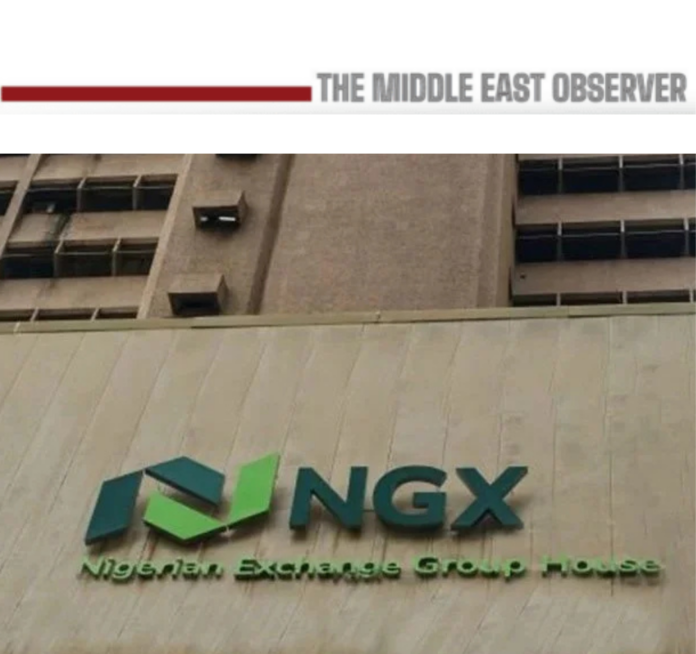
Nigeria’s equity market suffered one of its sharpest single-day reversals of the year on Wednesday as widespread profit-taking erased approximately ₦3.64 trillion ($2.6 billion) in market value, highlighting growing investor caution after months of strong gains and raising fresh questions over how far valuations can continue to outpace corporate fundamentals.
The broad-based selloff interrupted a rally that had propelled the Nigerian Exchange (NGX) to successive record highs in recent weeks. Investors moved to crystallise gains across several large-cap stocks, pushing the NGX All-Share Index down by 7,668.65 index points, or 2.35%, to close at around 233,074.54 points, compared with 240,743.19 points in the previous session.
Total market capitalisation declined from ₦154.48 trillion to ₦150.85 trillion, wiping out roughly ₦3.64 trillion in shareholder value. While corrections following sustained rallies are a normal feature of equity markets, the scale and breadth of Wednesday’s decline underscored how quickly sentiment can shift when investors begin questioning stretched valuations.
The retreat was accompanied by a marked deterioration in market activity. Trading volume fell 13.6% to 488.08 million shares, while the value of transactions dropped 46.8% to ₦20.93 billion from ₦39.35 billion in the previous session. The number of executed trades also declined 6.1% to 46,239, suggesting that many investors preferred to remain on the sidelines rather than increase exposure during the correction.
The combination of weaker prices and falling turnover indicates that the session was driven less by aggressive repositioning than by a broad reduction in risk appetite. In equity markets, corrections accompanied by declining liquidity often signal investor caution rather than panic selling, with market participants waiting for fresh catalysts before committing new capital.
The Nigerian Exchange is one of Africa’s strongest-performing equity markets
Market analysts attributed the decline primarily to profit-taking following an exceptional rally that has made the Nigerian Exchange one of Africa’s strongest-performing equity markets over the past year. Strong domestic liquidity, resilient corporate earnings, banking-sector reforms and improving macroeconomic confidence have attracted sustained investor interest, lifting valuations across many sectors.
Those gains, however, have inevitably increased sensitivity to valuation concerns. After extended periods of appreciation, investors frequently reassess whether future earnings growth is sufficient to justify prevailing share prices. Wednesday’s correction reflected that reassessment rather than a fundamental deterioration in corporate or economic conditions.
Large-cap stocks were central to the market’s decline. Nigeria’s benchmark index remains heavily influenced by a relatively small number of high-capitalisation companies, particularly within the banking, industrial, cement, consumer goods and power sectors. Profit-taking across these heavyweight counters therefore had a disproportionate impact on the broader market, amplifying the decline in both the index and overall market capitalisation.
The correction also reflects a more selective investment environment. Investors are increasingly differentiating between companies with strong earnings visibility, healthy cash generation and sustainable dividend prospects and those whose recent share-price appreciation may have moved ahead of underlying fundamentals. As markets mature, broad momentum-driven buying typically gives way to more disciplined stock selection.
Several structural factors nevertheless continue to support the medium-term outlook. Ongoing banking-sector recapitalisation remains one of the market’s most significant investment themes, with financial institutions expected to raise fresh capital, strengthen balance sheets and improve lending capacity. The process is likely to generate additional capital-market activity while reinforcing confidence in Nigeria’s financial system, although it may also create periods of volatility as investors assess individual capital-raising strategies and potential shareholder dilution.
Monetary policy is likely to remain another key influence. Nigeria’s relatively high domestic interest rates continue to offer attractive yields on fixed-income securities, requiring investors to balance the potential for capital appreciation in equities against comparatively strong returns available in government debt markets. Any future easing in monetary policy could improve the relative attractiveness of equities, while prolonged high interest rates may encourage periodic portfolio reallocation towards lower-risk income-generating assets.
Currency stability has also become increasingly important. Following exchange-rate reforms implemented over the past two years, greater stability in the naira has gradually improved investor confidence, particularly among international portfolio managers. Although foreign participation remains below historical peaks, improving foreign exchange liquidity and policy reforms have encouraged a gradual return of overseas investors seeking exposure to one of Africa’s largest capital markets. At the same time, international investors remain highly sensitive to valuation levels, macroeconomic developments and currency risk, factors that can amplify market volatility during periods of correction.
Compared with many regional markets, Nigeria continues to benefit from a relatively deep domestic institutional investor base, including pension funds and asset managers, which has helped provide resilience during periods of heightened volatility. This structural support distinguishes the current correction from previous episodes driven primarily by foreign capital outflows.
The sharp decline in transaction values also deserves attention. Falling turnover during a market correction often reflects temporary investor caution rather than widespread liquidation. Should trading volumes recover alongside renewed buying interest, the latest decline could ultimately prove to be a healthy consolidation within a broader upward trend rather than the beginning of a prolonged downturn.
Attention will now shift towards second-quarter corporate earnings, progress in banking recapitalisation, inflation trends and future monetary policy decisions. Together, these factors will determine whether current valuations remain justified and whether institutional investors regain confidence to increase market exposure.
For industrial and consumer companies, earnings quality will become increasingly important. Businesses with strong pricing power, export exposure, foreign-currency revenues or resilient operating margins are likely to continue attracting investor interest, while companies facing weaker domestic demand or rising production costs may encounter greater scrutiny as markets become more selective.
Wednesday’s selloff therefore represents more than a routine market correction. It signals that Nigeria’s equity rally is entering a more mature phase in which company fundamentals, earnings performance and valuation discipline are expected to matter more than broad market momentum. Rather than signalling the end of the bull market, the decline illustrates the natural transition from liquidity-driven optimism to more discriminating investment behaviour.
Whether the correction proves temporary or develops into a broader consolidation will depend largely on the strength of upcoming corporate results, continued progress on economic reforms and investor confidence in Nigeria’s macroeconomic trajectory. For now, the market appears to be undergoing a necessary valuation adjustment rather than a fundamental reassessment of its long-term prospects. If earnings continue to support current prices, Wednesday’s sharp decline may ultimately be remembered less as the start of a downturn than as a healthy pause in one of Africa’s strongest equity market recoveries.
Related news:
Algeria Begins Work on Trans-Saharan Gas Linking Nigeria to Europe
Nigeria and Egypt: From Pan-African Solidarity to a New Era of Trade and Innovation
Read also:
Brent Falls to $72.5 as Iraq Exposes OPEC to a New Challenge
Oman Advances $1bn Solar Expansion with Adam and Sinaw Projects