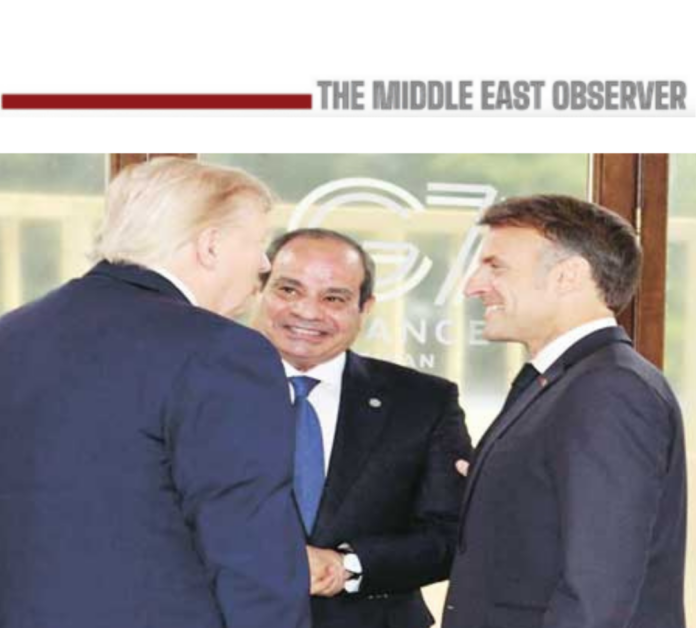
The Group of Seven (G7) leaders gathered in the French city of Évian from 15 to 17 June for a summit dominated by the wars in Ukraine and Gaza, tensions in the Gulf, energy security, global trade resilience and the growing challenge of geopolitical fragmentation. Alongside the leaders of the United States, France, Germany, Italy, Japan, Canada and the United Kingdom, the summit also brought together key partner countries and international organisations as part of the G7’s broader effort to engage influential regional powers on issues extending beyond its membership. Discussions focused on international security, economic stability, energy supply chains, migration, artificial intelligence and the future of global growth amid an increasingly volatile geopolitical environment.
Against this backdrop, President Abdel Fattah El-Sisi used Egypt’s participation in the summit to reinforce Cairo’s position as a strategic partner for Europe and an increasingly influential actor in regional diplomacy. El-Sisi’s meetings with European Commission President Ursula von der Leyen and European Council President António Costa came as the European Union sought to deepen cooperation with Egypt on issues ranging from investment and economic reform to migration, energy security and conflict resolution. At a time when crises in Palestine, Sudan and Lebanon continue to intersect with concerns over maritime security, international trade routes and regional stability, Egypt emerged as one of the few countries positioned at the crossroads of multiple geopolitical challenges shaping both European and Middle Eastern agendas.
The discussions in Évian highlighted a broader reality: Egypt’s strategic importance to Europe increasingly extends beyond traditional bilateral relations to encompass regional security, migration management, energy routes, trade corridors and diplomatic efforts aimed at resolving conflicts across the Mediterranean, Africa and the Middle East.
Why Egypt Matters to the G7 Agenda
Egypt’s presence in Évian reflected a growing recognition among major economies that many of today’s geopolitical and economic challenges converge around the country’s strategic geography and diplomatic influence.
As conflicts in Palestine (Gaza & West-Bank), Sudan, Lebanon and the wider Middle East increasingly affect migration patterns, maritime trade, energy markets and regional stability, Egypt has emerged as a central stakeholder in efforts to contain crises and support diplomatic solutions.
The country’s importance is amplified by its control of the Suez Canal, one of the world’s most critical trade arteries linking Europe and Asia. With the Strait of Hormuz and Red Sea disruptions exposing vulnerabilities in global supply chains, Egypt’s role in safeguarding international trade routes has become increasingly significant for Europe and the wider global economy.
Egypt’s invitation also reflects a broader shift in G7 diplomacy. As geopolitical challenges increasingly transcend traditional alliances, the grouping has expanded engagement with influential regional powers from Africa, the Middle East, Asia and Latin America. Alongside other invited countries, Egypt was viewed as an important partner capable of contributing to discussions on energy security, migration, food security, regional conflicts and global economic stability. This outreach underscores the growing recognition that many contemporary challenges require cooperation beyond the G7’s own membership.
The summit therefore underscored not only Egypt’s diplomatic relevance but also its growing strategic value within discussions on energy security, global trade and regional stability.
Egypt-EU Partnership Moves into a New Phase
In his meeting with European Commission President Ursula von der Leyen, El-Sisi welcomed the positive momentum characterising Egypt-EU relations since their elevation to a Comprehensive Strategic Partnership in 2024.
The president stressed Egypt’s commitment to expanding cooperation across economic, investment and emerging sectors, while reviewing efforts to implement the outcomes of the 2024 Egypt-EU Investment Conference and the economic forum held on the sidelines of the Egypt-EU Summit in October 2025.
The economic dimension of the partnership has become increasingly significant. The European Union remains Egypt’s largest trading partner, accounting for roughly a quarter of the country’s total external trade, while European companies represent one of the largest sources of foreign direct investment into the Egyptian market. Both sides increasingly view economic integration, industrial cooperation and supply-chain resilience as central pillars of the strategic partnership.
El-Sisi outlined Egypt’s ongoing structural economic reforms, aimed at enhancing competitiveness, strengthening economic resilience and improving the investment climate. He expressed confidence that these efforts would encourage greater European engagement and expansion of private-sector activity.
Von der Leyen praised Egypt’s reform programme and commended its role in combating terrorism, managing migration and contributing to regional stability despite the significant economic and humanitarian burdens resulting from regional crises.
She reaffirmed the European Union’s commitment to deepening cooperation with Egypt across political, economic and security dimensions, describing Cairo as a key partner in addressing common challenges on both shores of the Mediterranean.
Costa Talks Focus on Strategic Coordination
A separate meeting with European Council President António Costa focused on strengthening political coordination and advancing the strategic partnership between Egypt and the European Union.
El-Sisi highlighted the importance of building on the momentum created by the Comprehensive Strategic Partnership and the inaugural Egypt-EU Summit, stressing the need for deeper cooperation in trade, investment and economic development while enhancing political consultation on regional issues.
Costa praised the progress achieved in bilateral relations and reaffirmed the European Union’s commitment to expanding cooperation in ways that serve the interests of both sides.
The discussions reflected the increasing centrality of Egypt to European policy priorities, particularly in relation to Mediterranean security, migration management, counterterrorism cooperation and regional crisis resolution.
Regional Crises Dominate the Agenda
Regional developments featured prominently in El-Sisi’s discussions with both European leaders.
The Egyptian president welcomed the agreement reached between the United States and Iran, expressing hope that it would contribute to reducing tensions and preventing a return to military escalation in the region. He stressed the importance of preserving the security and sovereignty of Gulf Cooperation Council states while safeguarding freedom of international navigation.
El-Sisi reiterated Egypt’s longstanding position that sustainable solutions to regional crises must be based on diplomacy, dialogue and respect for state sovereignty, rather than military confrontation.
The president also discussed Egypt’s efforts to support stability in Lebanon and advance initiatives aimed at ending the conflict in Sudan and alleviating the suffering of the Sudanese people.
Both von der Leyen and Costa praised Egypt’s responsible approach to regional crises and highlighted the convergence between Egyptian and European positions on several key issues.
Palestine and the Two-State Solution
The Palestinian issue remained one of the most important themes of Egypt’s diplomatic engagement during the summit.
El-Sisi reaffirmed Egypt’s commitment to working with European partners to implement the agreement aimed at ending the war in Gaza, ensuring the uninterrupted delivery of humanitarian assistance and launching early recovery and reconstruction efforts.
At the same time, Egypt continues to view humanitarian relief and reconstruction as part of a broader political process rather than an end in themselves.
Cairo maintains that the two-state solution remains the only viable framework for achieving lasting peace and stability. Egyptian diplomacy continues to support the establishment of an independent Palestinian state on the June 1967 borders, with East Jerusalem as its capital, alongside guarantees for Israel’s security.
As discussions increasingly shift from ceasefire arrangements to reconstruction and governance, Egypt sees the revival of a credible political process as essential to preventing future cycles of violence and instability.
G7 Focuses on Ukraine, Iran and Energy Security
The wider G7 Summit was dominated by discussions on Ukraine, the Middle East and global energy security.
In their geopolitical statement, G7 leaders reaffirmed support for Ukraine’s sovereignty and territorial integrity, pledged additional military assistance and agreed to increase pressure on Russia’s war economy through expanded sanctions, including measures targeting the oil and gas sectors.
The leaders also welcomed the agreement between the United States and Iran and expressed support for efforts aimed at ensuring freedom of navigation and restoring maritime traffic through the Strait of Hormuz.
The G7 further backed international efforts to protect merchant shipping and facilitate the safe resumption of commercial navigation through one of the world’s most important energy corridors.
Energy Routes, Trade and the Suez Canal Factor
The Hormuz crisis elevated energy security to one of the summit’s principal themes.
G7 leaders committed to accelerating the diversification of energy supply routes, reducing global dependence on vulnerable maritime chokepoints and strengthening energy reserves.
For Egypt, these discussions carried particular significance. The country occupies a unique position linking the Mediterranean, the Red Sea and the Suez Canal, placing it at the centre of global trade and energy flows.
The disruptions experienced in both the Red Sea and the Strait of Hormuz have reinforced the strategic importance of secure maritime routes and highlighted Egypt’s role in facilitating international commerce between Europe, Asia and Africa.
The convergence of discussions surrounding the Strait of Hormuz, the Red Sea and the Suez Canal highlighted Egypt’s unique strategic position. Together, these maritime corridors form one of the world’s most important trade and energy arteries, carrying a substantial share of global commerce between Asia and Europe. As governments and businesses seek to build more resilient supply chains, Egypt’s role as a guarantor of maritime connectivity is becoming increasingly important to international economic security.
As global powers seek greater supply-chain resilience, Egypt’s geographic position is becoming an increasingly valuable strategic asset.
Egypt Between Europe, Africa and the Global South
Beyond regional crises, the summit reflected the G7’s broader effort to engage influential emerging economies and regional powers.
Egypt’s participation underscored its growing role as both an Arab and African voice within international forums. Cairo increasingly positions itself as a bridge between Europe, Africa, the Middle East and the wider Global South, particularly on issues relating to development, food security, debt sustainability, climate resilience and conflict resolution.
This role has gained importance as major powers seek broader international partnerships to address geopolitical and economic challenges that extend beyond traditional Western alliances.
Outlook
The immediate significance of El-Sisi’s meetings in Évian lies in the continued deepening of Egypt’s strategic partnership with the European Union and Cairo’s expanding role in regional diplomacy.
The broader significance, however, is that Egypt is increasingly becoming part of the solution set for many of the issues dominating international agendas: Palestine, Sudan, migration, energy security, maritime trade and regional de-escalation.
The summit demonstrated that Europe’s relationship with Egypt is no longer confined to traditional bilateral cooperation. It has evolved into a wider strategic partnership shaped by shared interests in stability, economic development and crisis management across the Mediterranean, Africa and the Middle East.
For Cairo, the challenge now is to convert diplomatic influence into a deeper integration into global economic networks. Yet the summit also underscored a broader reality: as Europe searches for reliable partners along its southern flank, Egypt’s strategic value increasingly derives not only from its geography, but from its ability to shape outcomes across several of the world’s most consequential crises simultaneously. In an era defined by geopolitical fragmentation, energy insecurity and regional instability, that influence may prove to be one of Egypt’s most important assets.
