
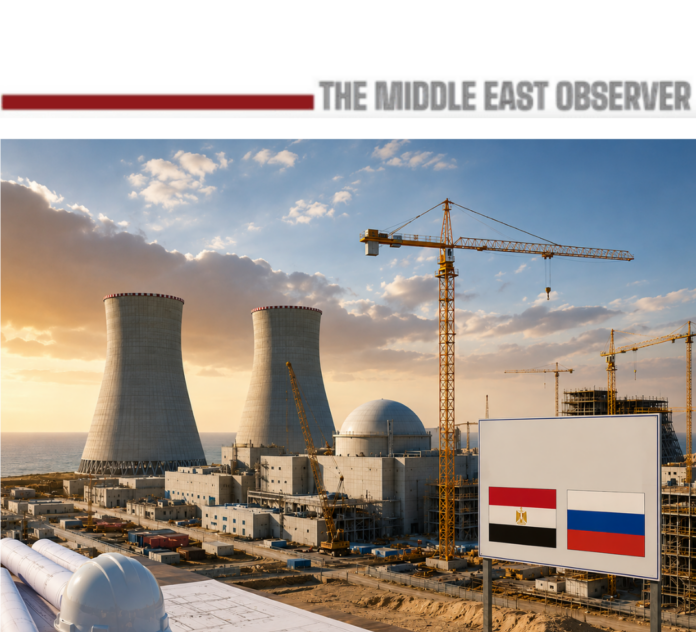
CAIRO — Egypt has launched an international tender for a high-voltage transmission line to connect the country’s under-construction Dabaa Nuclear Power Plant to the national electricity grid, marking another milestone in the country’s long-term Grid Expansion strategy aimed at strengthening energy security and accommodating new generation capacity.
According to a government official cited by Asharq, the project involves the construction of a 500-kilovolt transmission line stretching approximately 128 kilometres at an estimated cost of EGP4.5 billion ($86.5 million). The line will transport electricity generated by the Dabaa plant directly into Egypt’s national grid and is expected to be completed by the third quarter of 2027.
The project forms part of a broader effort to prepare Egypt’s transmission infrastructure for one of the most significant additions to its electricity system in decades. While attention has largely focused on the construction of the nuclear plant itself, energy planners increasingly view grid readiness as equally critical to ensuring the project’s long-term success.
Preparing for Nuclear Power Integration
The new transmission line will complement two 220-kilovolt lines scheduled for completion this month as part of the wider electricity evacuation system designed for the Dabaa project.
Officials expect construction of the 500-kilovolt line to take approximately one year from contract award and commencement of works.
The choice of a 500-kilovolt transmission system reflects the scale of the project. Such high-voltage lines are designed to transport large volumes of electricity efficiently over long distances while minimizing transmission losses, making them essential for integrating major generation assets such as nuclear power plants into national electricity networks.
Located on Egypt’s Mediterranean coast in Matrouh Governorate, the Dabaa Nuclear Power Plant is the country’s first commercial nuclear energy project and one of the largest infrastructure developments currently underway in the energy sector.
The project is being implemented by Russia’s state nuclear corporation Rosatom under agreements signed between Cairo and Moscow, with the main contracts entering into force in late 2017. Financing is supported primarily through a long-term Russian loan valued at $25 billion.
Construction is currently progressing across all four reactor units at Dabaa, with major civil works and installation activities advancing under the project’s phased development schedule. The first reactor is expected to enter operation later this decade, marking Egypt’s entry into commercial nuclear power generation and creating new requirements for large-scale transmission infrastructure.
Strategic Role in Egypt’s Energy Mix
The Dabaa facility will comprise four Generation III+ nuclear reactors, each with a capacity of 1,200 megawatts, bringing total installed capacity to 4,800 megawatts.
Once fully operational, the plant is expected to generate approximately 35 billion kilowatt-hours of electricity annually, equivalent to around 12% of Egypt’s projected electricity requirements by 2030.
Beyond expanding generation capacity, the project is expected to reduce reliance on natural gas for power generation. Egyptian officials estimate that nuclear generation from Dabaa could save at least 7 billion cubic metres of natural gas annually, volumes that could potentially be redirected toward industrial use, exports or strategic reserves.
Beyond energy security, nuclear generation is expected to contribute to Egypt’s decarbonization objectives. Unlike conventional fossil-fuel power stations, nuclear reactors provide continuous baseload electricity with minimal operational carbon emissions, enabling countries to expand electricity supply while supporting long-term climate and sustainability goals.
The transmission project therefore represents more than a grid upgrade. It is a critical component in unlocking the economic value of the nuclear investment itself by ensuring electricity can be delivered efficiently to consumers and industries nationwide.
Supporting Energy Diversification
The Dabaa project forms part of Egypt’s broader strategy to diversify its electricity mix and reduce dependence on fossil fuels.
Alongside nuclear power, the government continues to expand solar and wind energy projects across the Gulf of Suez, the Red Sea region and other strategic locations. Egypt aims to increase the contribution of renewable energy to more than 42% of the electricity mix by 2030 and above 60% by 2040.
Achieving these targets requires not only new generation projects but also substantial investment in transmission networks capable of handling increasingly diverse energy sources.
As a result, Egypt has accelerated spending on substations, transmission corridors and smart-grid infrastructure while expanding connections between production centres and major demand hubs.
The integration of nuclear, renewable and conventional generation sources is expected to enhance system reliability and reduce exposure to fluctuations in fuel markets, particularly during periods of high electricity demand.
Regional Connectivity and Future Opportunities
The transmission line also supports Egypt’s broader ambition to position itself as a regional electricity hub connecting Africa, the Middle East and Europe.
The country is currently advancing a 3,000-megawatt electricity interconnection project with Saudi Arabia and continues to pursue plans for electricity links with Greece and Cyprus that could eventually facilitate exports of renewable and low-carbon electricity to European markets.
For investors and infrastructure contractors, the latest tender highlights continuing opportunities in Egypt’s power-transmission sector as the country upgrades networks to accommodate large-scale energy projects.
However, challenges remain. Grid expansion must keep pace with the rapid growth of generation capacity, while financing requirements and project execution timelines will require careful management. The integration of multiple energy technologies into a single system also increases operational complexity and demands sustained investment in network modernization.
Looking ahead, the Dabaa transmission project illustrates a broader reality of the global energy transition: generation assets alone are insufficient without the infrastructure required to move power efficiently across the network. As countries invest in nuclear, renewable and other low-carbon technologies, competitive advantage will increasingly depend not only on the ability to generate electricity, but also on the strength, flexibility and resilience of the transmission systems that connect power to consumers, industries and export markets.
For Egypt, the EGP4.5 billion project represents more than a grid upgrade—it is a strategic investment in the infrastructure underpinning the country’s future energy competitiveness.
