
When Amazon acquired robotics company Kiva Systems for $775 million in 2012, the move was viewed as an ambitious attempt to improve warehouse efficiency.
Fourteen years later, that experiment has evolved into one of the largest robotics deployments in commercial history.
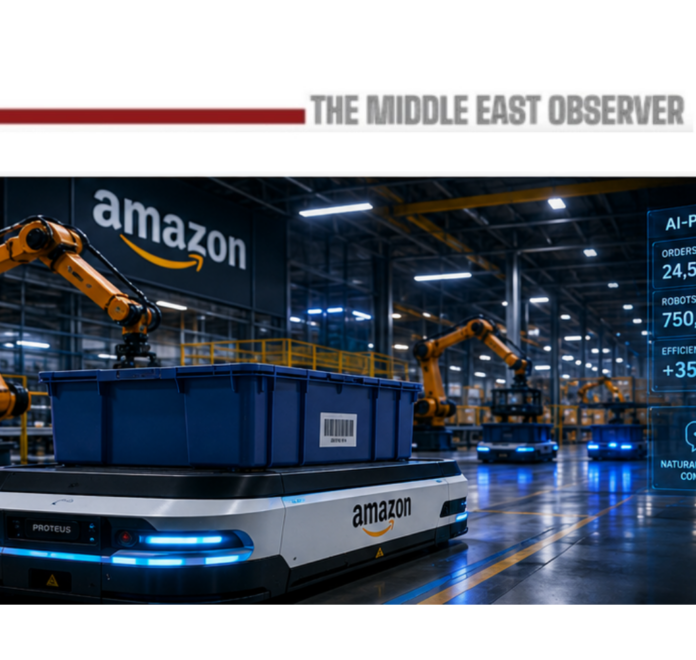
Amazon now operates more than 750,000 robots across its global fulfilment network and has steadily expanded their capabilities from simple shelf-moving machines to increasingly sophisticated systems capable of navigating warehouses, handling inventory and supporting human workers.
The latest step in that evolution came this week when Amazon unveiled a new generation of its AI-powered Proteus robot during its “Delivering the Future” event in Dartford, United Kingdom, alongside plans to invest approximately €10 billion across its European operations.
The robotics announcement forms part of Amazon’s broader European investment programme, which includes fulfilment centres, delivery infrastructure, cloud capabilities and automation technologies. The scale of the commitment underlines the company’s expectation that Europe will remain one of its most important growth markets despite slower economic expansion, demographic pressures and rising labour costs.
The announcement was about far more than a new machine. It offered a glimpse into how the world’s largest online retailer believes warehouses will operate during the coming decade.
From Kiva to Proteus: Amazon’s Robotics Journey
Amazon’s automation strategy has developed in stages.
The first generation of robots focused primarily on moving shelves across warehouse floors. Instead of employees walking long distances to retrieve products, robots transported inventory directly to workers.
The approach significantly reduced walking time and increased productivity.
Subsequent generations introduced more advanced navigation systems, machine vision and warehouse coordination capabilities.
Proteus represented a major milestone because it became the first fully autonomous Amazon robot capable of moving safely in areas occupied by human workers rather than operating behind safety barriers.
Today, Amazon is integrating artificial intelligence into that ecosystem. During its latest demonstration, the company showcased AI interfaces that allow operators to use natural-language prompts to coordinate warehouse workflows involving robots. Rather than functioning as an independent decision-maker, Proteus remains part of a broader software platform that translates operational instructions into movement and logistics tasks.
In effect, Amazon is moving from automation toward intelligent automation.
What Exactly Does Proteus Do?
Despite the excitement surrounding artificial intelligence, Proteus is not a humanoid robot.
It does not resemble a person, pack parcels independently or replace entire warehouse departments.
Its primary role is transportation.
The robot moves containers, inventory totes and product loads between different stages of the fulfilment process. It navigates warehouse floors, avoids obstacles, adjusts routes dynamically and responds to changing operational requirements.
Think of it as an autonomous logistics vehicle operating inside a building.
Its value lies in eliminating some of the least productive aspects of warehouse work—walking, pushing, carrying and transporting inventory across large facilities.
The productivity implications can be significant. Industry studies have found that warehouse employees may walk between 10 and 15 kilometres during a typical shift, particularly in large fulfilment centres. A substantial portion of that time is spent transporting inventory rather than performing value-added tasks such as picking, packing or quality control.
Autonomous mobile robots are designed to reduce those non-productive movements. By bringing inventory closer to employees or moving goods between workstations automatically, operators can increase throughput without proportionally increasing labour hours. In highly automated facilities, productivity improvements of 20–40 per cent have been reported depending on warehouse design and workflow integration.
The latest AI enhancements are intended to make that process more adaptive and efficient.
A Robot Ecosystem, Not a Single Machine
Proteus is only one component of Amazon’s expanding automation architecture.
The company is simultaneously deploying Vulcan, a robotic system equipped with force-sensing technology capable of handling a large percentage of items stored in warehouse inventory.
Unlike traditional industrial robots that rely primarily on vision systems, Vulcan can effectively “feel” objects and determine how much pressure to apply when handling them.
Amazon says the system can process approximately 75 percent of items stored in its fulfilment centres.
Another system, known as STARK, focuses on automating tote movement and inventory transport processes.
Together, these technologies reveal Amazon’s broader vision.
Rather than building a single all-purpose robot, the company is creating a network of specialised machines designed to work alongside human employees and communicate through AI-enabled warehouse management systems.
The result is a warehouse increasingly managed by software and increasingly executed by coordinated fleets of machines.
How Much Labour Can One Robot Replace?
This remains the most contentious question—and one for which there is no definitive answer.
Amazon has not disclosed the cost of the new Proteus system, its operating economics or the number of employees it expects each unit to replace.
More importantly, the concept of direct replacement can be misleading.
Robots rarely replace jobs.
They replace tasks.
A warehouse employee performs dozens of different activities during a shift. Some involve moving inventory. Others involve decision-making, quality checks, customer issue resolution, safety procedures and operational problem-solving.
Proteus primarily automates movement.
Consider a warehouse employee responsible for order picking. Historically, a significant portion of a shift might be spent walking between storage locations to retrieve products. In a robot-assisted environment, inventory is increasingly brought to the worker rather than the worker travelling to the inventory.
The employee’s role shifts from transportation toward picking accuracy, exception handling and process supervision. The work does not disappear, but its nature changes.
Consequently, the more appropriate question is not how many jobs one robot replaces, but how much labour time it eliminates.
A mobile warehouse robot capable of operating nearly continuously can potentially perform transport tasks equivalent to the movement workload generated by multiple workers across several shifts.
Industry specialists generally estimate that autonomous mobile robots can offset the transport-related labour equivalent of approximately two to three full-time employees under high-utilisation conditions.
However, this does not mean those employees disappear.
Instead, warehouses often redeploy labour toward higher-value activities while increasing overall throughput.
The most visible impact may therefore be slower workforce growth rather than large-scale job reductions.
The Economics of Automation
The financial rationale for robotics is becoming increasingly compelling.
Across Europe, warehouse wages have risen steadily amid labour shortages, demographic ageing and competition for logistics workers.
Amazon currently advertises entry-level warehouse wages in several European markets at rates significantly above minimum wage levels.
Once benefits, social contributions, training costs, recruitment expenses and employee turnover are included, the total annual employer cost of a warehouse worker can easily reach between €38,000 and €45,000 in many Western European markets.
By comparison, autonomous mobile robots available in today’s industrial market typically cost anywhere from approximately €25,000 to well above €150,000 depending on payload capacity, software sophistication and integration requirements.
A reasonable industry model suggests that a robot purchased for around €80,000 and depreciated over five years may generate annual ownership costs of approximately €24,000 before maintenance, software subscriptions and infrastructure expenses.
Including those additional costs could bring the annual operating burden to roughly €30,000–35,000.
On paper, that places robotic systems in a similar or potentially lower cost range than a full-time employee.
Yet the comparison remains imperfect.
Robots require maintenance technicians, software support, charging infrastructure, replacement parts and operational redesign. Their economics depend heavily on utilisation rates.
A robot operating around the clock creates substantial value.
A robot sitting idle does not.
The real advantage emerges when robots enable higher throughput, lower injury rates, reduced overtime and fewer seasonal hiring requirements.
Why Labour Shortages Matter as Much as Labour Costs
Much of the public debate focuses on whether robots are replacing workers.
For many logistics companies, the more pressing concern is finding workers in the first place.
Across Europe, ageing populations are shrinking labour pools while e-commerce continues to expand demand for fulfilment services.
Warehouses often struggle to recruit and retain staff for physically demanding roles involving repetitive movement and long shifts.
In this environment, automation is increasingly viewed as a response to labour scarcity rather than solely a cost-cutting exercise.
The challenge facing logistics operators is not merely reducing headcount. It is maintaining service levels when labour becomes harder to secure.
That trend helps explain why investment in warehouse robotics continues to accelerate despite economic uncertainty.
Amazon Is Not Alone
The race toward automated logistics extends far beyond Amazon.
Retailers and logistics providers worldwide are investing heavily in robotics and artificial intelligence.
Ocado has developed highly automated fulfilment centres using dense robotic grids and advanced warehouse orchestration software.
Walmart continues to expand automation throughout its distribution network.
Chinese e-commerce giants Alibaba and JD.com have invested heavily in smart warehouses capable of processing large volumes of orders with limited human intervention.
Major third-party logistics companies including DHL and GXO Logistics are also integrating autonomous mobile robots into operations.
The competitive question is therefore not whether warehouses will become more automated.
It is which companies can integrate automation most effectively.
Amazon’s scale gives it an important advantage. Every efficiency gain achieved by its robotics programme can be replicated across hundreds of facilities worldwide.
Why Investors Are Paying Attention
For investors, warehouse automation is ultimately a margin story.
Labour represents one of the largest operating costs in fulfilment and logistics. Even small improvements in productivity can generate substantial savings when applied across Amazon’s vast network.
Analysts increasingly evaluate robotics investments not only in terms of cost reduction but also through their impact on fulfilment speed, capacity utilisation and return on invested capital. Faster processing times can support premium delivery services, while more efficient facilities may handle larger order volumes without equivalent increases in headcount.
For Amazon, the long-term objective is not simply to lower labour costs. It is to create fulfilment networks capable of processing more packages, more quickly and with greater operational flexibility than competitors.
The Warehouse of the Future
The image of fully automated warehouses staffed entirely by robots remains distant.
Human workers continue to perform many functions that machines struggle to replicate, particularly tasks requiring judgement, adaptability, customer awareness and complex problem-solving.
However, the balance of work is clearly changing.
Future warehouses are likely to employ fewer people per package shipped while generating higher overall productivity. Employees will increasingly supervise systems, manage exceptions, maintain equipment and coordinate automated processes rather than manually transporting goods.
The transition resembles what occurred in manufacturing during previous decades.
Factories did not become worker-free.
They became more technologically intensive.
Warehouses appear to be following a similar path.
More Than a Robot
Amazon’s new Proteus robot is therefore best understood not as a labour-replacement machine but as a symbol of a broader transformation taking place across global supply chains.
The company’s €10 billion European investment reflects a belief that the future of logistics will be defined by the integration of robotics, artificial intelligence and human expertise rather than by any one technology alone.
For consumers, the likely result will be faster deliveries and more reliable fulfilment.
For businesses, it promises greater efficiency and scalability.
For workers, it will require adaptation to a logistics sector increasingly centred on technology rather than manual movement.
The most important question is no longer whether robots will enter warehouses.
That transition is already underway.
The real question is how quickly the economics of automation, labour shortages and artificial intelligence will reshape the workforce that supports modern commerce.