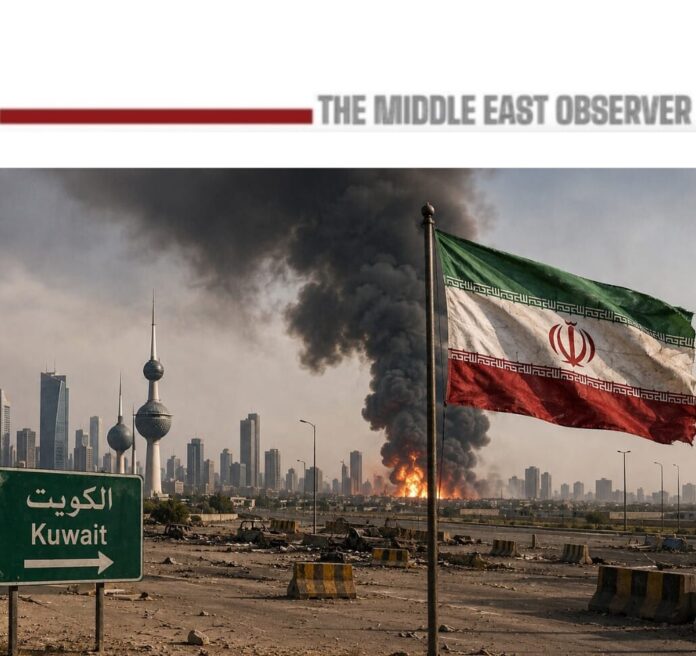
Kuwait suspended flights and activated emergency procedures after an Iranian missile and drone attack struck Kuwait International Airport, damaging facilities, injuring dozens and temporarily disrupting air traffic before operations gradually resumed. The strike, which hit Terminal 1 and forced flight diversions, immediately became one of the most visible incidents since the fragile ceasefire announced in April, drawing attention across diplomatic, security and aviation circles.
The attack is notable not only because of where it occurred, but because of what was not targeted. Despite months of confrontation involving Iran, the United States and their respective regional partners, the conflict has largely stopped short of sustained attacks on the Gulf’s most economically consequential assets. Major oil production facilities, export terminals and critical energy infrastructure have remained largely intact, even as military exchanges intensified elsewhere. Both Washington and Tehran remain aware that a direct threat to Gulf energy exports would likely trigger immediate repercussions in global oil markets and risk to upgrade the conflict. That pattern suggests a continued awareness among all parties that attacks on such assets could trigger wider economic disruption, destabilise energy markets and sharply reduce the scope for future diplomacy.
Against that backdrop, the Kuwait strike raises a different possibility: that the primary objective was not to inflict maximum economic damage but to maximise political visibility and diplomatic leverage. The attack comes at a moment when military pressure and diplomatic manoeuvring are unfolding simultaneously, increasing the value of actions that demonstrate capability without necessarily foreclosing the possibility of future negotiations.
Targeting an airport rather than energy infrastructure may have allowed Tehran to demonstrate reach, generate immediate international attention and remind its adversaries of its escalation options without crossing thresholds that might provoke a broader regional response. The choice suggests an effort to send a message while preserving strategic flexibility.
Airports offer unique advantages in that regard. Unlike an oil terminal, whose economic consequences may unfold over days or weeks, aviation disruptions become visible almost instantly. Flight suspensions appear within minutes on airline networks, airport departure boards and news platforms around the world. Images of grounded aircraft and disrupted travel circulate rapidly, amplifying political impact far beyond the physical scale of the damage. Airports combine economic importance with unusually high public visibility, making them effective instruments of strategic signalling.
The choice of Kuwait further strengthens that interpretation. Since its liberation in 1991, Kuwait has remained one of Washington’s closest security partners in the Gulf and continues to host important American military and logistical assets. At the same time, while maintaining its strategic relationship with the United States, Kuwait has generally preserved channels of communication with Iran and has often sought to play a mediating role during periods of regional tension. Targeting Kuwait therefore delivers a message likely to resonate in Washington while carrying fewer escalation risks than strikes against larger energy producers or more strategically sensitive regional assets.
Equally significant is what Iran appears to have avoided. American military facilities in Kuwait would have carried greater strategic significance but also risked provoking a far stronger US response. Major oil infrastructure would have generated severe economic repercussions and potentially united international actors behind a more forceful reaction. An airport occupies a middle ground: important enough to command global attention, yet limited enough to avoid some of the thresholds associated with broader regional escalation.
Seen through that lens, the strike may represent less an attempt to alter the military balance than an effort to influence the diplomatic one. In effect, it demonstrates the capacity to escalate while signalling that more economically damaging options remain available. By disrupting a close US partner without targeting the Gulf’s most critical energy assets, Tehran may have been seeking to strengthen its negotiating position while preserving room for future diplomacy. The message is not necessarily that Iran seeks a wider conflict, but that it retains credible options should negotiations fail.
It remains too early to determine whether the Kuwait attack represents a broader shift in Iranian targeting strategy. One incident is insufficient to establish a new pattern. Yet the choice of an airport rather than an oilfield, refinery, export terminal or military base suggests that visibility, political signalling and negotiation leverage may have been as important as physical disruption.
Whether the message was intended for Washington, Gulf capitals or negotiators themselves, the strike suggests that in the current phase of the conflict, signalling may matter as much as destruction. The target was not the region’s most valuable asset. It may simply have been the one capable of delivering the clearest message at the lowest strategic cost.