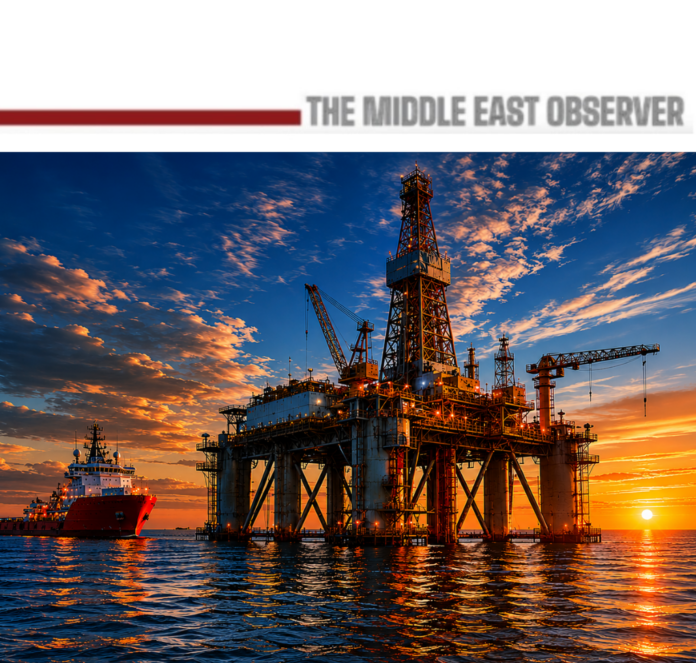
The deepwater prospect, located within the North Cleopatra concession west of the Nile Delta, is being drilled by the sixth-generation Stena IceMAX drillship as part of Shell’s wider 2026 offshore campaign. The project comes at a pivotal moment for Egypt, which is seeking to reverse a decline in domestic gas production that has transformed the country from a net gas exporter into a seasonal importer of liquefied natural gas (LNG).
For Cairo, the significance of Velox extends well beyond a single exploration well. The government has intensified efforts to attract fresh upstream investment through a series of incentives aimed at accelerating exploration activity and unlocking new reserves. Egypt plans to drill 14 exploration wells in the Mediterranean this year as part of a broader strategy to raise national gas production and reduce reliance on imported LNG during periods of peak summer demand.
The Herodotus Basin, spanning the maritime zones of Egypt, Greece, Cyprus and Libya, is regarded by geoscientists as one of the last major underexplored gas provinces in the Eastern Mediterranean. Covering approximately 113,000 square kilometres, the basin has attracted growing interest from international energy companies following advances in seismic imaging and the success of nearby discoveries elsewhere in the region.
Unlike Shell’s established producing assets in Egypt’s West Delta Deep Marine, Rosetta and North East El Amriya concessions, Velox represents a genuine frontier exploration venture. A successful outcome could open an entirely new offshore production province, potentially requiring substantial follow-on investment in subsea infrastructure and floating production facilities. Industry sources suggest development costs could ultimately run into several billions of dollars if commercial volumes are confirmed.
The well also reflects Shell’s continued confidence in Egypt despite recent challenges facing the country’s gas sector. Earlier this year, the company reported encouraging results from the Sirius-1X exploration well and continued progress on the Mina West development project, which is expected to add around 160 million cubic feet of gas per day to national output by the end of 2026.
The broader strategic backdrop extends beyond Egypt. As Europe continues to seek diversified gas supplies and Eastern Mediterranean countries pursue closer energy cooperation, new discoveries in the basin could strengthen Egypt’s position as the region’s principal gas processing and export hub. The country remains uniquely positioned through its existing LNG export facilities at Idku and Damietta, which provide infrastructure unavailable elsewhere in the region.
Success at Velox could therefore reshape perceptions of Egypt’s remaining offshore potential at a time when policymakers are seeking to restore gas self-sufficiency and reinforce the country’s role in regional energy markets. Failure, however, would underscore the geological and commercial risks associated with some of the Mediterranean’s most technically challenging and capital-intensive exploration acreage.
By linking a frontier geological play to Egypt’s energy-security agenda and the evolving dynamics of the Eastern Mediterranean gas market, the Velox well has become far more than a routine exploration project—it is emerging as an important test of the region’s next phase of offshore development.