
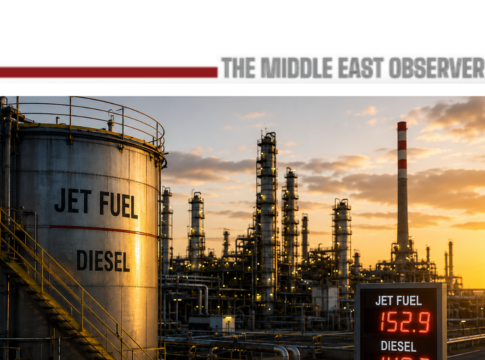
The biggest risk facing energy markets in 2026 may no longer be a shortage of crude oil. Instead, investors, policymakers and transport operators are increasingly confronting a different challenge: a tightening market for refined fuels, where jet fuel and diesel prices remain elevated even as crude oil faces growing downward pressure from weakening demand.
This emerging paradox is becoming the defining energy story of the year.
Since the outbreak of the Iran conflict in late February, oil markets have been dominated by concerns over supply disruptions around the Strait of Hormuz, the world’s most important energy corridor. Those fears helped push Brent crude sharply higher and briefly revived concerns of a return to triple-digit oil prices. Yet as the conflict has evolved, the market narrative has begun to change.
The shift reflects a market moving from fears of crude scarcity to concerns over refinery capacity, export restrictions and fuel distribution. While global crude supplies remain relatively resilient, the ability to convert that crude into jet fuel, diesel and other refined products has come under increasing pressure from disrupted shipping routes, refinery outages and tightening export policies.
According to Goldman Sachs, weakening demand in China and Western Europe is beginning to offset much of the geopolitical risk premium embedded in crude prices. The bank continues to view Brent around $90 per barrel as a central case while warning that softer consumption trends could place additional downward pressure on prices during the second half of 2026. Brent, meanwhile, continues to trade near the mid-$90s, reflecting a market caught between geopolitical supply risks and weakening demand.
At the same time, Goldman expects refined fuel margins to remain elevated throughout the year. Reuters reported this week that disruptions around Hormuz have tightened refined-product markets more severely than crude markets, supporting margins that remain well above historical norms and reinforcing a widening gap between crude prices and the cost of finished fuels.
In practical terms, the world may have enough crude oil, but not enough readily available jet fuel, diesel and other refined products where and when they are needed.
Russia’s recent decision to ban aviation fuel exports until the end of November further strengthens that thesis. The measure follows repeated attacks on Russian refinery infrastructure and removes additional jet fuel volumes from export markets. While the direct impact on global crude balances is limited, it adds pressure to an already constrained aviation-fuel market and reinforces expectations of prolonged tightness in refined products.
The result is an increasingly plausible scenario in which crude oil prices stabilise or gradually soften while airlines, logistics operators and industrial consumers continue paying elevated fuel costs. In other words, oil may become cheaper, but energy may not.
For the Middle East and North Africa, the implications are uneven.
The principal beneficiaries are likely to be Gulf energy exporters and regional refining hubs. Countries with substantial refining capacity and access to export markets stand to benefit from stronger margins on diesel, jet fuel and other high-value petroleum products. Integrated energy companies may also outperform pure crude producers as profitability shifts further downstream into refining, marketing and fuel distribution.
Among the potential winners are major refining and integrated energy players in the Gulf, where investments in downstream capacity over the past decade are now providing a strategic advantage. Higher refining margins allow these companies to capture value not only from producing crude oil but also from converting it into premium fuels increasingly sought by global markets.
The pressure, meanwhile, falls on airlines, shipping companies, logistics operators and energy-importing economies. Higher aviation-fuel costs increase operating expenses across the travel sector, while elevated diesel prices raise freight, manufacturing and transportation costs. Tourism-dependent economies could also face indirect headwinds if persistently high fuel prices translate into more expensive air travel and softer passenger demand.
Globally, the implications extend beyond the energy sector. Falling or stable crude prices may create the impression that inflationary pressures are easing, yet persistently high diesel and jet fuel costs can continue feeding through supply chains, transportation networks and consumer prices. The result is a more complex inflation environment than crude oil prices alone would suggest.
The consensus emerging from Goldman Sachs, Reuters market analysis and broader industry forecasts is becoming increasingly clear: crude oil is approaching a demand ceiling, but refined fuels remain constrained by refinery disruptions, export restrictions and logistical bottlenecks. The key risk for the remainder of 2026 is therefore not a lack of oil, but a shortage of the fuels modern economies consume every day.
For much of the past decade, energy markets were defined by concerns over crude supply. In 2026, the more important indicator may be the availability of diesel and jet fuel. The era of crude scarcity is giving way to an era of refining scarcity — a shift that may prove more consequential for businesses, consumers and policymakers than the price of oil itself.
